Have you ever opened a cabinet and forgotten what you were looking for? Most of the time, that tiny blank space is just part of being human. But when memory slips start getting tangled with daily life, a new online test is trying to make the first step less intimidating.
The tool is called DigiDiaDem, and it was designed mainly for people over 50 in the Czech Republic. It checks memory and speech from home, using a computer or large tablet with a microphone and speaker. The key point is simple, since it is a free screening tool, not a diagnosis.
Why this matters
Dementia is not one single disease. It is a condition that affects memory, thinking, communication, mood, behavior, and everyday tasks, often slowly enough that families wonder for months whether something is really wrong.
The World Health Organization reported on July 3, 2026, that 57 million people were living with dementia worldwide in 2021, with nearly 10 million new cases each year. Alzheimer’s disease is the most common form, and dementia is more common after 65, though it is not a normal or guaranteed part of aging.
How the test works
DigiDiaDem was developed by scientists and doctors from the Third Faculty of Medicine at Charles University, Královské Vinohrady University Hospital, the Czech Academy of Sciences, and the University of West Bohemia in Pilsen.
The University of West Bohemia said the app uses machine learning to analyze speech and memory, and project leader Luboš Šmídl described it as a way for people to undergo anonymous screening from home.
The test includes ten tasks, some written and some spoken. A person may describe a picture, repeat numbers, read a text, repeat words, or remember a sentence after a short delay.
Aleš Bartoš, a neurologist involved in the work, said the process takes about 11 minutes because the app guides users step by step.
Why speech is important
Memory tests usually focus on right and wrong answers. DigiDiaDem goes further by listening to how a person speaks, then using artificial intelligence to transcribe the voice and compare patterns with data from volunteers.
Does that mean one shaky answer points to Alzheimer’s? No, since tiredness, stress, hearing trouble, a bad microphone, or noise from the next room can all affect performance. Still, voice can carry small clues, such as pauses, word choices, and hesitation, that may help doctors decide who needs a closer look.
Getting ready
The authors recommend taking the test in a quiet room, with the television and radio off and windows closed. That sounds obvious, but it matters because the app has to hear the voice clearly. Glasses and hearing aids should be used if they are part of everyday life.
The test is not adapted for cell phones, so a computer is the better choice. A family member may help an older person click through screens, but should not help with the answers. Otherwise, the result may say more about teamwork than memory.
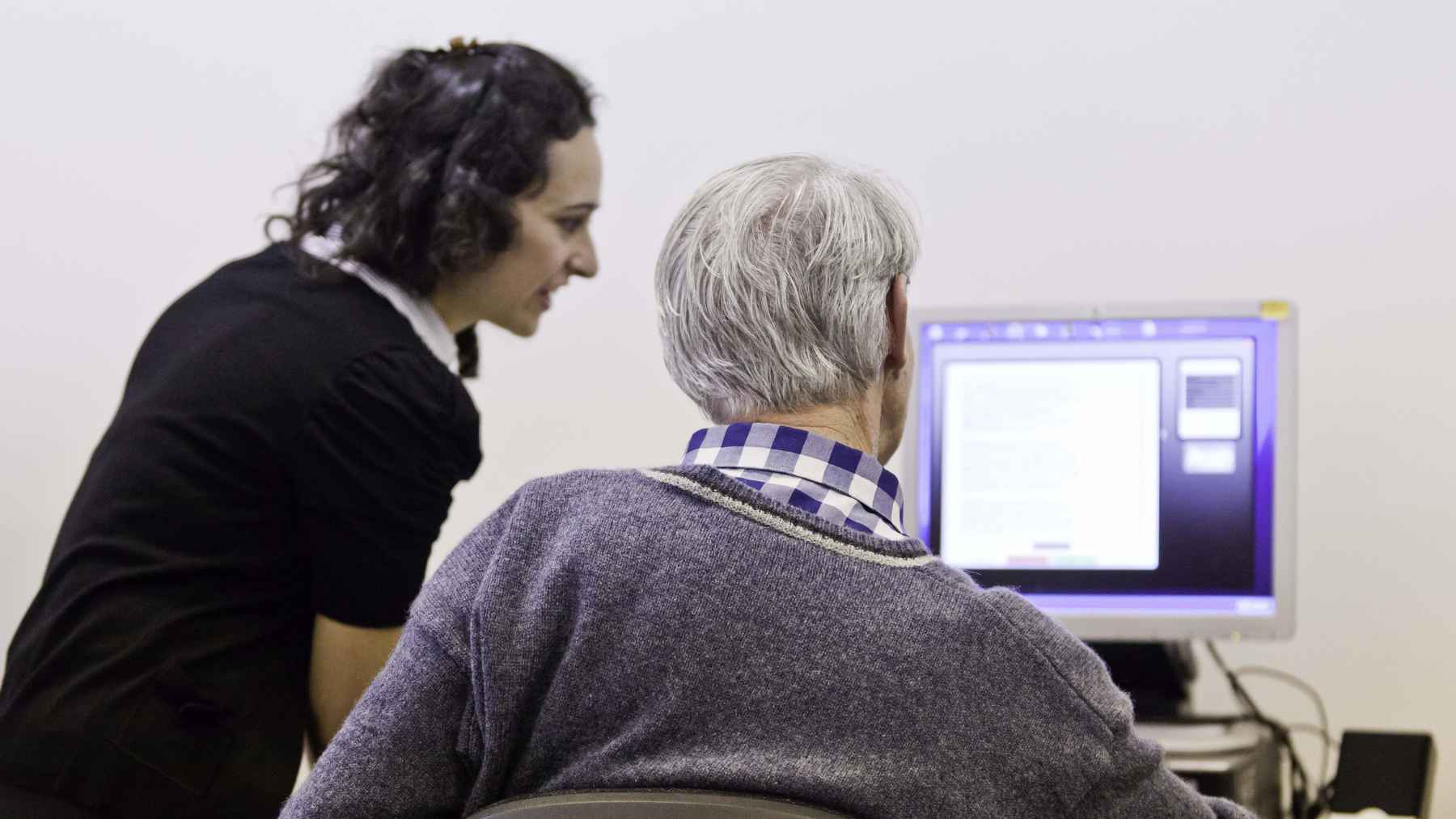
An older adult completes a computer-based cognitive screening, similar to the online memory and speech tests designed to help identify possible cognitive changes early.
What the result means
After the final task, DigiDiaDem produces a short cognitive report. The app compares the user’s answers with three groups of people, including cognitively healthy volunteers, patients with partial cognitive deficits, and patients with dementia.
The comparison included 246 healthy volunteers, about 45 people with mild problems, and a similar number of dementia patients.
The report can be saved or printed for a doctor, and it includes a brief verbal assessment with visual graphs. That can be useful for a future medical visit, especially when a person feels something is off but cannot explain exactly what has changed.
Doctors still decide
This is where the line has to be clear. DigiDiaDem may flag a possible cognitive problem, but it cannot tell a person they have Alzheimer’s disease, frontotemporal dementia, or any other specific condition.
If the report raises concern, the next step is to contact a general practitioner, who may work with a neurologist, psychiatrist, or geriatrician. In practical terms, the app is a doorbell, not the whole house. It can get attention, but a physician still has to open the door.
Digital screening grows
DigiDiaDem is part of a broader project supported by the Technology Agency of the Czech Republic. The official project record says the goal is to create a web app for self-examination and automatic detection of cognitive disorders from speech, with the project running from September 1, 2023, to August 31, 2026.
Other digital memory tools already exist, including Terrapino and ALBAV, but DigiDiaDem’s voice analysis gives it a different angle. For many families, that may be the real value. A vague worry can finally become a clearer question for a doctor.
The main work has been published in IEEE Access.