What happens when the straight-on vision fades but the edges remain? For those with geographic atrophy, an advanced form of dry age-related macular degeneration, reading a medicine label or recognizing a friendly face can become nearly impossible when left with only peripheral vision.
On July 22, 2026, the manufacturer announced that PRIMA, a wireless retinal implant paired with camera-equipped glasses, had received a CE (European conformity) mark permitting commercial availability in 30 European countries.
It does not bring back ordinary eyesight, but trial data show that many patients regained enough central “form vision” to read letters, numbers, and words.
Why central vision disappears
The retina is the light-sensitive layer at the back of the eye, and the macula is its high-detail center. Geographic atrophy slowly breaks down the photoreceptors there, which are the cells that convert light to electrical signals in the brain.
The result is often a blank or blurred patch straight ahead, while side vision remains partly intact. Current medicines can slow the growth of damaged areas in some patients, but they do not replace photoreceptors that have already died. That is where PRIMA follows a different path.
How the implant works
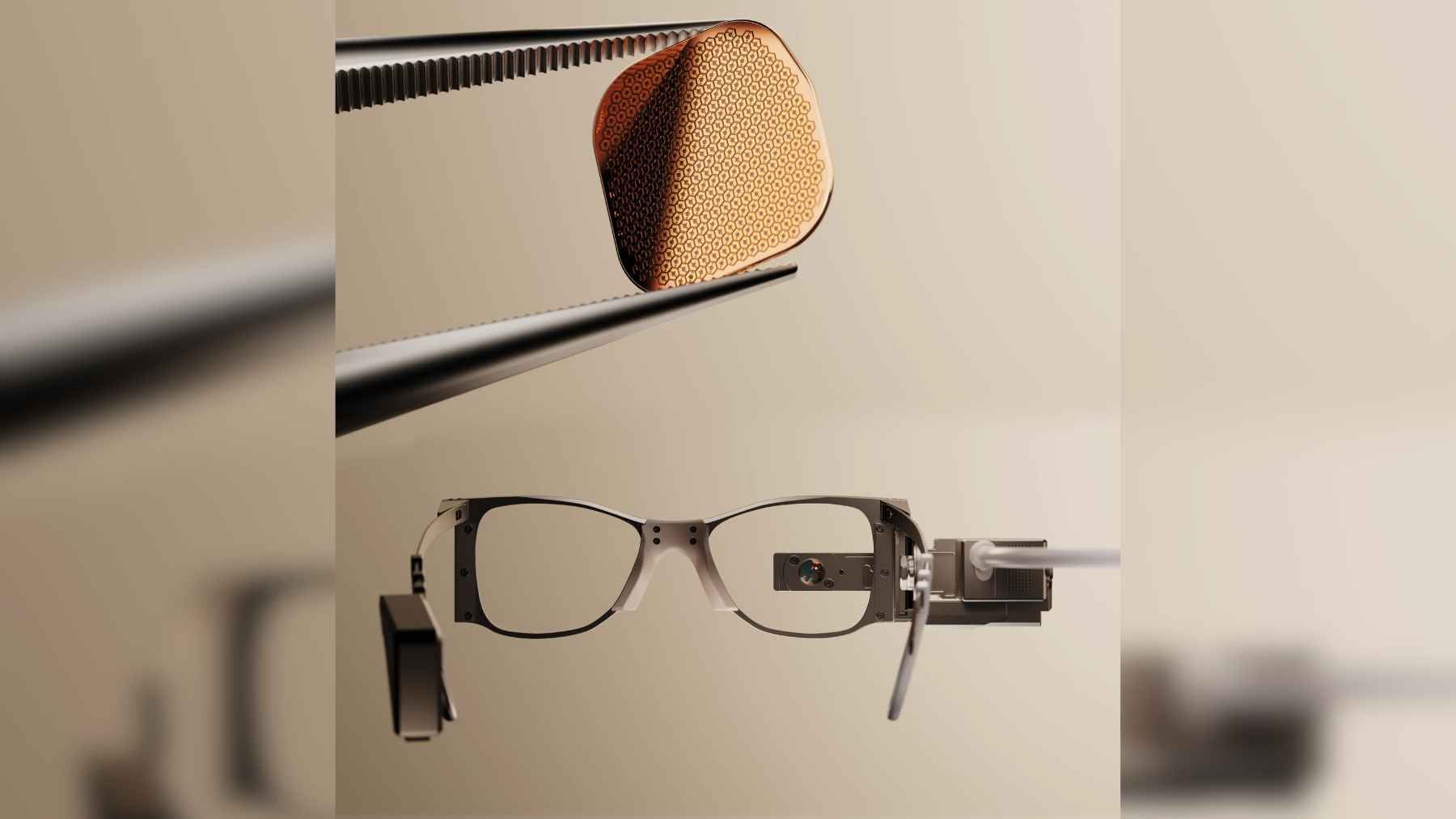
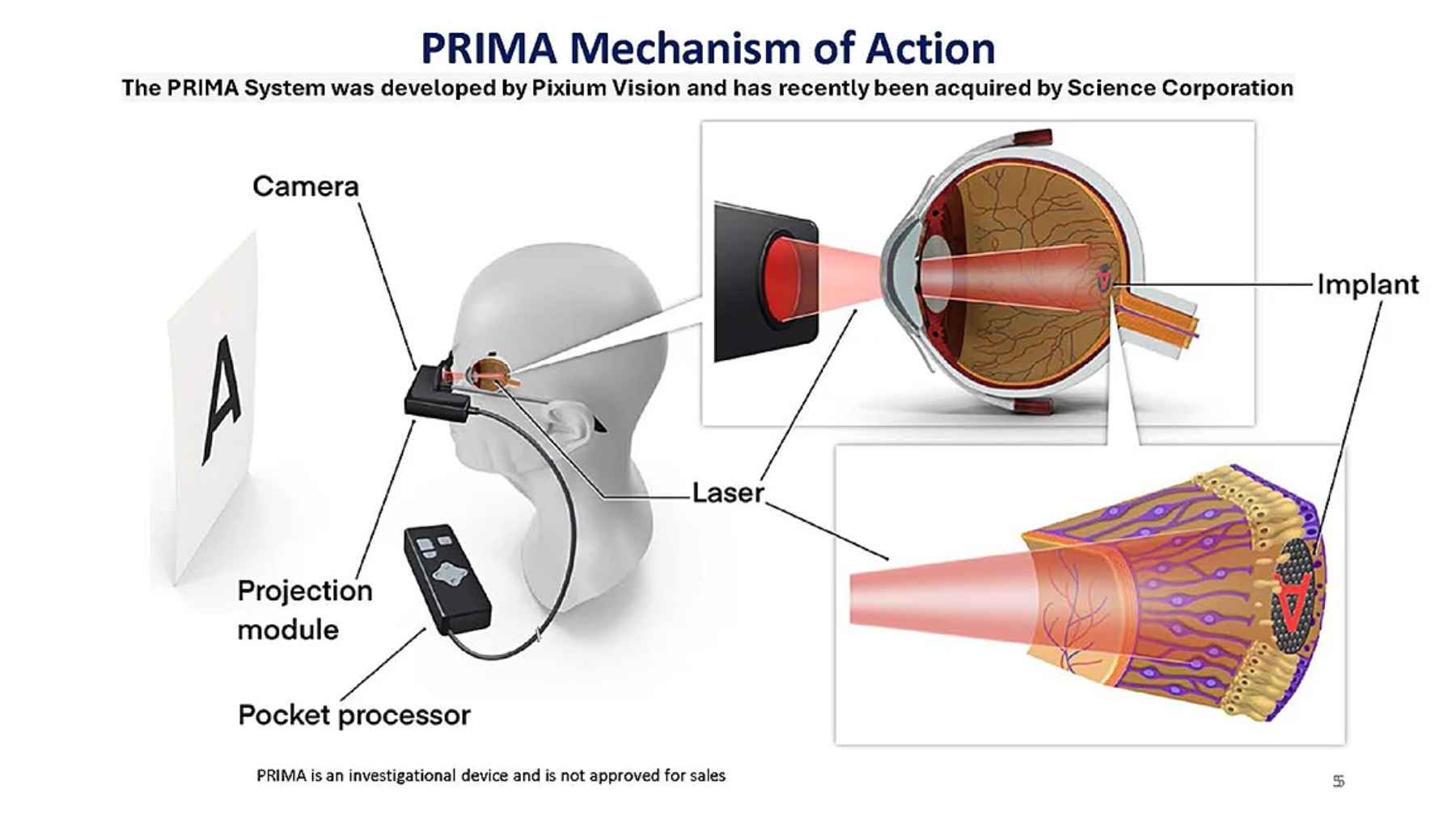
PRIMA does not rebuild the retina or act like a complete artificial eye. A photovoltaic chip about 0.08” on each side is placed beneath the damaged macula, where its 378 microscopic pixels act much like tiny solar panels.
A camera on the glasses captures the scene before the wearer. A pocket processor adjusts brightness, contrast, and magnification, then the glasses project patterned near-infrared light onto the implant.
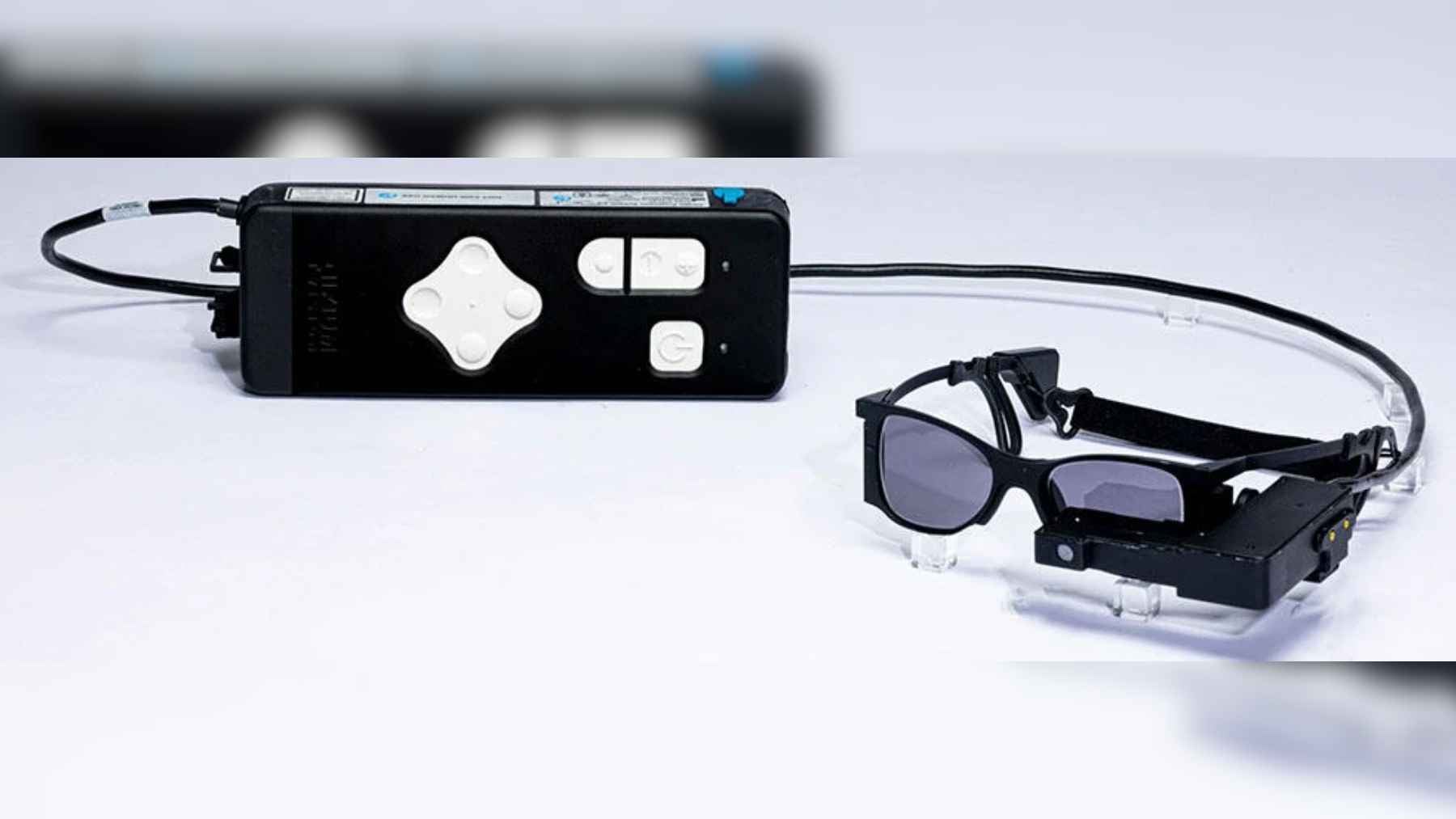
The chip converts that invisible light into electrical stimulation for surviving retinal neurons. Those cells transfer the information through the optic nerve, allowing the brain to interpret a simple central image while the person continues using natural peripheral vision.
What the trial found
The multicenter study implanted PRIMA in 38 adults at 17 sites across 5 European countries. At 12 months, 32 participants were available for the main vision assessment, and 26 of them improved by at least two lines on a standard eye chart.
After researchers accounted statistically for the missing one-year evaluations, the estimated rate of clinically meaningful improvement for the full group was 80%. The average improvement was 25.5 letters, or more than five eye-chart lines.
At home, 27 of the 32 evaluated participants, or 84%, reported reading letters, numbers, or words with prosthetic vision.
Frank Holz of the University of Bonn led the trial, while Stanford Medicine’s Daniel Palanker, the original inventor and a senior author, described the advance as “form vision,” an improvement over the simple flashes produced by many earlier prostheses.
Useful vision with real limits
The restored image is not normal vision. The current system provides black-and-white vision without shades of gray, and users must have training over many months to interpret what they see.
Zoom can make small print clearer, and some trial participants used the system for books, signs, or crossword puzzles.
But magnification narrows the visible area, face recognition remains difficult, and a broader quality-of-life questionnaire did not show a measurable change in behavior during the first year.
The trial was also small, open-label, and lacked a separate control group. That does not negate the gains, but it makes longer follow-up and real-world data crucial as more patients receive the device.
Surgery carries risks
Implantation requires retinal surgery, so the safety findings matter as much as the reading results. Researchers recorded 26 serious adverse events in 19 participants, including high eye pressure, retinal breaks, bleeding beneath the retina, and macular holes.
All serious events were linked to the procedure only or to the procedure and device together. None was attributed to the device alone; 21 occurred within two months of surgery, and 20 of those early events resolved within two months after they began.
Four events were classified as severe, although not life-threatening. On average, the participants’ remaining natural peripheral visual acuity was unchanged after implantation, an important sign that PRIMA added prosthetic central vision without affecting the sight they still had.
What European clearance changes
The CE mark was issued under the European Union Medical Device Regulation by DEKRA, an independent certification body. The manufacturer, Science Corporation, was founded by Max Hodak, co-founder of Neuralink.
The company says the first commercial implantation is expected in Germany, while reimbursement applications and clinical-site activation continue across Europe.
Access will wait for national reimbursement decisions and activated treatment centers, so the implant may not become available at the same rate in every country.
The manufacturer says PRIMA is not commercially available beyond the 30-country European market covered by its CE mark.
In the United States, the Food and Drug Administration has granted Breakthrough Device status and two humanitarian-use designations, but none of those steps permits commercial sale.
The full study was published in The New England Journal of Medicine.