Could a pill prescribed for blood sugar also help protect eyesight? A five-year study of people with type-2 diabetes found that those prescribed metformin had 37% lower odds of developing intermediate age-related macular degeneration, or AMD.
The signal is intriguing because metformin is low-cost, familiar to doctors, and widely used. It is not proof that the drug prevents vision loss, however, and conflicting research means patients should not take it for eye protection alone.
What the five-year study found
Researchers randomly selected 2,600 adults from more than 10,000 people enrolled in a diabetic eye screening program. The records went back to 2011. They had usable baseline retinal photographs for 2,545 participants, while 2,089 returned with gradable images five years later.
The team, including first author Dewi Fathin Romdhoniyyah and eye specialist Nicholas Beare at the University of Liverpool, compared AMD changes with prescription records.
After accounting for age, sex, diabetes duration, and other differences, metformin use was linked to 37% lower odds of intermediate AMD. That figure describes relative odds, not the number of people whose eyesight was saved.
The result was narrow. Metformin was not linked to a lower incidence of early AMD, and an apparent drop in late AMD did not remain statistically convincing after adjustment, partly because few people developed advanced disease. “What we need to do now is test metformin as a treatment for AMD in a clinical trial,” he said.
Why AMD changes everyday vision
AMD damages the macula, a small area near the center of the retina that produces sharp, straight-ahead vision. It is the part you use to read a text message, recognize a face, or see fine detail while driving.
Dry AMD is more common and usually moves slowly as light-sensing tissue thins and yellow deposits called ‘drusen’ build up. Wet AMD is less common but often faster, because abnormal blood vessels grow under the retina and leak fluid or blood.
How metformin might protect retinal cells
Metformin does more than lower glucose. It activates AMPK, a signaling pathway that acts like a cellular fuel gauge, and may improve mitochondrial function, lower inflammation, and help cells clear damaged material.
The retina uses enormous amounts of energy and is vulnerable to oxidative stress, which is damage caused by unstable molecules.
In 2018, laboratory research showed that increasing AMPK activity protected light-sensing cells and supporting retinal tissue in experimental models. Biological plausibility is not proof in patients, though.
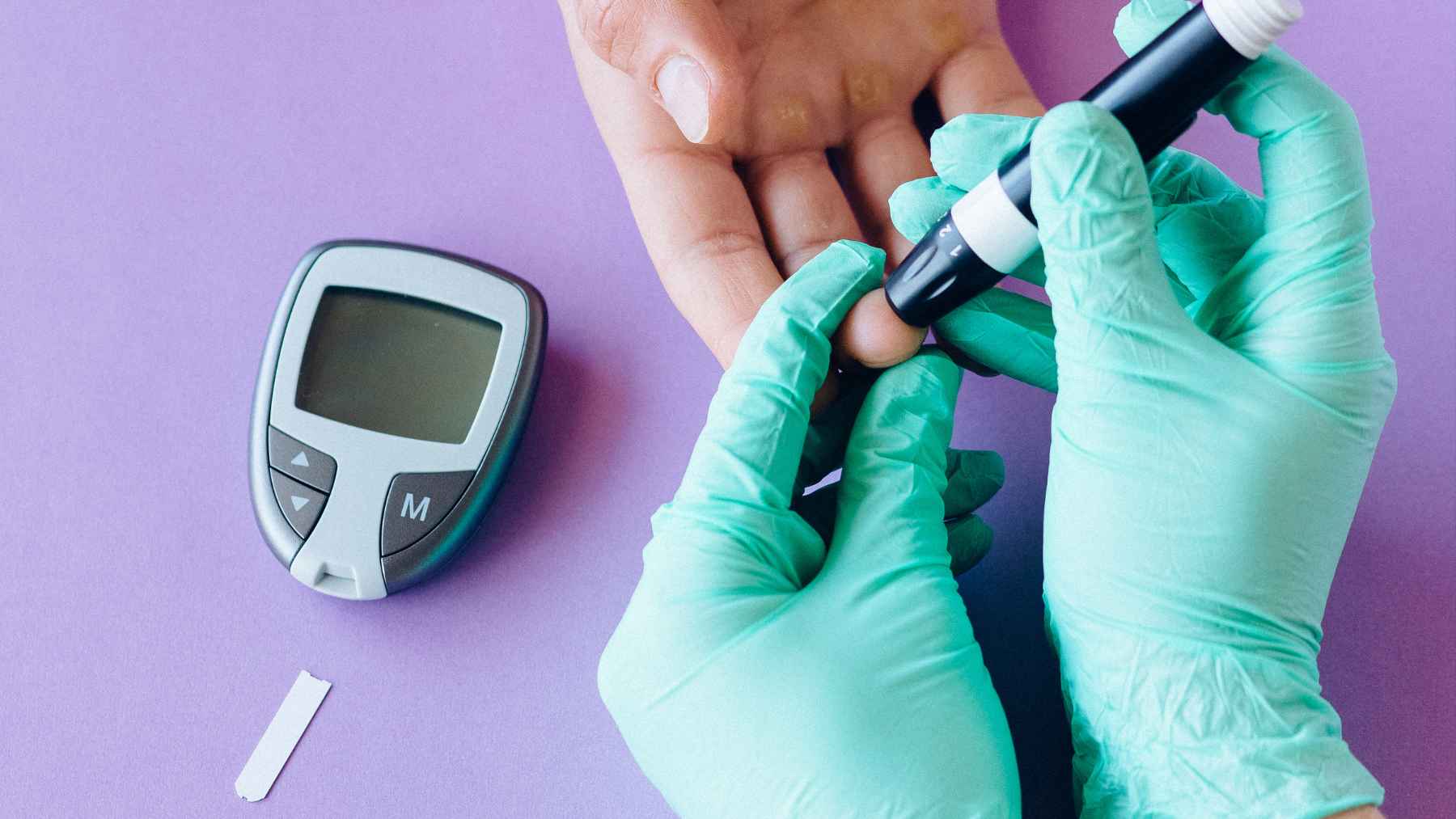
A routine blood glucose test represents diabetes care as researchers investigate whether metformin may also help reduce the risk of age-related macular degeneration.
Why scientists are still cautious
This was an observational study, so it can find patterns but cannot establish cause and effect. The researchers lacked complete data on dose, long-term adherence, diet, and AREDS supplement use, and they did not use optical coherence tomography, a scan that shows retinal layers in fine detail.
People not taking metformin were also older and had more AMD at the start, differences that statistical adjustment may not fully remove.
Other evidence has not lined up neatly. A randomized trial of 66 people without diabetes and with geographic atrophy, an advanced form of dry AMD, found that oral metformin did not slow the disease as conducted.
A large 2025 study involving more than 1.6 million adults found no meaningful overall difference, and a June 2026 analysis of Singapore and United Kingdom cohorts also reported no broad protective association.
Those studies asked somewhat different questions and examined different stages of AMD, so they do not directly cancel the new result. Still, the pattern is mixed. A prospective, placebo-controlled trial focused on intermediate AMD would be the clearest next step.
What treatment looks like now
For intermediate AMD, the AREDS2 research found that a specific vitamin and mineral formula can reduce the chance of progression to advanced disease by about 25%. Omega-3 supplements did not add a proven benefit, and the formula is not meant for everyone with early AMD.
Wet AMD is usually treated with repeated anti-VEGF injections that slow leakage from abnormal blood vessels and often preserve vision. In the United States, two injected drugs are also approved for geographic atrophy and can slow lesion growth, although they do not restore vision already lost.
The basics still matter: do not smoke, keep blood pressure and cholesterol under control, eat a balanced diet, and schedule regular eye appointments. New distortion, blur, or a dark spot in central vision deserves prompt attention.
An eye drop is being developed
Curative Biotechnology is developing a reformulated metformin eye drop under a license from the National Eye Institute. The company said a first-in-human study was planned for 2026, subject to regulatory and operational readiness, so the treatment remains experimental.
For now, metformin should be used only under a clinician’s direction. The idea that it might protect aging eyes is worth testing, but it is not yet a reason to change a prescription.
The main study was published in BMJ Open Ophthalmology.