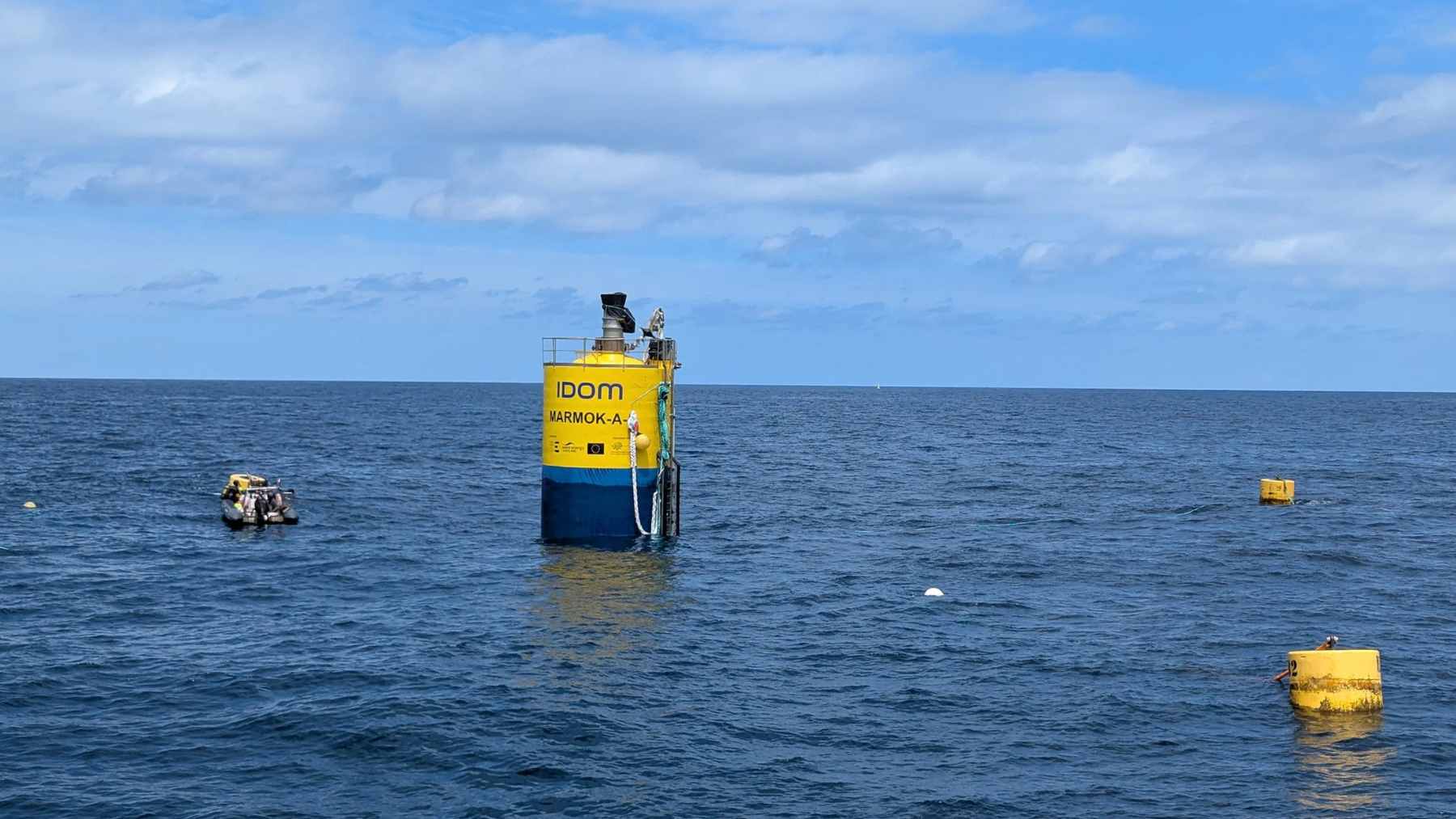
A giant Spanish-built buoy has just been deployed off the coast of Bizkaia, in northern Spain, with one simple mission. It has to prove that the constant push and pull of ocean waves can be turned into usable electricity, not just in a lab, but in real, rough Atlantic waters.
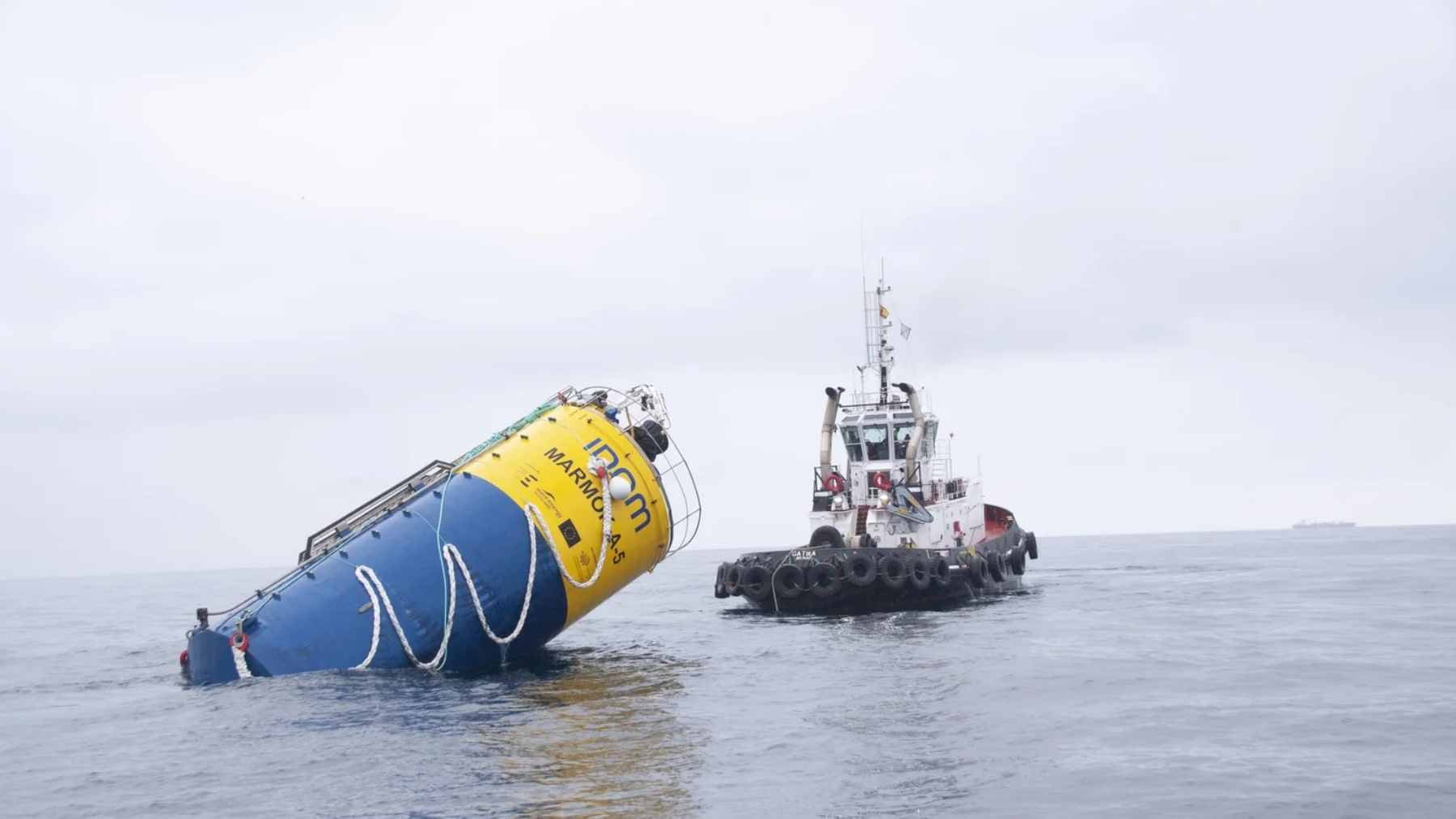
The device is called MARMOK-A-5, and it was developed by the Spanish engineering firm IDOM as part of the EuropeWave program. The upgraded floating wave energy converter has been installed at the Biscay Marine Energy Platform (BiMEP), where it is now entering offshore commissioning after being safely deployed and connected at the test site.
A buoy with a power plant inside
At first glance, MARMOK-A-5 looks like a massive buoy, which is more or less the point.
The device is 42 meters long, about 5 meters in diameter, and uses oscillating water column technology. IDOM describes it as a low-power wave energy converter with two 15-kilowatt turbines, giving it a nominal output of around 30 kilowatts.
That is not enough to power a city, or even a large neighborhood, but this is not about replacing a power plant overnight. In practical terms, it is a test of whether wave energy can become more reliable, easier to maintain, and eventually cheaper to scale.
How the waves become electricity
So how does a buoy make power from the sea?
Inside MARMOK-A-5, a cylindrical water column moves as waves pass around the structure. That movement acts like a piston, compressing and expanding air in a chamber near the top of the buoy.
The moving air then drives a turbine, and the electricity is sent toward shore through a subsea cable. It is a neat idea, almost like letting the ocean breathe through a machine and capturing the energy from every breath.
Why this test matters
Wave energy has always had a tempting promise. The ocean keeps moving day and night, and coastal communities already know the force hidden inside rough seas, crashing swells, and winter storms.
The trouble is that seawater is brutal on machinery. Salt, storms, corrosion, access costs, and hard-to-predict wave patterns can turn a clever prototype into an expensive repair job very quickly. That is why this test at BiMEP matters more than its modest 30-kilowatt rating.
BiMEP says the new campaign will help validate the system and gather key information for future scalability. During the coming months, the device will be assessed for performance, robustness, reliability, and ease of maintenance in demanding marine conditions.
What IDOM changed this time
This is not MARMOK-A-5’s first trip into open water. An earlier version was tested at BiMEP between 2016 and 2019, becoming the first wave energy converter connected to Spain’s grid and one of the first such devices in the world.
The upgraded version now includes controllable blades, on-board batteries, intelligent control systems, and a revised power take-off system. IDOM says the new Wells turbine design uses variable pitch blades to improve efficiency and operability across a wider range of sea states.
That sounds technical, but the everyday meaning is simple. The device is being tuned to cope with the sea as it actually behaves, not as engineers wish it behaved.
EuropeWave enters the water
MARMOK-A-5 is part of EuropeWave, a research and development program designed to push wave energy technologies closer to commercial use. EuropeWave says the program combines more than €22.5 million ($26.24 million) in national, regional, and EU funding through a competitive pre-commercial procurement model.
The program is backed by Wave Energy Scotland, the Basque Energy Agency, and Ocean Energy Europe. Its goal is to help wave energy converters survive harsh ocean environments while producing useful electricity at a cost that could eventually make sense.
That last point is key. Clean power is not just about clever machines. At the end of the day, it has to work when the weather turns ugly, and it has to do so without making the electric bill harder to swallow.
Not a silver bullet yet
Experts and companies have tested wave energy devices around the world for years, from Hawaii to Australia and Europe. Some projects have shown promise, while others have struggled with cost, maintenance, and survivability.
MARMOK-A-5 does not erase those challenges. For the most part, it represents another careful step toward proving that wave energy can move from demonstration to pre-commercial use.
Still, the hope is real. A Spanish-engineered buoy, standing in open water off the Basque coast, is now helping answer one of renewable energy’s most stubborn questions. Can the ocean become a dependable part of the power mix?
What happens next
With the device installed and connected at BiMEP, IDOM is beginning the offshore commissioning phase. The team will verify the power take-off system, gradually increase operations, and collect performance data in real sea conditions.
Borja de Miguel, project manager at IDOM, described the deployment as a “pivotal milestone” for both the company and EuropeWave. He also said the safe installation and grid connection are a key step toward bringing wave energy closer to commercial reality.
For now, the real story is not that one buoy will change the energy world by itself. It is that engineers are learning how to make the ocean’s messy, restless power behave more like a dependable machine.
The official statement was published on EuropeWave.