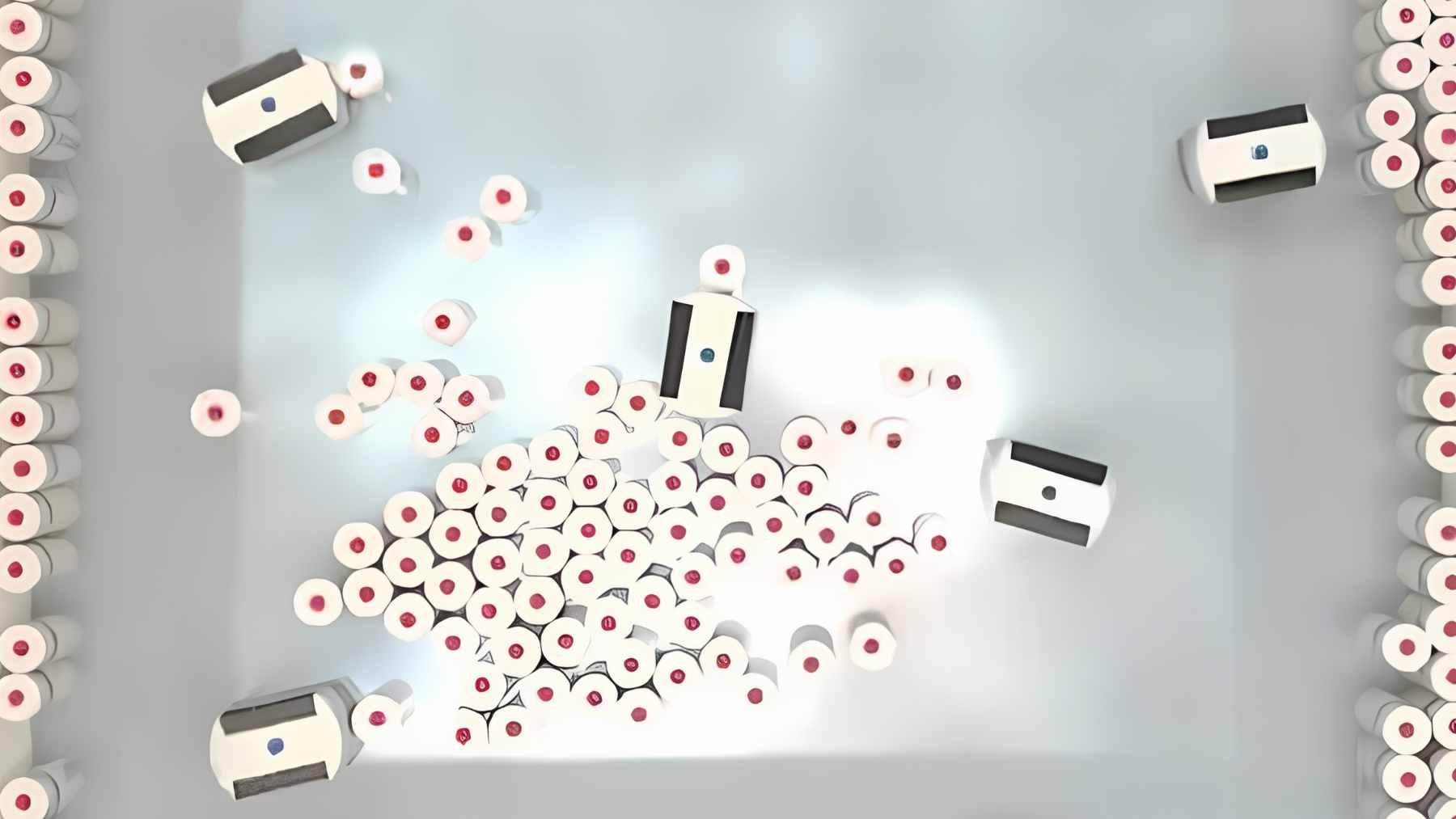
Have you ever watched ants move across a sidewalk crack and wondered how so many tiny bodies seem to know what to do? Harvard researchers have now turned that everyday bit of nature into a robotics experiment with a surprisingly big idea.
The team developed small ant-like robots called RAnts that can collectively build and dismantle simple structures without central control, detailed blueprints, or a single machine giving orders. In a world dealing with disaster zones, contaminated sites, and the high cost of sending people into dangerous places, that matters more than it first sounds.
What are RAnts?
RAnts, short for robotic ants, are small, autonomous wheeled robots designed to mimic how social insects work together. They do not need a boss robot, a worksite foreman, or a master computer telling each unit what to do next.
In nature, ants and termites use a process called stigmergy, where one animal changes the environment and others react to that change. In the lab, the researchers replaced chemical pheromones with “photormones,” which are light fields that guide the robots across the test surface.
No foreman needed
The most striking part is not that the robots move blocks. It is that they do it with simple local rules, sensing light gradients, carrying building pieces, and dropping or removing material when certain conditions are met.
Professor L. Mahadevan said the study shows how “simple, local rules” can produce complex task completion. That is the heart of the experiment, because the intelligence does not sit inside one powerful machine.
Building and demolition
In the tests, the robots could switch between construction and dismantling by changing two main parameters. Those were cooperation strength and material deposition rate, which helped decide whether the swarm gathered material or removed it.
What makes that interesting? The same basic group of robots can behave like a tiny construction crew one moment and a demolition crew the next, at least in a controlled arena. As more robots cluster around the light signals, those spots become starting points where structures can begin to form or come apart.
Why engineers care
For engineers, the appeal is easy to understand. A swarm can keep working even if one robot fails, which is very different from relying on one large machine that can bring an entire operation to a halt if something breaks.
In practical terms, that could matter in places where humans should not spend much time, such as unstable disaster zones, polluted ground, collapsed tunnels, or areas with radiation. It could also interest space planners, since Harvard says possible applications include hazardous autonomous construction and planetary exploration.
Nature as a design manual
This experiment is also a reminder that ecology is not just about protecting forests, oceans, or wildlife. Sometimes, nature becomes the design manual for new technology, and ants have been running their own decentralized construction systems for far longer than humans have had job sites.
That does not mean robots should replace people or that every construction problem can be solved by copying insects. But it does suggest that future machines may become more resilient by acting less like isolated tools and more like parts of a living system.
Not ready for job sites
Still, this is not a revolution ready to roll onto a real construction site. The experiments used small robots, small building pieces, a controlled space, and projected light fields, while real sites have dust, rain, rough ground, heavy materials, and the kind of unpredictable mess that anyone near construction knows well.
That caution matters. By the supplied background’s own framing, RAnts are not about replacing masons or erecting buildings tomorrow, but about proving that simple autonomous coordination can work at a small scale.
What happens next?
At the end of the day, this research is less about toy-sized machines and more about a new way of thinking. Instead of making every robot smarter, engineers may be able to make the group smarter by letting machines respond to their surroundings.
That is where the environmental angle comes in. If future versions can operate in dangerous terrain, they could help reduce human exposure to toxic cleanup sites, disaster rubble, or extreme off-world environments.
The study was published on PRX Life.