Could a plastic bag headed for the trash become liquid fuel? That is the question surrounding Julian Brown, a Georgia-based inventor whose demonstrations show plastic waste being heated, condensed, and collected as a hydrocarbon liquid he says can be refined into gasoline, diesel, and jet fuel alternatives.
The video hit a nerve because plastic pollution is not abstract anymore. It is in storm drains, beaches, rivers, and landfills, and Brown’s project offers the kind of simple visual people remember. But the real story is not just the viral clip, it is whether an experimental prototype can become safe, repeatable, and useful outside a demonstration.
From viral clip to prototype
Brown began working on the idea as a teenager, and WTVM reported that he built his first plastic-to-fuel reactor at 17 before moving through several later prototypes. “This has been my passion since I was a senior in high school,” Brown told the station.
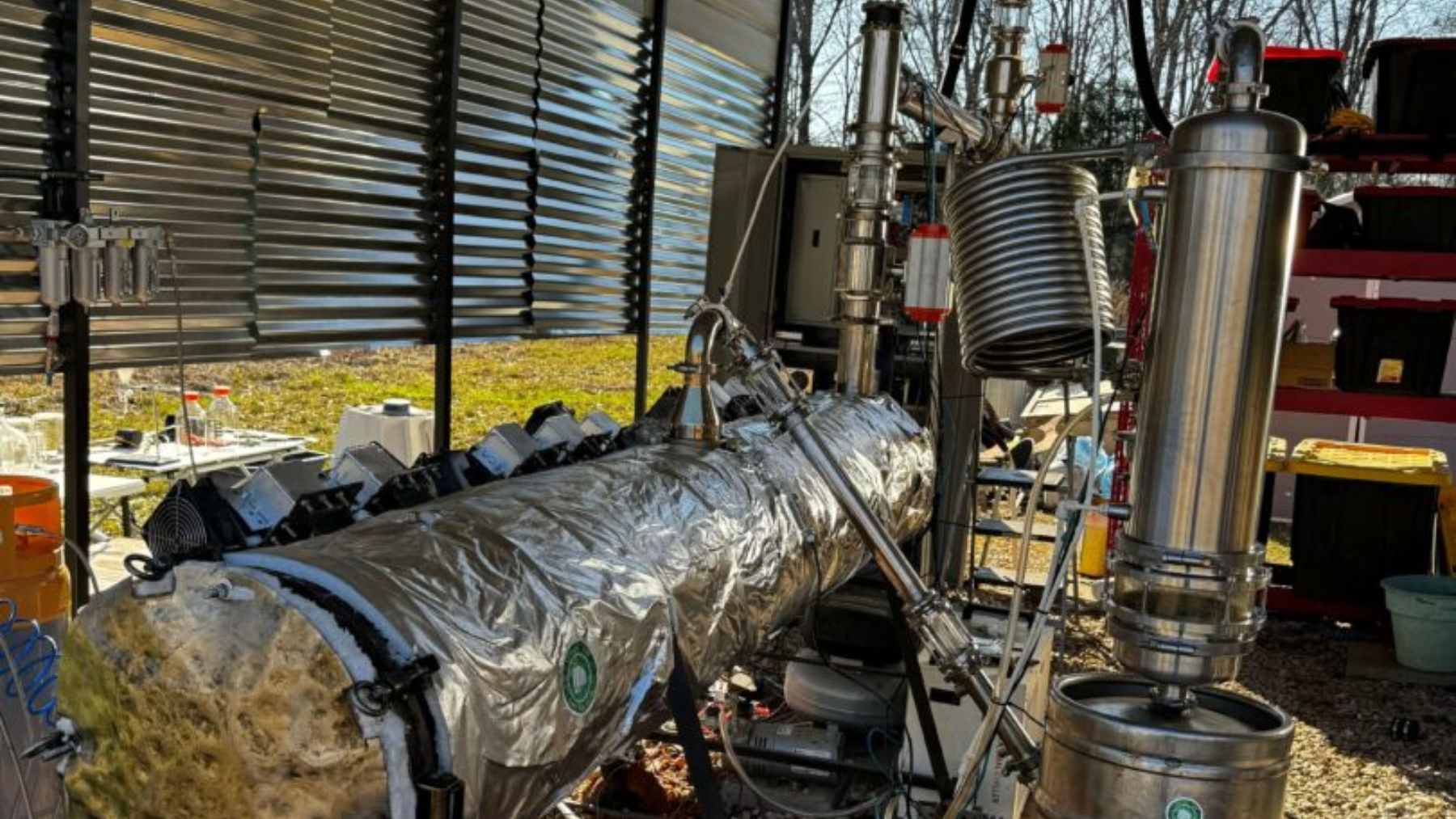
His public project pages describe him as self-taught in welding, chemistry, and engineering, and say he has built multiple reactor generations by hand. NatureJAB says the effort has moved toward a mobile, solar-powered microwave pyrolysis reactor called the Mark V.
How the process works
The science behind the idea is called pyrolysis. In plain terms, plastic is heated with little or no oxygen, so the material does not simply burn. Instead, the long polymer chains break into smaller hydrocarbon molecules, some of which leave as vapor and can be cooled back into liquid.
Researchers have studied plastic pyrolysis for years, and a 2025 review found that it can produce liquid fuels, although yields depend heavily on temperature, residence time, catalysts, and the type of plastic used. That detail matters, because a clean-looking liquid in a jar is not automatically ready for every engine.
Where microwaves come in
Brown’s twist is the use of microwave-assisted heating. Unlike conventional systems that heat from the outside in, microwave-assisted pyrolysis is designed to interact more directly with the material or the absorber used in the reactor, which can change heating speed and efficiency.
That sounds promising, but it is not a solved problem. A 2023 review of microwave-assisted pyrolysis said continuous large-scale devices still need development, along with better optimization of catalysts, reactors, and operating conditions.
In other words, the science can work, but engineering decides whether it works safely every day.
Why the stakes are huge
The world produces more than 440 million tons of plastic every year, according to the United Nations Environment Programme. UNEP also says 21 to 25 million tons of plastic waste leak into aquatic ecosystems each year, polluting lakes, rivers, and seas.
Traditional recycling is not keeping up. The OECD estimated that only 9% of plastic waste was ultimately recycled globally in 2019, while nearly half went to sanitary landfills and 22% was mismanaged through dumpsites, open burning, or environmental leakage. That is why chemical recycling and energy recovery keep attracting attention.
The missing proof
Brown’s official pages make strong claims about 110-octane output, three fuel types, and independent lab testing. JAB Innovations says its fuel has been tested by ASAP Labs and describes the planned Mark V as solar-powered, continuous-feed, and mobile.
Still, there is a big gap between “liquid that burns” and “certified fuel.” A pyrolysis product may need distillation, upgrading, emissions testing, and quality control before it can be treated like gasoline, diesel, or jet fuel at scale. Aviation is even stricter, since ASTM D1655 defines minimum requirements for Jet A and Jet A-1 turbine fuels.
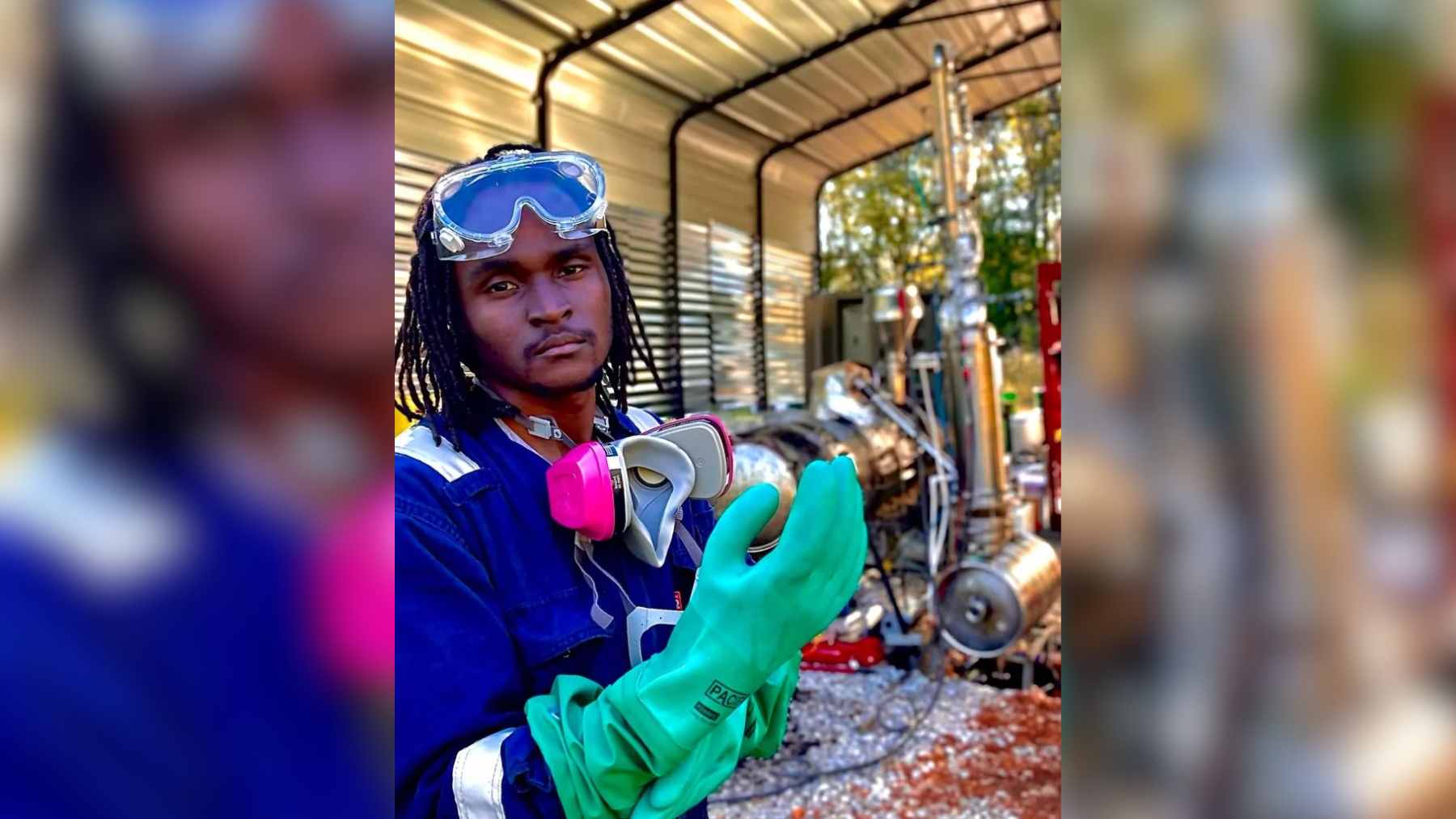
There is also a safety issue. Brown’s own fundraiser says he was hospitalized after an explosion and suffered second-degree burns while working on the system. Sealed chambers, flammable vapors, heat, pressure, and oxygen control are not garage toys.
A promise with conditions
In practical terms, Brown’s project is valuable even before it becomes a finished product. It pushes a bigger conversation about how much energy remains locked inside discarded plastic, and whether communities could recover some of that value instead of paying to bury it.
At the end of the day, public trust will depend on independent data. That means repeatable tests, emissions measurements, verified fuel specifications, lifecycle analysis, and clear rules for what plastics can go in.
It also means showing what happens to gases, char, additives, and plastics that do not convert neatly into fuel.
What comes next
The most exciting part of this story is not only the before-and-after transformation. It is the possibility that a self-taught inventor can push a mature field toward a more visible, mobile, and transparent model.
At the same time, the plastic crisis will not be solved by one machine. Reduction, reuse, better collection, mechanical recycling, chemical processing, and regulation all have a role. Brown’s reactor may become one tool in that messy toolkit, but only if the evidence catches up with the excitement.
The official project statement was published on NatureJAB.