When people picture rooftop solar, they usually think of a lower electric bill. Yet the equipment sitting above the shingles can do something surprisingly simple on a scorching afternoon. It can shade the roof, reduce some heat entering the building, and generate power at the same time.
That makes solar increasingly relevant as a climate adaptation tool, not only a way to produce cleaner electricity. Studies point to cooler ceilings, lower city temperatures, possible savings on air conditioning, and a modest property premium.
The gains are real enough to matter, but they vary with the building, installation, weather, and local housing market.
Solar’s EU role is growing
Eurostat says renewables supplied 45.5% of the electricity generated in the European Union during the first quarter of 2026, up from 42.7% a year earlier. Solar made up 17.3% of renewable electricity, not 17.3% of the entire EU mix. That works out to roughly 7.9% of total generation.
The distinction matters, but so does timing. Solar output rises on bright summer days, just when many homes reach for fans or air conditioning. The same roof can become a small power plant and a layer of sun protection.
Panels act like roof shade
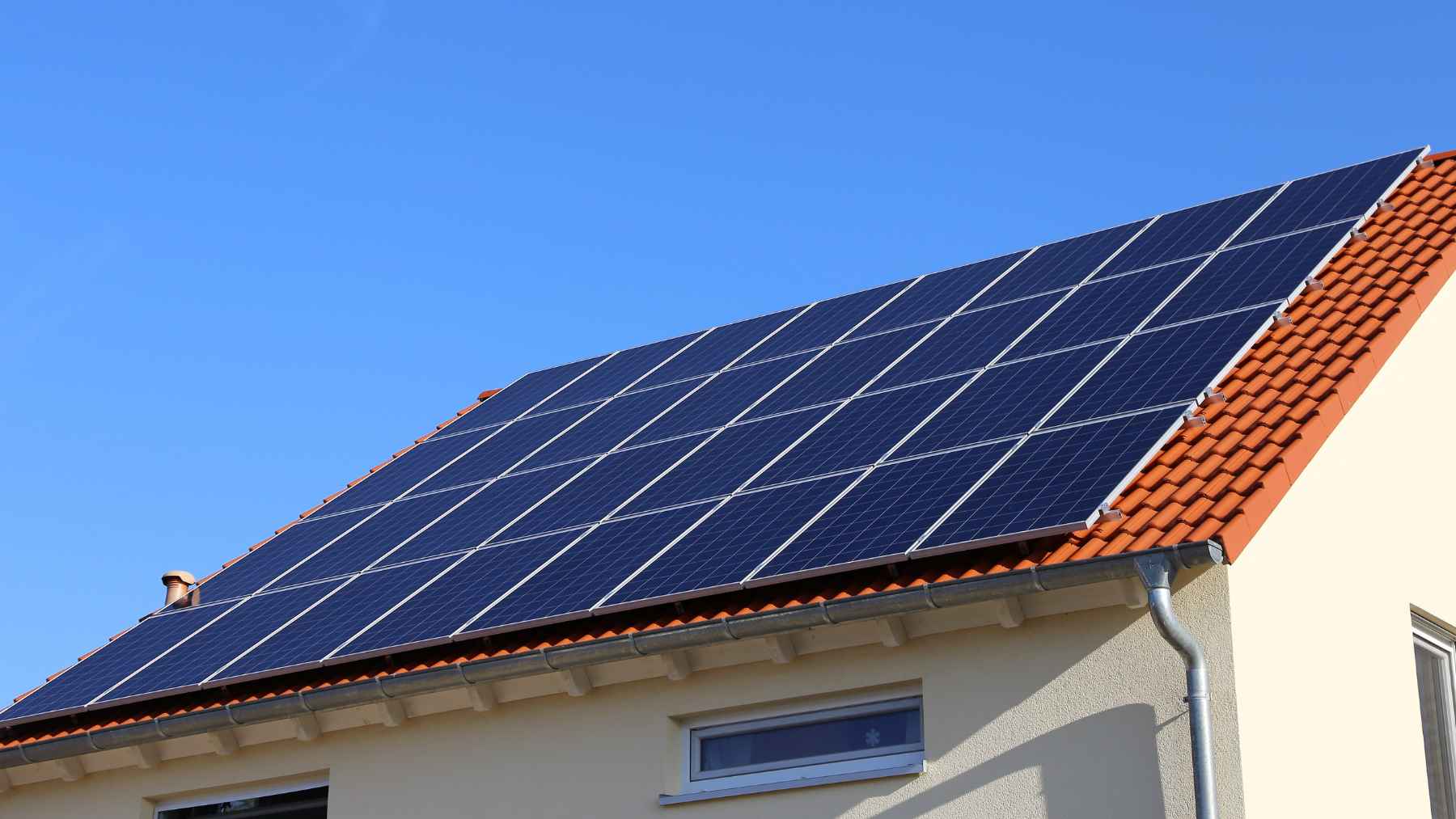
The cooling effect starts with simple geometry. Photovoltaic modules intercept sunlight that would otherwise strike the roofing material, while the gap beneath them allows moving air to carry away some heat. Think of the difference between leaving a car in open sun and parking under a carport.
University of California San Diego researchers used thermal imaging at a laboratory building and found that the ceiling beneath solar panels was about 5°F cooler during the day than the ceiling under an exposed roof.
On that building, the panels reduced the heat reaching the roof by about 38%, with tilted panels performing better because air could circulate. The measurements covered a limited period at one site, so the result should not be treated as a universal promise.
Jan Kleissl, a professor of environmental engineering, put the limitation plainly. “There are more efficient ways to passively cool buildings, such as reflective roof membranes,” he said. Insulation, roof color, panel clearance, wind, and local climate can all change the outcome.
London shows the wider potential
A 2024 study in Nature Cities asked a much bigger question. Researchers modeled what might have happened if rooftop solar had covered buildings across Greater London during the extremely hot summer of 2018. The model found that the average summer outdoor temperature across the city could have been about 0.5°F lower.
The researchers estimated that 786 deaths in Greater London during those three months were attributable to heat. Under the full rooftop solar scenario, 96 of those deaths, or 12%, might have been avoided. These were modeled outcomes, not deaths observed to have been prevented by existing panels.
Solar was not the strongest cooling option in the study. Highly reflective cool roofs produced a larger modeled reduction, with 249 fewer heat-related deaths in that scenario. It is a reminder that cities may need a mix of technologies because one roof rarely solves every problem.
Solar and AC peak together
During a June 2026 heat wave, energy think tank Ember calculated that a typical United Kingdom home with rooftop solar generated enough electricity to run a whole-home air conditioning setup for about five hours per day.
Across 1.9 million homes with solar, the group estimated the equivalent of 10 million solar-powered cooling hours on each heat wave day. The calculation highlights a useful match between sunny weather and rising cooling demand.
But “free air conditioning” needs an asterisk. Households paid for the panels, cooling often continues after solar output falls, and homes without batteries may still draw power from the grid later in the day. Solar can reduce the electricity impact of cooling, but efficient equipment, insulation, exterior shading, and sensible thermostat settings still do much of the work.
Home value comes with caveats
A report from trade group Solar Energy U.K. analyzed more than five million property sales and estimated a price premium of about 0.9% to 2% for typical homes with photovoltaic systems. The result varied with location, property type, financing, and expected savings. That is encouraging, but the research is specific to the United Kingdom and was published in 2021.
Some commercial estimates claim average increases as high as 14%, but homeowners should not treat that figure as a guarantee. Buyers may care about the system’s age, ownership or lease terms, roof condition, battery storage, warranties, and local electricity prices. A well-documented installation is likely easier to value than one with missing paperwork.
Solar’s resale benefit is less like a fixed coupon and more like an efficiency feature. It may strengthen a home’s appeal, but the market decides what that is worth.
The less visible benefit
Climate psychologist Linda Aspey told Euronews that taking practical action can ease feelings of powerlessness for some people. “Things like gaining energy independence can help,” she said. Producing electricity at home may also lead people toward local energy groups and shared projects.
That should not be mistaken for treatment for anxiety or depression. Solar panels cannot fix climate distress on their own, and many people do not have the money or roof access needed to install them. The more defensible point is smaller and more human, since agency can feel better than helplessness.
What homeowners should remember
Before signing a contract, homeowners should check the roof’s age and structural condition, nearby shade, panel spacing, inverter and battery terms, warranties, and whether the system will be owned or leased.
They should also compare expected production with their daytime electricity use, especially when cooling is a main reason for buying. A solar quote that ignores building efficiency tells only half the story.
The big picture is straightforward. Rooftop solar can lower bills, reduce some roof heat, support cooling during heat waves, and possibly add resale value, but the size of each benefit depends on context.
The data release was published by Eurostat.