Coal has always carried one stubborn image: a dark fuel feeding a hot furnace while smoke rises into the sky. Now a team of Chinese researchers says it has found a different route, one that turns coal into electricity through chemistry instead of fire.
The system is called a zero-carbon-emission direct coal fuel cell, or ZC-DCFC. It does not make coal disappear, and it does not erase every environmental concern around mining. It does try to solve the dirtiest part of coal power, however, which is letting carbon dioxide escape into the air while electricity is made.
A coal battery, not a furnace
The idea sounds strange at first. How can coal make electricity if nobody burns it? The simple answer is that the fuel is treated more like the chemicals inside a battery than the fuel inside a boiler.
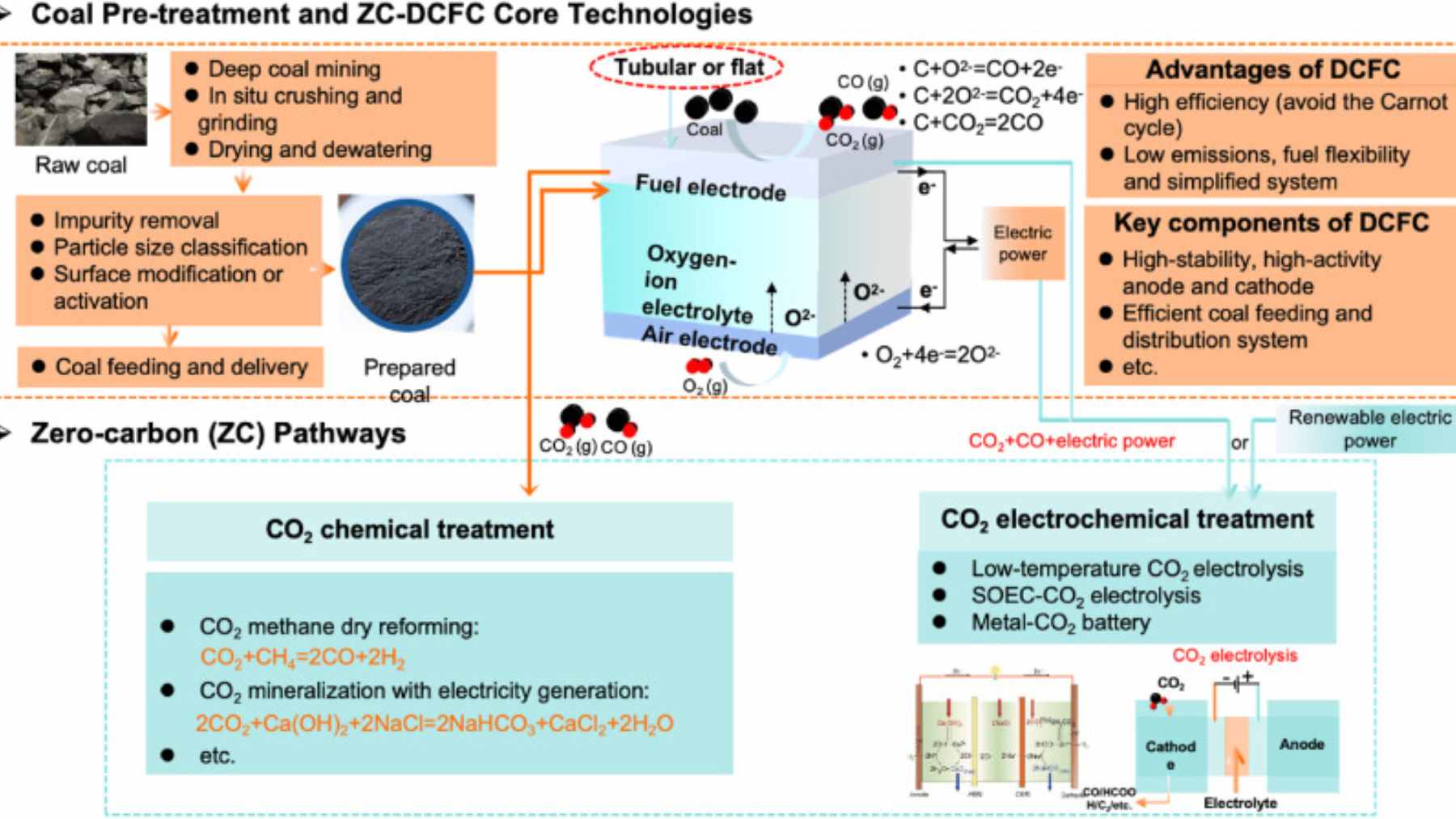
According to reports on the research, coal is pulverized, dried, purified, and pretreated before it enters the anode side of the cell. Oxygen is supplied at the cathode, and the coal undergoes electrochemical oxidation across an oxide membrane, sending electrons through an external circuit as usable power.
Since conventional coal plants usually burn coal to create heat, boil water, make steam, and spin turbines, this is significant. This new approach skips that familiar chain and tries to pull electricity directly from the chemical energy in coal. Less machinery in the middle could mean fewer energy losses, at least in theory.
What happens to the CO2
Here is the part that needs careful wording: the process still creates carbon dioxide. The difference is that the CO2 is produced inside a controlled cell, where researchers say it can be captured in place before it becomes diluted in flue gas.
The South China Morning Post reported that the high-purity CO2 at the anode outlet can be captured in place and then converted into chemical feedstocks such as synthesis gas, or mineralized into compounds such as sodium bicarbonate.
That is a big shift from a smokestack model, where emissions are mixed with other gases and become harder to manage.
Still, this is not a magic wand. For the most part, the climate value depends on whether the captured carbon stays out of the atmosphere, whether the conversion products are useful at scale, and whether emissions from mining and fuel preparation are counted honestly.
Why China is interested
There is a reason this research is getting attention now. Coal is not vanishing from the energy system overnight, even as solar and wind grow quickly. The International Energy Agency says coal power generation accounts for about two-thirds of global coal consumption, and global coal demand still grew slightly in 2025.
China sits at the center of that story. The IEA says China consumes 30% more coal than the rest of the world combined, even though its coal-fired electricity generation fell by about 1.5% in 2025. At the same time, China commissioned almost 80 gigawatts of coal power capacity that year, largely for peak demand and energy security.
That tension is not just theoretical. On June 16, 2026, Reuters reported that China’s fossil-fueled power generation, mostly coal with some natural gas, rose 2.1% in May from a year earlier after weak wind conditions curbed renewable output. In everyday terms, when the wind drops and demand keeps rising, the grid still reaches for backup.
Deep mines could be next
The research also points toward a more futuristic possibility. Instead of digging coal out of deep seams, the system could one day generate electricity closer to underground coal deposits and send power to the surface.
The source brief describes the target as coal formations more than 6,560 ft. underground, where extraction can become more difficult and dangerous. The researchers frame ZC-DCFC as a possible tool for in-place conversion of deep coal resources, although that remains a major engineering challenge rather than a finished industrial plan.
At the end of the day, what they are trying to do is change the role of coal from something hauled, burned, and vented into something converted inside a closed system. It sounds almost like science fiction. The hard part is making it work outside a research setting.
Efficiency is the business hook
For power companies, the environmental claim is only half the story. Efficiency is the other half, because a system that extracts more electricity from the same fuel could change operating costs.
China Daily reported that technologies such as Integrated Gasification Combined Cycle are limited to conversion rates of around 45% and can emit more than 1.8 lbs. of CO2 per kilowatt-hour. The new method aims to bypass traditional combustion and convert coal’s chemical energy directly into electricity through electrochemical oxidation.
In practical terms, the fuel cell is being pitched as both a climate technology and an energy security technology. That combination matters in countries where coal is still abundant, electricity demand is rising, and leaders do not want the lights to depend only on the weather.
The hard part
The study does not pretend the technology is ready to replace power plants next week. Summaries of the paper point to key challenges, including fuel supply, materials, in-situ CO2 conversion, and future development needs.
There are also practical bottlenecks. Coal has to be turned into a cleaner, more reactive form, which can involve slurry preparation, impurity removal, drying, dewatering, and surface activation. That is a lot more complicated than simply shoveling fuel into a furnace.
Researchers cited by Market Watch also acknowledged “critical bottlenecks” tied to eliminating carbon emissions and long-term stability. That is the line to watch. A technology can look elegant in a diagram, but power grids need equipment that runs reliably, cheaply, and safely for years.
What to keep in mind
This invention does not make coal green overnight. What it does is move the emissions fight from the smokestack into the cell, where carbon may be easier to capture and reuse.
If the system scales, it could give coal-heavy grids a cleaner bridge while renewables, storage, nuclear, and transmission continue to expand. But if the carbon accounting is incomplete, or if the system proves too costly, it could become another “clean coal” promise that never quite leaves the lab.
For now, the most honest takeaway is also the most interesting one. Chinese scientists are not trying to burn coal better, they are trying not to burn it at all.
The study was published on Energy Reviews.