A coal power plant that does not burn coal sounds like a riddle. But a Chinese team led by Shenzhen University professor Xie Heping says it has built what it calls a “zero-carbon-emission direct coal fuel cell”, turning coal into electricity through electrochemical oxidation rather than a boiler and turbine.
The pitch is that carbon dioxide leaves as a concentrated stream for storage or reuse, instead of drifting out of a smokestack. A CREA snapshot found coal power’s share of China’s generation fell from 57% to 52% year over year in early 2025, even as coal remains a key backstop when demand jumps during summer heat waves. Think of it as trying to keep the exhaust in a bottle.
How the coal fuel cell works
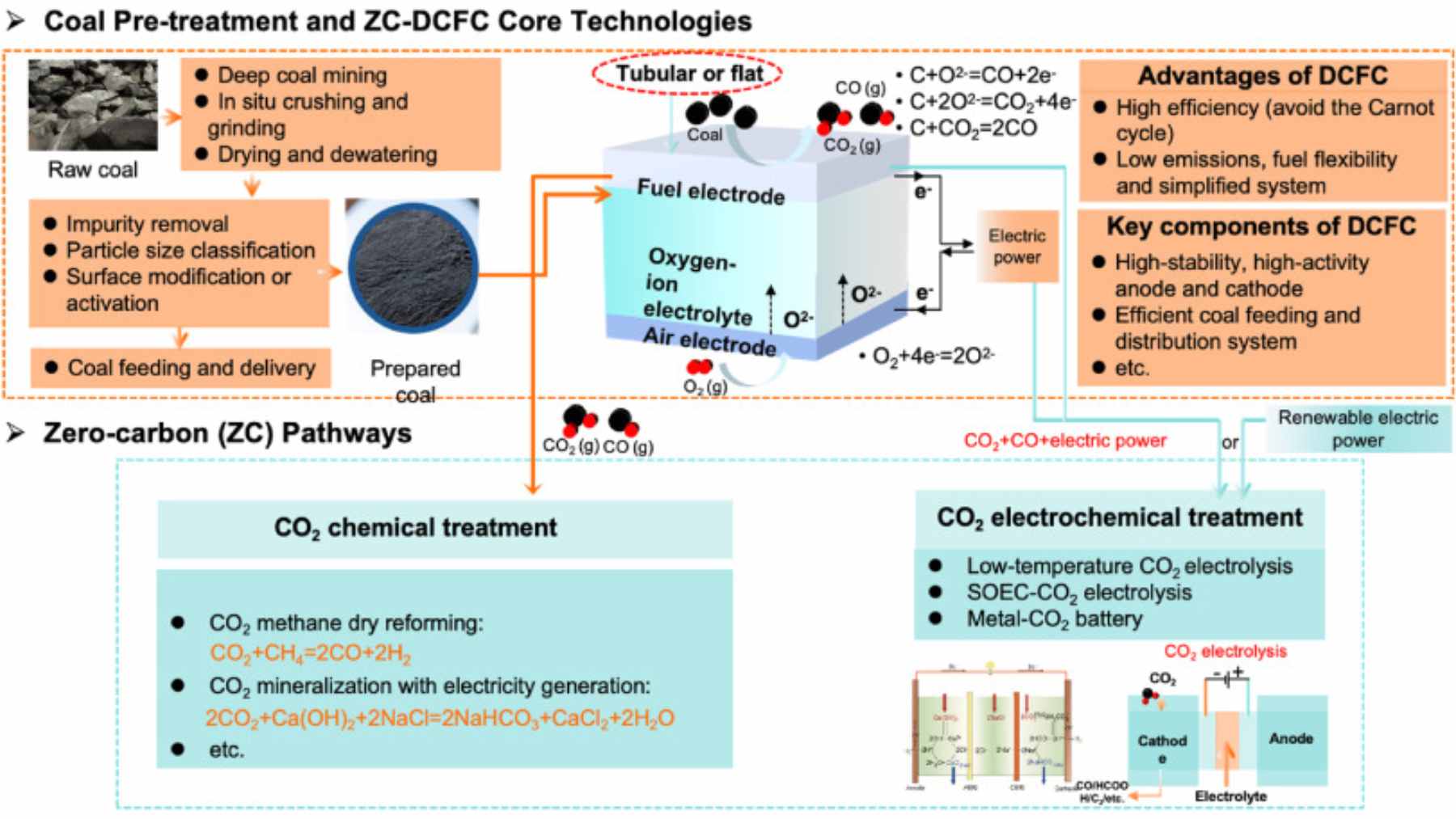
Conventional coal plants burn fuel to make heat, boil water, and spin a turbine. Reports on the ZC-DCFC say it feeds prepared coal powder into the anode (fuel side) of a high-temperature electrochemical cell while oxygen enters at the cathode (air side).
Electrons flow through an external circuit as usable electricity, so some coverage even calls it a coal “battery”.
Carbon dioxide still forms, but it is not mixed into bulky flue gas. The South China Morning Post reported that the high-purity CO2 can be captured on site and then converted into synthesis gas or mineralized into compounds such as sodium bicarbonate.
Earlier U.S. Department of Energy analysis highlighted a similar advantage for direct carbon fuel cells, producing an “almost pure” CO2 stream that can simplify cleanup.
Solids are the tricky part. A DOE-linked assessment warned that volatile compounds and steady fuel feeding can cause coal to clump together and interrupt operation, and it also noted that anode exhaust can carry sulfur and nitrogen compounds that still need handling. Academic reviews add another headache: ash and impurities that can block channels and attack materials.
Why the efficiency numbers matter
Coal plants are heat engines, and heat engines waste a lot of energy as heat. The U.S. Energy Information Administration notes that a heat rate around 10,500 Btu per kilowatt-hour works out to about 33% efficiency, while 7,500 Btu per kilowatt-hour is about 45%.
China Daily pointed to coal systems “around 45%” as a practical ceiling for today’s cleaner coal options.
Fuel cells are different because they make electricity straight from chemistry. In early DOE work, analysts modeled direct carbon fuel cell plants operating around 75% efficiency on a heating-value basis, while stressing the technology was still early-stage. If even part of that gain holds at scale, you burn less coal per kilowatt-hour and you have less CO2 to handle.
The business case and the lock-in risk
The economics are hard to ignore. A joint report covered by Carbon Brief says developers in China submitted new or reactivated proposals for 161 gigawatts of coal plants in 2025, even as clean power pushed coal generation downward.
AP reported that China commissioned 78 gigawatts of new coal capacity in 2025 while adding 315 gigawatts of solar and 119 gigawatts of wind, citing National Energy Administration data.
A technology branded as “near-zero” emissions could help utilities defend new builds and keep older assets alive longer. But the climate benefit hinges on what happens after capture, because converting CO2 into a fuel only delays emissions unless that carbon is permanently stored or mineralized. So does this solve coal’s climate problem, or just move it downstream?
Energy security and defense implications
China’s coal surge is not only about money. AP notes that power shortages in 2021 and 2022 sharpened energy security concerns and helped trigger a wave of coal permits. When factories slow and neighborhoods see rolling outages, governments tend to reach for whatever is firm and available.
China Daily also reports that the ZC-DCFC concept could be useful for deep underground coal resources, a reminder that energy and national security often overlap. Sending electricity up a cable is simpler than moving tons of fuel on trains and trucks, and it could reduce exposure to transport bottlenecks during a crisis.
Still, underground systems bring their own risks, including heat management and groundwater protection.
What to watch next
The real test is durability and scale. Reviews of direct carbon fuel cells warn that corrosion, ash, and impurity tolerance can end promising cells early, especially when you try to stack them for industrial output. Long-run demonstrations with transparent performance data would do more than any press headline, and that is the hard part.
For climate credibility, the accounting also has to be end-to-end. That means counting emissions from mining and fuel prep, then proving the captured CO2 stays out of the atmosphere for good.
The study was published on Energy Reviews.