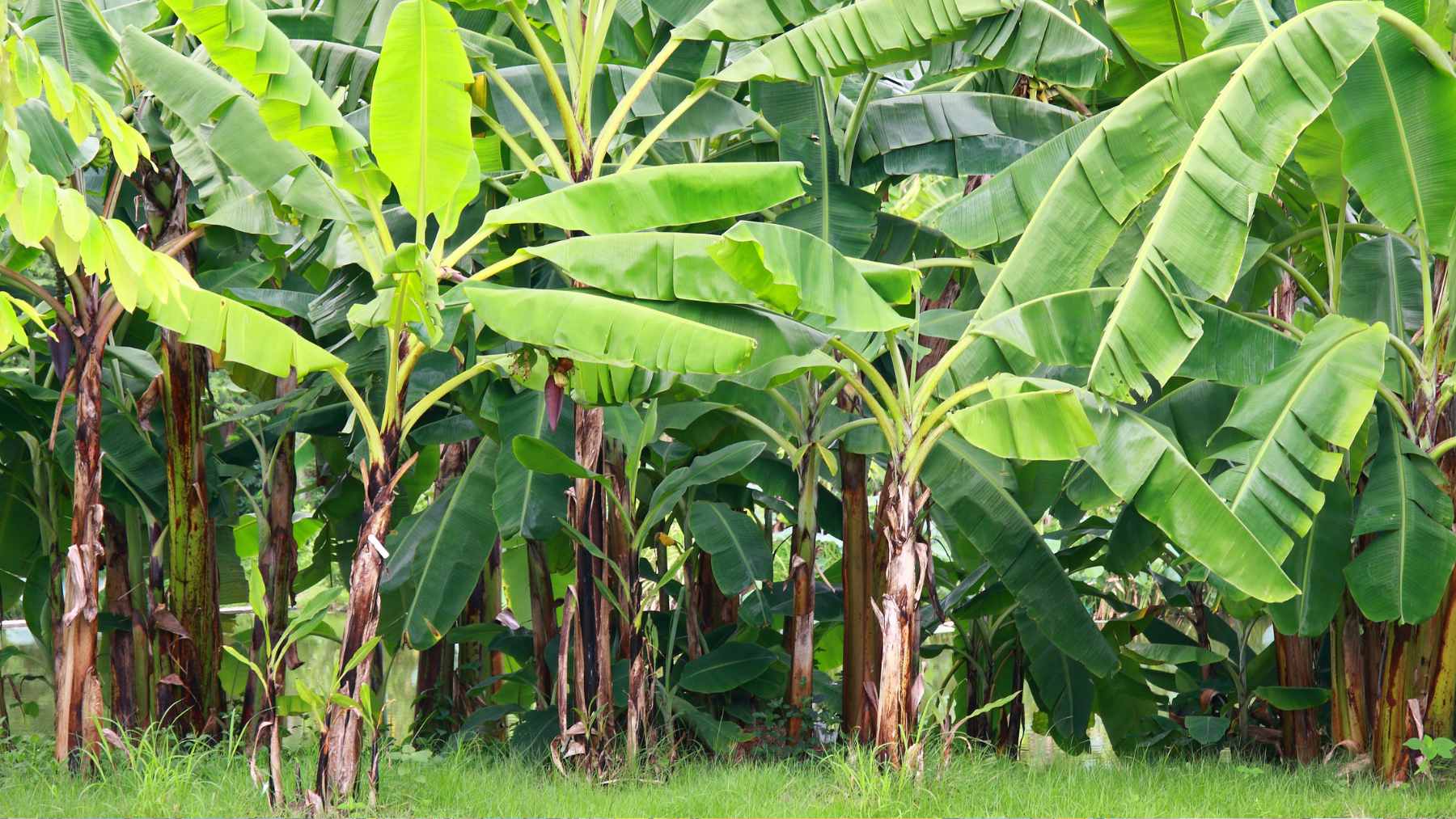
What happens to the banana plant after the fruit is cut? For the most part, the tall, watery pseudostem, which is the trunk-like part of the plant, is left in the field, chopped up, or treated as waste. That overlooked trunk is now being pulled into a new industrial chain for clothing, paper, and molded packaging.
The real breakthrough is not that banana fiber exists–small producers have used it for years. The change is that factories are trying to make the material predictable, using mechanical extraction, controlled drying, water treatment, and quality checks that can satisfy textile mills and packaging companies.
A waste stream hiding in plain sight
Banana farming creates far more plant material than edible fruit. A 2021 review reported that almost 60% of banana biomass remains as waste after harvest, while separate sustainability research cites about 220 tons of banana byproducts per hectare (2.5 acres) annually in some systems.
That scale helps explain why the pseudostem is moving from farm nuisance to business opportunity. Nobody wants more trucks full of wet waste on rural roads, but nobody wants useful cellulose rotting beside the field, either. The question is simple: can factories turn that messy residue into something steady enough to sell?
From trunk to fiber
The first challenge is location. Fresh pseudostems are heavy and packed with water, so the processing plant needs to be close to farms or the economics start to fall apart. That means shorter hauls, less traffic, and less time for the material to degrade.
At the plant, workers sort the stems by size, moisture, and condition. Then comes decortication, a mechanical process in which rollers and blades press and scrape the stem to separate the strong fiber from the softer pulp. It sounds rough, but that is the point.
The fiber is not just a feel-good material. One study in SN Applied Sciences reported mechanically extracted banana pseudostem fiber tensile strength at 590 MPa, compared with 249 MPa for jute and 350 MPa for sisal.
Brazil is testing the textile business
In Brazil, the industrial shift is already visible. A project called Banana Têxtil, developed through the SENAI Institute of Textile Technology, Apparel and Design in Blumenau, turned banana stem residue into an industrially viable fabric and reached the final of the BRICS Solutions Awards 2025.
That matters because fashion has a raw material problem. Polyester is tied to fossil inputs, cotton can demand large amounts of water and land, and shoppers are increasingly skeptical of sustainability labels that sound better than they perform.
Banana fiber will not replace every shirt in your closet, but it could become one more tool in the industry’s search for lower impact blends.
The most likely near-term use is not a pure banana-fiber wardrobe. It is blended fabrics, nonwovens, home textiles, and reinforcement materials that use the fiber where strength and texture make sense. At the end of the day, the market wants consistency as much as novelty.
Packaging is the next proving ground
The same fiber could also land somewhere more ordinary. Think of the tray under fruit at a supermarket, the kind that usually disappears into the trash after one grocery trip. A recent study tested banana pseudostem fiber mixed with gum arabic to create pressed boards for fruit packaging, comparing them with recycled paper pulp packaging.
The results were promising, but not perfect. The Embrapa repository summary says “The mechanical properties of the composites were superior to those of the recycled paper pulp packaging,” and it notes potential as a cushioning material aligned with circular economy principles.
Still, water absorption was a major weakness, reaching 358.3% in the most absorbent test compared with 130.5% for the recycled paper control. A fruit tray has to survive moisture, stacking, transport, and the rough little bumps of real retail life. Strong is good, but dry enough is better.
The rest of the plant still matters
A banana fiber plant cannot focus only on the shiny part of the story. Decortication leaves behind pulp, sap, and wet residues, and those streams need a destination, too.
Some research points to banana pseudostem sap and waste as a base for liquid organic fertilizer or biofertilizer, which could return nutrients to farms and reduce dependence on synthetic inputs in some cases.
But there is a catch: washing the fibers uses water, and poorly managed wastewater can turn an environmental idea into a local headache. Odor, runoff, and disposal costs are not side issues. They decide whether neighbors welcome the factory or fight it.
That is why the best version of this industry looks less like a single product and more like a small biorefinery. Fiber goes to textiles and packaging, and pulp, sap, and wastewater are treated, reused, composted, or converted into energy where possible.
A simple idea with difficult details
The appeal is easy to understand. Take a crop residue that already exists, process it close to the farm, and move part of the textile and packaging supply chain away from fossil inputs and virgin wood pulp. For communities that grow bananas, the bonus could be new rural income instead of a disposal burden.
Still, experts would be right to move carefully. Logistics, farmer training, drying conditions, wastewater treatment, and product standards will decide whether banana fiber becomes a serious material or another green promise that fades after the headline. The compass is clear, but the road is technical.
So, could the leftover trunk from breakfast fruit end up in a shirt, notebook, or produce tray? To a large extent, yes, if factories can keep quality steady and costs under control.
The study was published on Wiley Online Library.