Magelang has found one of the simplest ways to make plastic waste feel impossible to ignore. Put a bottle in a machine, watch a balance rise, and suddenly the empty container in your hand is not just trash anymore. It is a tiny deposit, almost too small to count, but useful enough to make people stop before tossing it away.
The machine was built by Ben Swarna Sugi, 36, a neighborhood sanitation worker in Magelang, Indonesia, who grew frustrated after finding one or two water bottles mixed into household trash again and again.
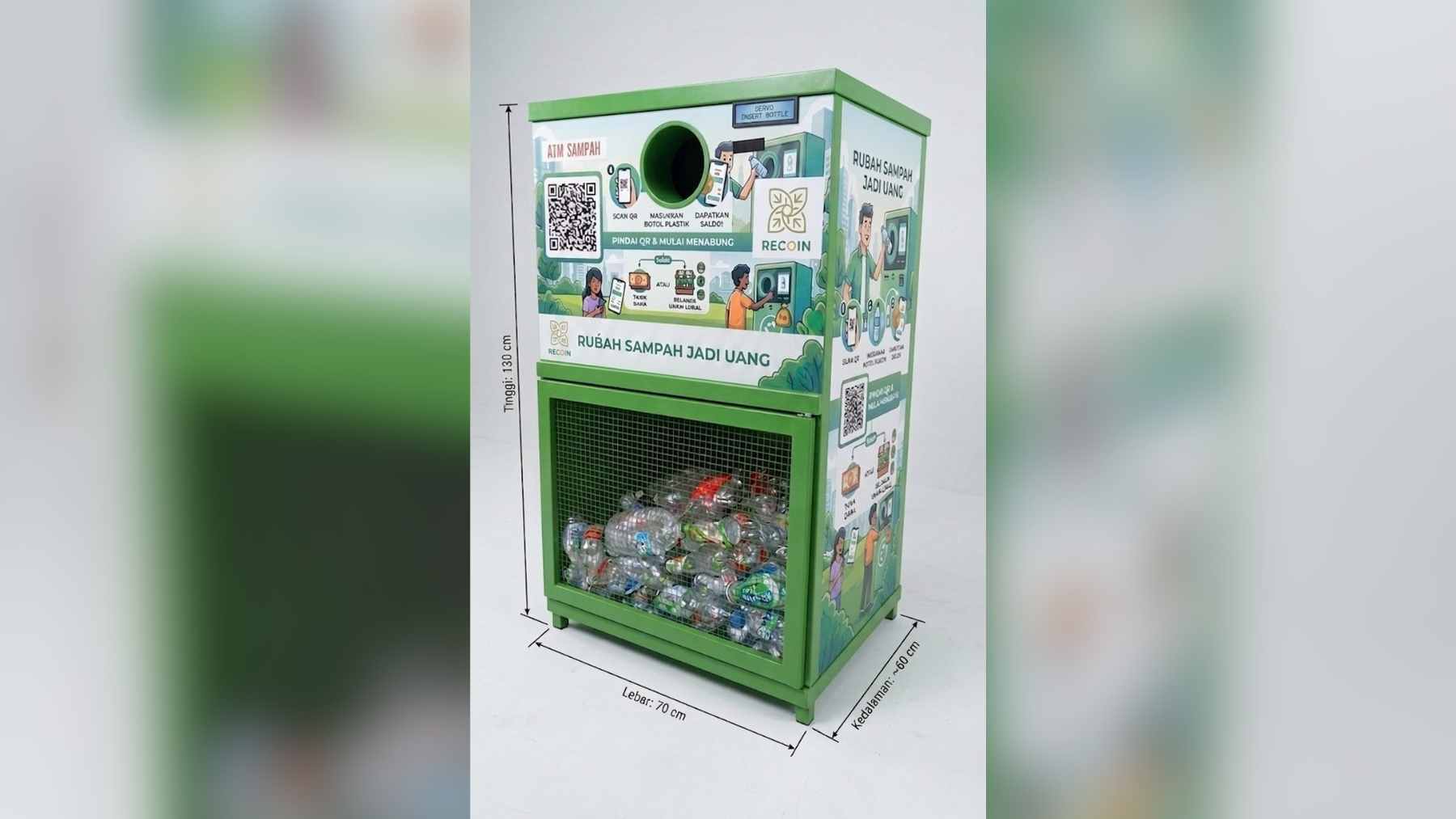
His answer is RECOIN, a small reverse vending machine outside his home that accepts plastic bottles and turns them into digital money, local shopping credit, or savings for later.
A bottle becomes a balance
RECOIN works like a very local version of a deposit machine. A resident scans a code with a phone, registers through a link, puts a plastic bottle into the opening, and the machine detects it with sensors before adding money to the user’s account.
Each bottle is worth 50 rupiah, which is about $0.003 at recent exchange rates. Users can withdraw once they reach 5,000 rupiah, roughly 28 cents, and the money can also move through digital wallet services or be used at nearby partner stalls.
That sounds tiny. But for Ben, the amount is not the main story. The real target is behavior, especially the habit of tossing one or two bottles into the same bin as everything else.
Why small payments matter
Ben said the problem was simple and familiar. Many residents did not want to store bottles until they had enough to sell by weight, so the bottles were thrown away instead.
That is where the machine changes the rhythm of recycling. Instead of waiting for a full sack, people can feed in a single bottle after drinking water on a hot day, then see the reward appear right away.
“For me, it is not just about giving 50 rupiah per bottle,” Ben said in comments reported by RRI. “It is about building awareness to separate plastic waste from other waste.”
The local business twist
The machine is not large. It stands about 4.3 feet high, 2 feet wide, and 2.3 feet long, and the holding box can take about 8.8 pounds of plastic bottles before it fills up.
There is a neighborhood economy tucked inside the idea too. Ben said users could cash out through bank transfer or digital wallets, while the balance could also be spent at local small businesses that have partnered with the project.
During the trial described by local reporting, about 1,700 used mineral water bottles had already been collected in roughly a month. For a single box in front of a house, that is not just a cleanup story. It is a small data point about how quickly everyday waste adds up.
A national problem, one bottle at a time
Indonesia’s plastic challenge is far bigger than one neighborhood in Central Java. A World Bank backed assessment found that Indonesia generates about 8.6 million U.S. tons of plastic waste each year, with 58 percent going uncollected.
The global picture is not comforting either. OECD data show that plastic waste more than doubled from 2000 to 2019, reaching about 389 million U.S. tons, while only 9 percent was ultimately recycled after recycling losses were counted.
Those numbers are so large they can feel distant. A bottle in a kitchen bin is different. You can see it, hold it, and decide whether it becomes litter, resale material, or a few more cents in a digital balance.
City leaders are paying attention
Magelang’s city planning and development agency has already recognized the idea. In its 2026 Krenova innovation contest announcement, the agency listed Ben Swarna Sugi in second place for “RECOIN,” describing it as an internet-connected reverse vending machine based on circular economy principles.
RRI also reported that Magelang Mayor Damar Prasetyono praised the machine as a way to sort and manage plastic waste while giving it economic value. The mayor said the innovation could later be integrated with local small businesses, and noted that each neighborhood unit in the city already has a waste bank.
That city link matters. A machine like this needs more than enthusiasm if it is going to last. Maintenance, transparent cash-out rules, fair partnerships with collectors, and public trust in the digital balance will decide whether it remains a clever prototype or becomes a repeatable neighborhood tool.
Plastic recycling gets personal
Can a reward worth less than a penny change how people handle plastic? On its own, probably not. But it gives families, children, shop owners, and trash collectors a reason to pause at exactly the moment when waste usually disappears from sight.
Ben’s next hope is to move higher up the value chain by adding a plastic shredding machine, which could let him sell processed material directly to recycling facilities for a better price. For the most part, that is the bigger lesson here. Recycling works best when the system makes the cleaner choice easy, visible, and worth something.
The official announcement recognizing RECOIN as a city innovation was published on Bapperida Kota Magelang.