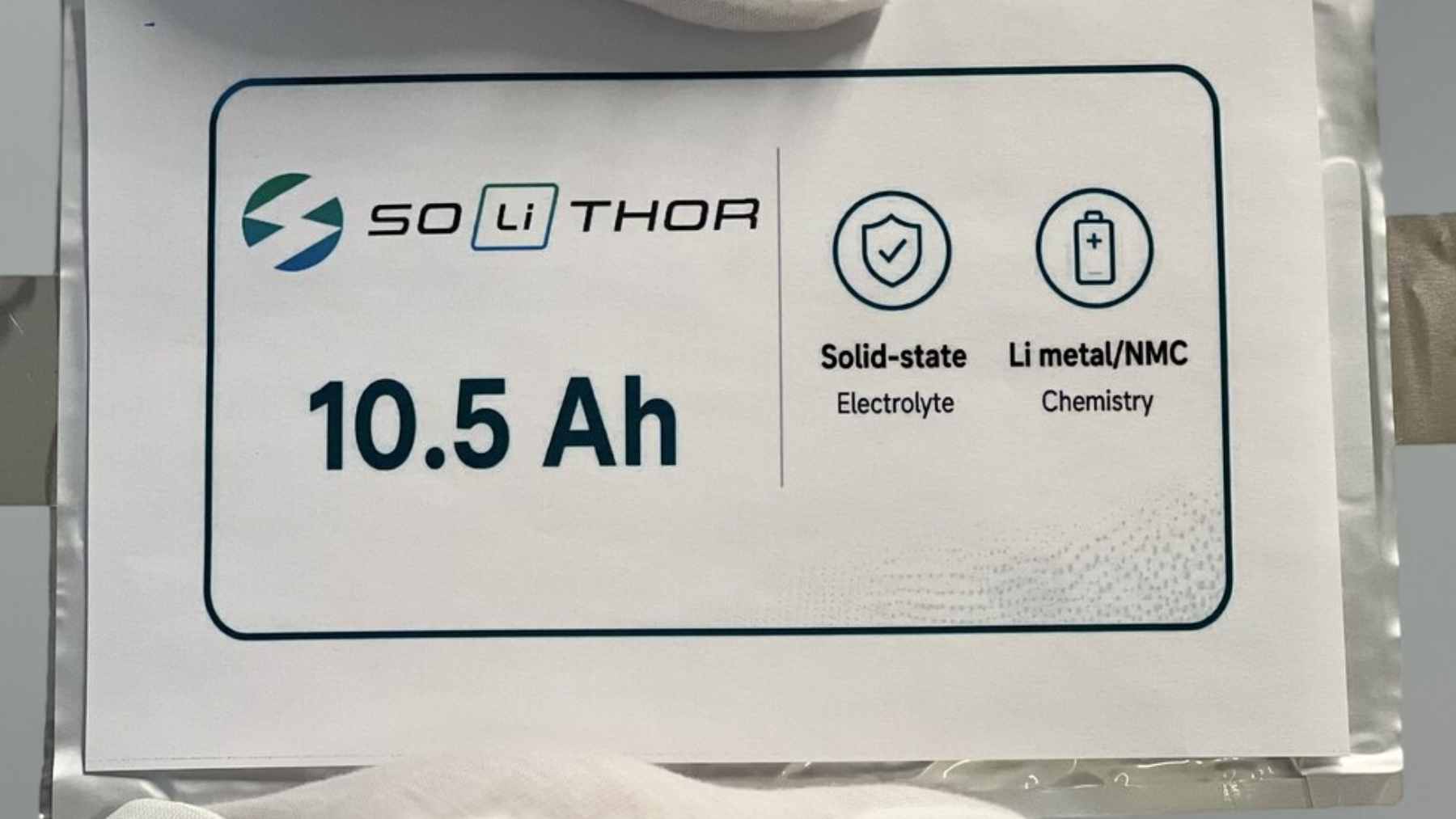
Cleaner power is not only a car story anymore. European deep-tech startup SOLiTHOR says it has built its first 10 Ah solid-state demonstration cell, a larger pouch-format battery meant to show that its lab chemistry can move toward real industrial use.
The company is aiming first at aerospace, maritime, transport, and defense, where a lighter battery can change what a drone, ship system, or specialized vehicle can do.
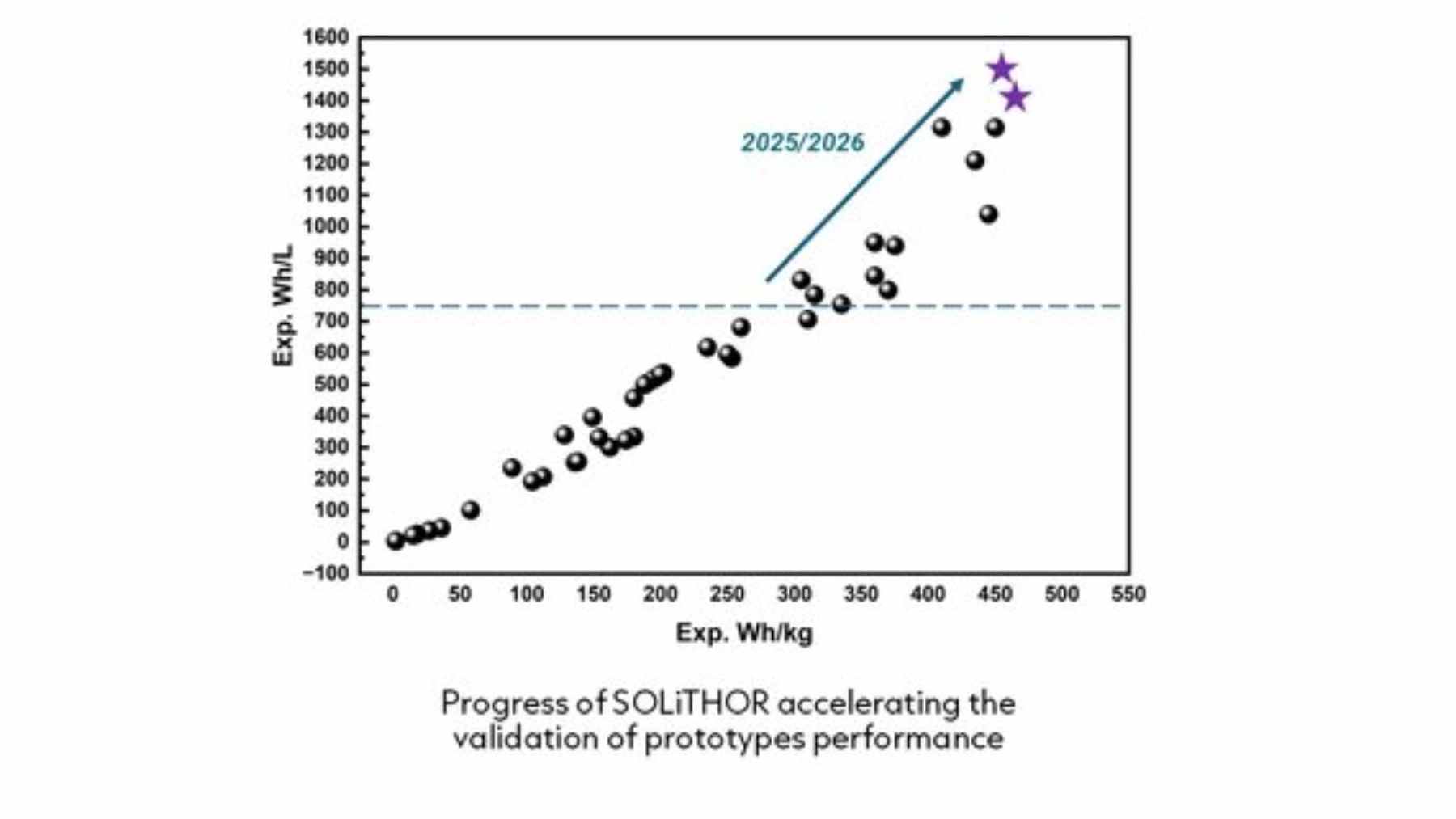
The headline number is hard to ignore. SOLiTHOR reports 465 watt-hours per kilogram, equal to 211 watt-hours per pound, and 1,400 watt-hours per liter, equal to roughly 5,300 watt-hours per gallon, at stack level in a pouch design.
That does not mean electric aircraft will flood the skies next year, but it does point to a cleaner-energy path for sectors that still depend heavily on fossil fuels and tight safety margins.
A bigger cell with big ambitions
SOLiTHOR’s new 10 Ah demonstration cell matters because scale is where many battery promises stumble. A chemistry that works in a small lab sample can behave differently once engineers build it into a larger multilayer pouch cell, with more material, more heat, and more manufacturing complexity.
The company says the result came from pairing its proprietary Solid Composite Electrolyte with a high-loading cathode. That cathode has an areal capacity of 8 mAh/cm², or about 51.6 mAh/in², which is one of the key pieces behind the reported energy density.
Unlike liquid-filled lithium-ion cells or some semi-solid approaches, SOLiTHOR uses a sol-gel chemistry that does not require liquid electrolyte filling. “SOLiTHOR has developed a chemistry that allows the industry to rethink the manufacturing of solid-state battery cells,” said Dr. Fanny Bardé, the company’s co-founder and chief technology officer.
Why drones and defense care
At 77°F, SOLiTHOR says its multilayer pouch cells demonstrated continuous discharge rates of up to 5C with minimal capacity loss. In plain English, that figure describes how fast a battery can deliver power relative to its capacity.
That matters when an unmanned aerial vehicle needs a hard burst during takeoff or landing, not just steady power during cruise. Anyone who has watched a small drone fight the wind knows the point. Sometimes, the battery has to respond right now.
The cells also handled 10C pulses for 30 seconds at 50% state of charge, according to the company. In defense, emergency response, or maritime inspection work, those seconds can decide whether equipment climbs, maneuvers, or keeps a sensor package running.
Still, these are prototype and company-reported results, not proof of mass deployment capability.
The safety question
Energy density is attractive, but high-energy cells need to be safe enough for tight spaces and harsh operating conditions. SOLiTHOR says fully charged multilayer cells passed overcharge and nail penetration tests with no smoke, leakage, thermal runaway, or fire.
That safety claim is especially relevant for aircraft, underwater systems, ships, and military equipment, where a battery failure can be more than an inconvenience. In those environments, fire risk and reliability often matter more than range.
The cycle-life figure is important, too. Smaller 1 Ah multilayer pouch cells completed more than 500 full discharge cycles while retaining more than 80% of their original capacity. For operators, that kind of durability could mean fewer replacements, less downtime, and less battery waste over time.
A climate angle beyond electric cars
For most people, batteries mean phones or cars. But the tougher environmental challenge is often found in machines we do not see every day, such as aircraft, vessels, military platforms, port equipment, and specialized transport systems.
SOLiTHOR’s target sectors overlap with some of those hard-to-clean parts of transportation. The International Energy Agency says aviation accounted for 2.5% of global energy-related CO2 emissions in 2023, while international shipping made up about 2% in 2022.
Those numbers may sound modest, but the sectors are technically stubborn because long trips, heavy loads, and strict safety requirements leave little room for weak batteries.
If a lighter, safer battery can extend drone range, help electrify harbor craft, or reduce fuel use in support systems, the environmental gain will come one application at a time. Not flashy, maybe, but real.
Manufacturing may be the hidden story
SOLiTHOR says its process is compatible with roll-to-roll systems already common in battery manufacturing. It also skips liquid electrolyte filling and shortens formation and aging steps by two-thirds, and those steps can represent up to 25% of current processing costs.
That matters for business as much as climate. A battery that needs an entirely new factory can struggle even if the chemistry is promising, while one that can upgrade existing lithium-ion lines with limited switching costs has a smoother route to market.
The company also says its Solid Composite Electrolyte can be produced with materials widely available at European scale. That gives the announcement a strategic edge, especially as Europe tries to reduce dependence on outside battery supply chains and build more industrial resilience.
What has to happen next
The 10 Ah cell is a milestone, not a finished revolution. SOLiTHOR still has to validate the technology with partners, prove repeatable manufacturing, and show that the performance holds up under real operating conditions.
The company says it is expanding its partner work and has received its first defense funding through the DEEP-TECH project, supported by the European Defense Fund, to advance Europe’s deep-sea autonomy. That connection helps explain why defense, maritime, and dual-use applications are near the front of the line.
For readers, the important point is not that one press release solves aviation or shipping emissions, it is that battery innovation is moving into places where electrification has been difficult, expensive, or too risky. The trouble is, the clock is moving faster than politics.
The press release was published on SOLiTHOR.