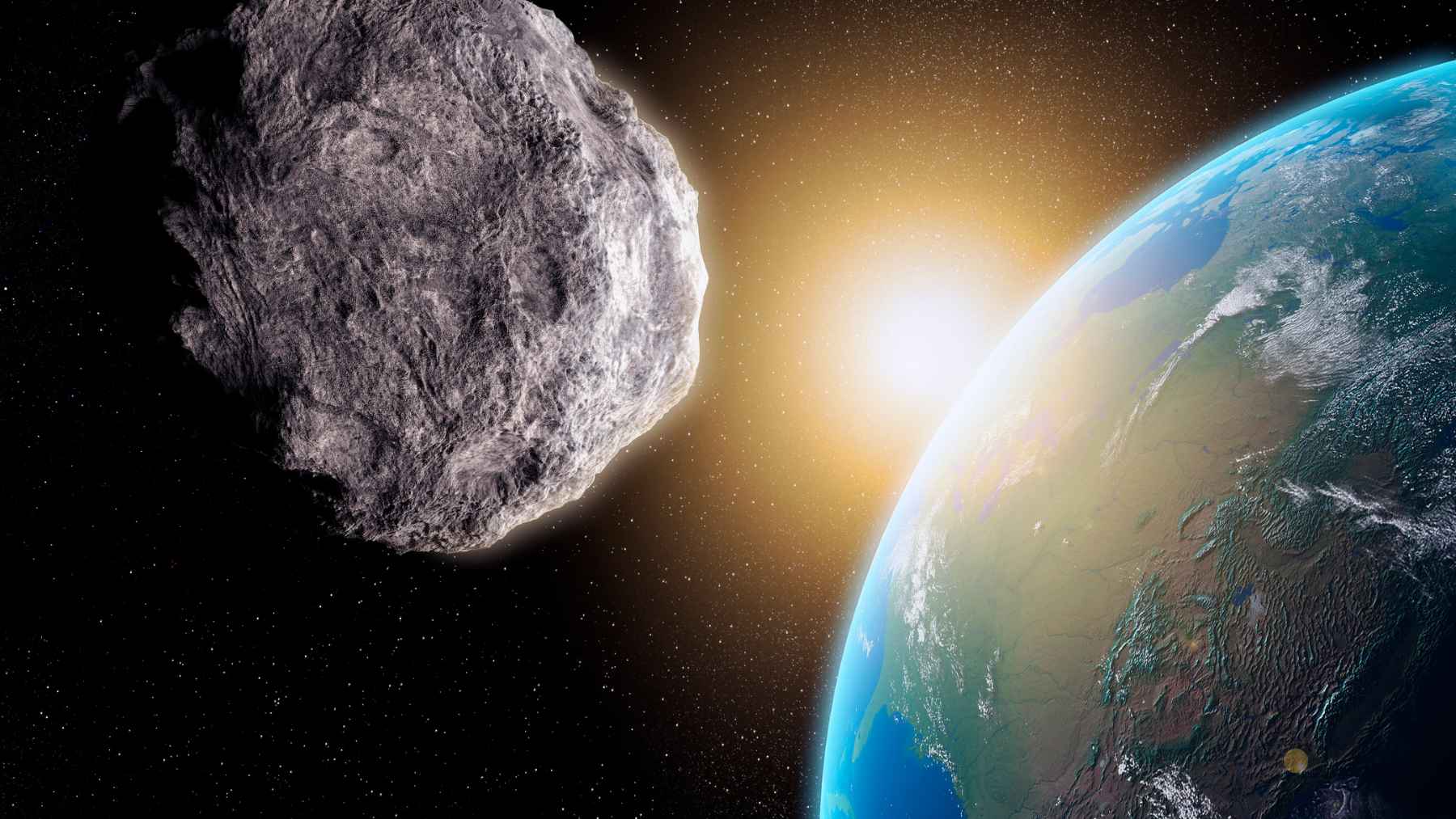
China is studying a planetary defense test that would send a spacecraft into a small near-Earth asteroid at more than 5.6 miles per second. The proposed target, 2015 XF261, is thought to be roughly 100 feet wide and could be struck during a 2029 or 2030 approach about 4.3 million miles from Earth.
A second spacecraft would inspect the rock before the collision and remain nearby to measure what changed afterward. This is a demonstration mission rather than a response to an announced impact warning, and the target is still provisional, but the test could give China an end-to-end rehearsal for finding, hitting, and safely tracking a future threat.
A planetary defense rehearsal
At first glance, the idea sounds simple. A kinetic impactor does not need to blow up an asteroid, since its job is to transfer momentum by crashing into the object and slightly changing its speed.
Given enough warning time, that tiny nudge can grow into a large miss distance as the asteroid continues around the Sun. Chinese sources summarize the mission standard as “hit accurately, push effectively, measure precisely and explain clearly.”
That last part matters. A bright plume may look impressive on a screen, but planetary defense only works when scientists can calculate the new orbit and show that Earth remains safely out of the way.
How it differs from NASA’s DART
NASA proved the basic kinetic-impact idea on Sept. 26, 2022, when its DART spacecraft struck Dimorphos at about 3.8 miles per second. Dimorphos is a 525-foot moonlet orbiting the larger asteroid Didymos, and the collision shortened its orbital period by roughly 32 minutes.
The proposed Chinese mission would tackle a different kind of test. Rather than using a well-observed binary asteroid as a convenient celestial clock, researchers want to hit a smaller and less understood object, then measure how its path changes around the Sun and relative to Earth.
That could make the experiment more representative of a real warning scenario. It also makes almost every part of the job harder.
A target with many unknowns
Asteroid 2015 XF261 was discovered by the Pan-STARRS survey in December 2015 and circles the Sun in about 359.9 days. A Chinese mission study calculated a nominal diameter of about 116 feet, although the plausible estimate ranged from roughly 79 to 276 feet because its reflectivity is not yet well known.
Why such a broad range? A dark asteroid can be much larger than a bright one while reflecting the same small amount of sunlight toward a telescope.
The environmental stakes are not abstract, since a June 2026 Chinese briefing said the roughly 164-foot object linked to the 1908 Tunguska airburst flattened more than 770 square miles of Siberian forest and warned that smaller near-Earth objects are harder to detect.
Scientists also lack firm measurements of 2015 XF261’s shape, rotation, composition, density, and internal structure. Those details are not trivia, since a solid rock and a loose “rubble pile” can respond very differently to the same collision.
Two spacecraft will split the work
Published mission studies describe an observer and an impactor launching together before 2030. The observer would reach the asteroid first and spend about three to six months flying alongside it or circling it, while the impactor would arrive later for the high-speed strike.
After the collision, the observer could continue watching for another six to 12 months. Its job would be to compare the asteroid’s shape, surface, rotation, and orbit before and after impact, while also tracking the crater and the material thrown into space.
The proposed instrument package includes a color camera, an imaging spectrometer with laser mapping, penetrating radar, and dust and particle sensors. The mission would examine both the outside of the asteroid and clues about what is hidden beneath its surface.
The real challenge is aiming
Calling the impact “Mach 26” makes for a striking comparison, but Mach is tied to the speed of sound in an atmosphere. Deep space has no air and therefore no local speed of sound, so the more useful figure is over 5.6 miles every second.
At the reported encounter distance, radio commands would take tens of seconds to travel between Earth and the spacecraft. That is far too slow for a human controller to steer through the final moments, which means the impactor must identify a faint, irregular, rotating target and guide itself.
Think of trying to hit a tumbling pebble in darkness after throwing the ball from another continent. The real version is less forgiving, since one small navigation error could turn years of work into a clean miss.
Impact does not always mean success
The collision’s outcome will depend heavily on what 2015 XF261 is made of and how tightly it is held together. Research papers say a hypervelocity strike could excavate a crater, release a cloud of debris, alter the orbit, deform the body, or under extreme conditions, cause structural breakup.
Breaking the object apart would not automatically answer the safety question. Researchers would still need to measure the motion of the remaining body and any significant fragments, then confirm that the experiment had not created a more complicated tracking problem.
Simulations reported by Chinese sources modeled an impactor weighing about 1,280 pounds and traveling near 5.8 miles per second. They indicated that a measurable deflection should be possible, but the predicted result changed with assumptions about composition and how efficiently the collision transferred momentum.
What the mission would really prove
Planetary defense is not one dramatic impact. It is a chain that begins with detection and continues through characterization, autonomous navigation, collision, follow-up observation, and a reliable prediction of where the asteroid will go next. At the largest scale, that is environmental protection for ecosystems, communities, and critical infrastructure.
The mission could also turn a defense experiment into a science laboratory. Chinese researchers describe kinetic impact as a “natural experiment” that could reveal an asteroid’s internal structure, composition, and mechanical behavior while improving future deflection models.
For readers, the key point is the difference between a serious research program and a launch-ready mission. China is working toward a demonstration before 2030, but the target, route, and timing may still change.
The latest scientific review of China’s planned demonstration was published in the Journal of Deep Space Exploration.