China has publicly demonstrated a fixed-wing drone launching from an electromagnetic track assembled from three eight-wheeled trucks. The footage provides the first public evidence of a land-based launch, turning technology normally associated with giant carrier decks into a mobile system that can arrive as a convoy and build its own short launch lane.
The bigger story is not just the catapult. Beijing Institute of Technology linked it to a wider family of containerized military modules, although the much-repeated target of 2,000 units applies to that broader family rather than 2,000 electromagnetic launchers alone.
A runway built from trucks
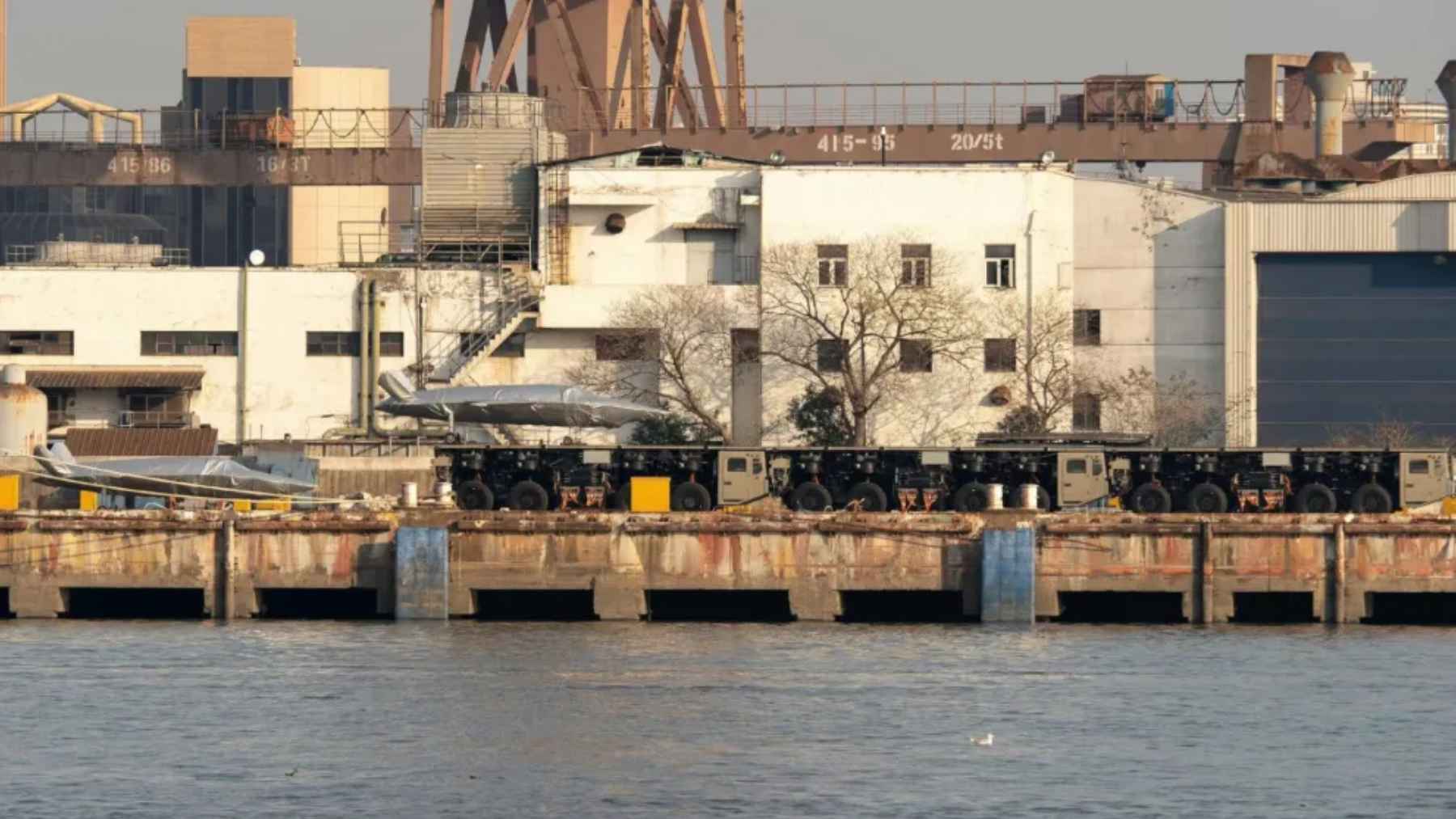
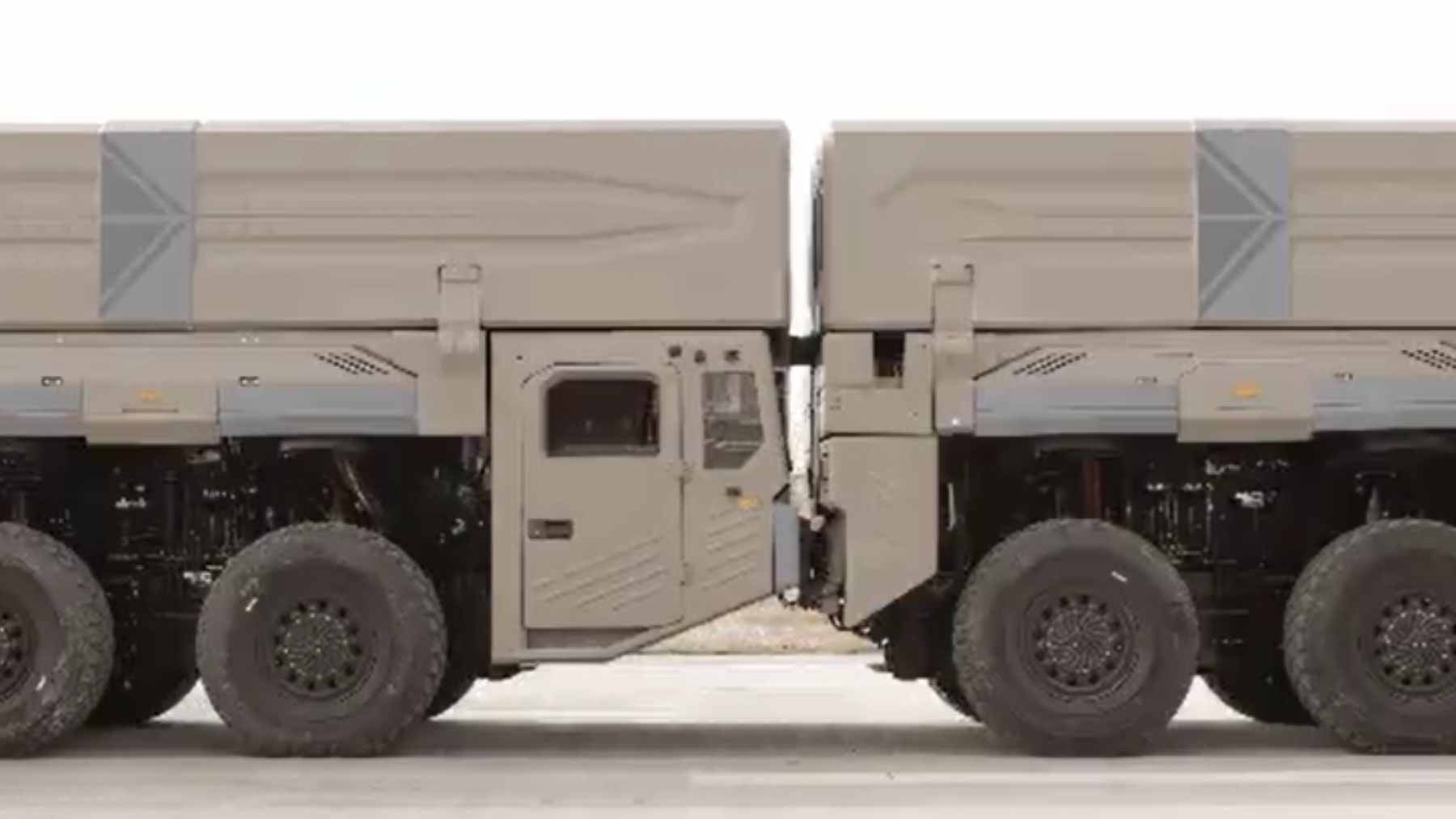
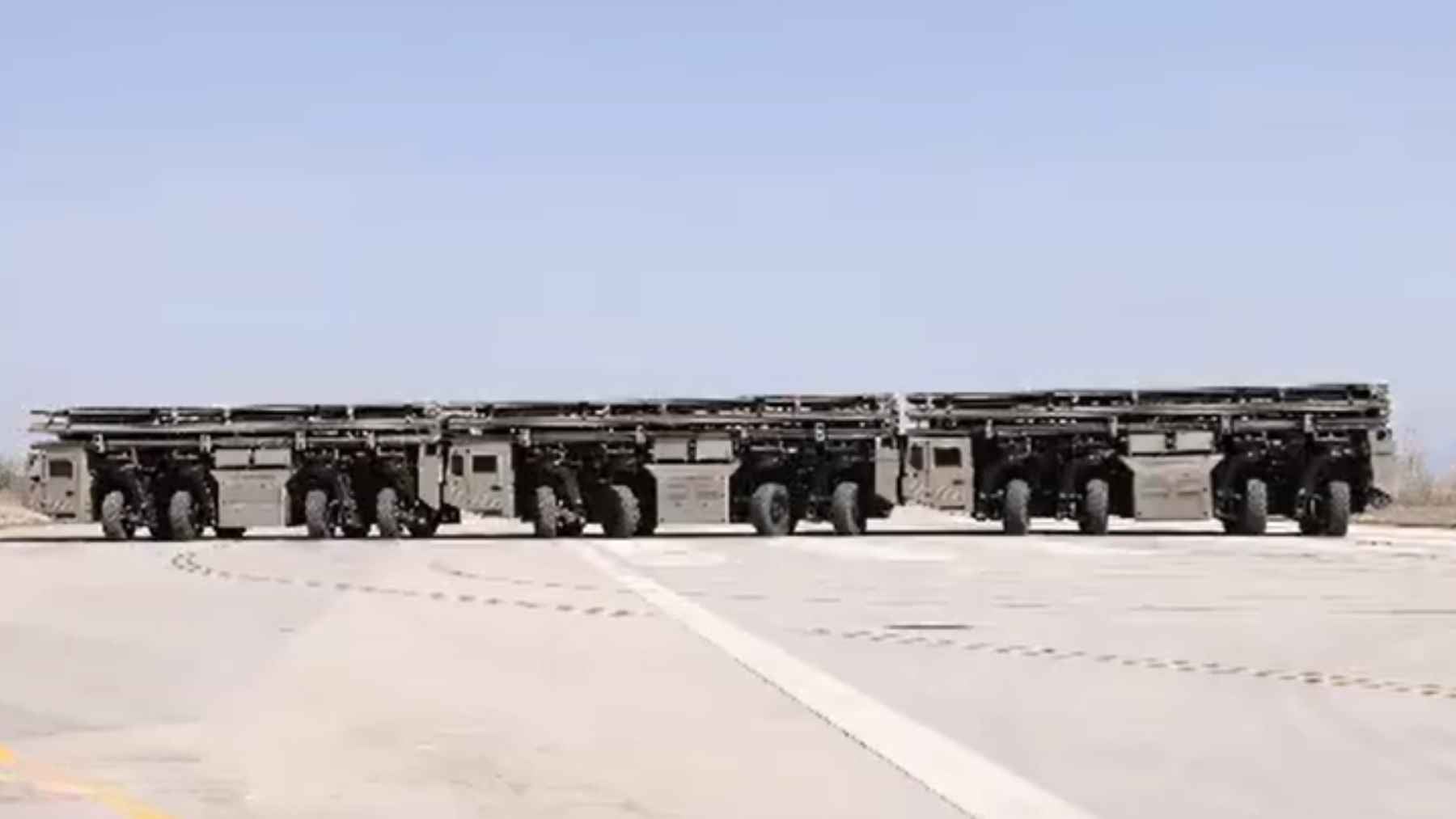
The video shows three flat-topped vehicles traveling separately, lining up, and connecting through mechanical couplings. Once joined, they form a continuous rail that accelerates a propeller-driven drone until it can climb away without completing a conventional runway takeoff.
The linked trucks can also turn together in a tight circle using all-wheel steering. In practical terms, that lets operators point the launcher into the wind, much like someone shifting a patio umbrella before a gust, while covers on top appear intended to protect the equipment during transit.
How the electric catapult works
Think of the system as an extremely powerful electric slingshot. Instead of relying on steam pressure, electromagnetic force pulls a launch shuttle along a rail, with computer controls shaping the acceleration for the aircraft attached to it.
The U.S. Navy says its carrier-based EMALS uses stored kinetic energy and solid-state electrical power conversion, allowing “a high degree of computer control, monitoring and automation.”
It is designed to handle aircraft ranging from lightweight unmanned platforms to heavy strike fighters, with smoother acceleration and more precise end-speed control than older steam catapults.
The United States operates the technology aboard USS Gerald R. Ford, while China commissioned the carrier Fujian with electromagnetic catapults in November 2025. The truck system uses the same broad launch principle, but the public demonstration does not show anything close to a carrier fighter taking off.
What Beijing actually revealed
The deleted June 30 post from a Beijing Institute of Technology school account described a modular equipment family involving more than 70 organizations. The list included electromagnetic launch equipment, drones, missile systems, radar, electronic warfare, command and control, and underwater systems intended for land and maritime platforms.
The developers presented the concept as “plug and play” equipment and set an annual target of 2,000 modules across the family. The post did not announce a People’s Liberation Army order, a current production rate, or fielding with an operational unit. A target is not the same as a contract.
What the video does not prove
The drone’s model, weight, payload, launch speed, and mission were not disclosed. Earlier images showed the trucks beside stealthy aircraft resembling collaborative combat aircraft, but analysts assessed that those airframes were probably mockups, so the new launch cannot be treated as proof that the system handles heavier combat drones.
A separate Chinese company, Tiantao Technology, has discussed a modular concept for drones weighing up to about 4,400 lbs. The War Zone (TWZ) notes that its design looks different from the Beijing Institute of Technology demonstrator and that any relationship between the projects remains unclear.
The footage also shows a launch on land, not at sea. Public information does not answer how the trucks would stay aligned on a moving deck, how quickly another drone could be loaded, where returning aircraft would land, or how the system would perform in rough weather. For now, the evidence stops at a convincing ground demonstration.
Why the concept matters
A mobile catapult could let forces disperse fixed-wing drones instead of concentrating them at a few visible airfields. The trucks could move closer to an operating area, launch from a sufficiently flat prepared site, and separate again, making the equipment harder to locate while allowing shorter-range drones to spend more time near their mission area.
Mobility moves the problem rather than erasing it, though. Operators would still need suitable ground, electrical power, maintenance crews, secure communications, spare drones, fuel or batteries for the aircraft, and a way to recover them after flight. A runway on wheels is still a logistics chain.
The hidden environmental bill
Electric launch does not automatically mean a low-impact system. Beijing Institute of Technology did not disclose the launcher’s energy source, storage capacity, electricity used per launch, generator fuel consumption, battery chemistry, or maintenance cycle, while TWZ also identified the power and logistics footprint as an open question.
In principle, mobile launchers might reduce the need to build a full permanent runway at every temporary operating site. On the other hand, heavy trucks, power equipment, transport, batteries, and repeated movement all carry environmental costs, and no lifecycle comparison was included in the public material. The electric rail is only one piece of the footprint.
Scale is the real test
The most ambitious part of the project may be its standardization. A common container-sized architecture could allow different factories and suppliers to produce interchangeable launch, sensing, communications, and support equipment, which is why the 2,000-module target deserves attention even though it remains unverified as actual output.
What should readers watch next? Formal procurement notices, appearances in People’s Liberation Army exercises, repeated launches with identified drones, disclosed power requirements, and a genuine test from a ship would do far more to establish military readiness than one polished video.
The demonstration is real, but its value will depend on the unglamorous details of power, reloads, recovery, reliability, and cost.
The official statement was published on BIT Mechanical Vehicle New Youth.