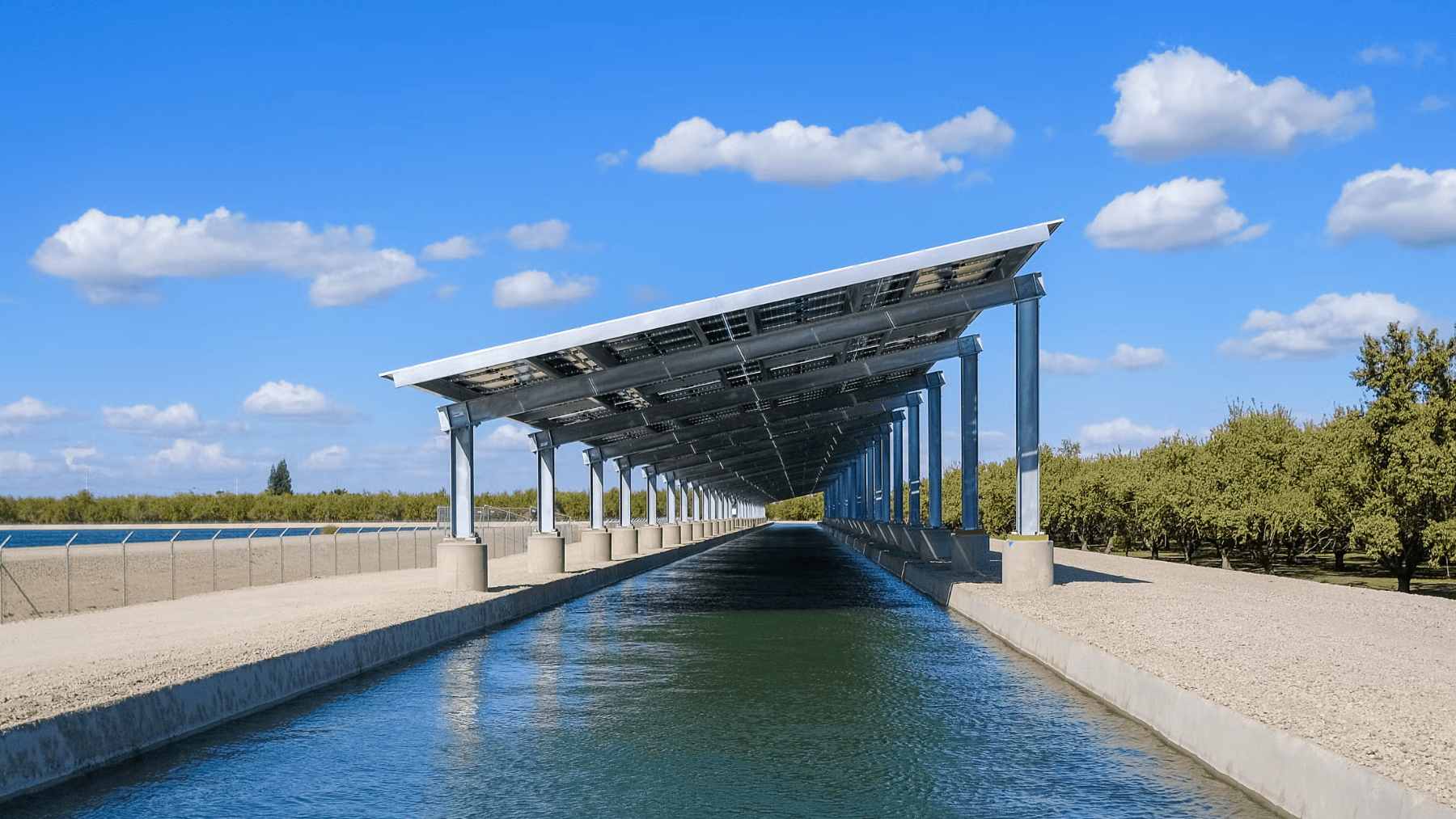
California has tested a simple idea with surprisingly big implications. Instead of clearing more land for solar farms, the state covered sections of working irrigation canals with solar panels, producing clean electricity while shading the water below.
The early numbers are what make Project Nexus worth watching. UC Merced says the shaded canals saw up to 70% less evaporation and 85% less weed growth, turning a small pilot near Modesto into a real-world test of how water, land, and power can work together.
A solar roof over water
Project Nexus sits on canals operated by the Turlock Irrigation District in California’s Central Valley. The $20 million pilot brings together the California Department of Water Resources, Turlock Irrigation District, Solar AquaGrid, and UC Merced.
The concept sounds almost too neat: put solar panels over infrastructure that already exists, generate power, reduce evaporation, and avoid taking up farmland or habitat that could be used for something else.
California marked the project’s completion in April 2026, though Turlock Irrigation District says both locations were completed and commissioned by August 2025. That timing matters because researchers are now moving from theory to measured results.
The first results
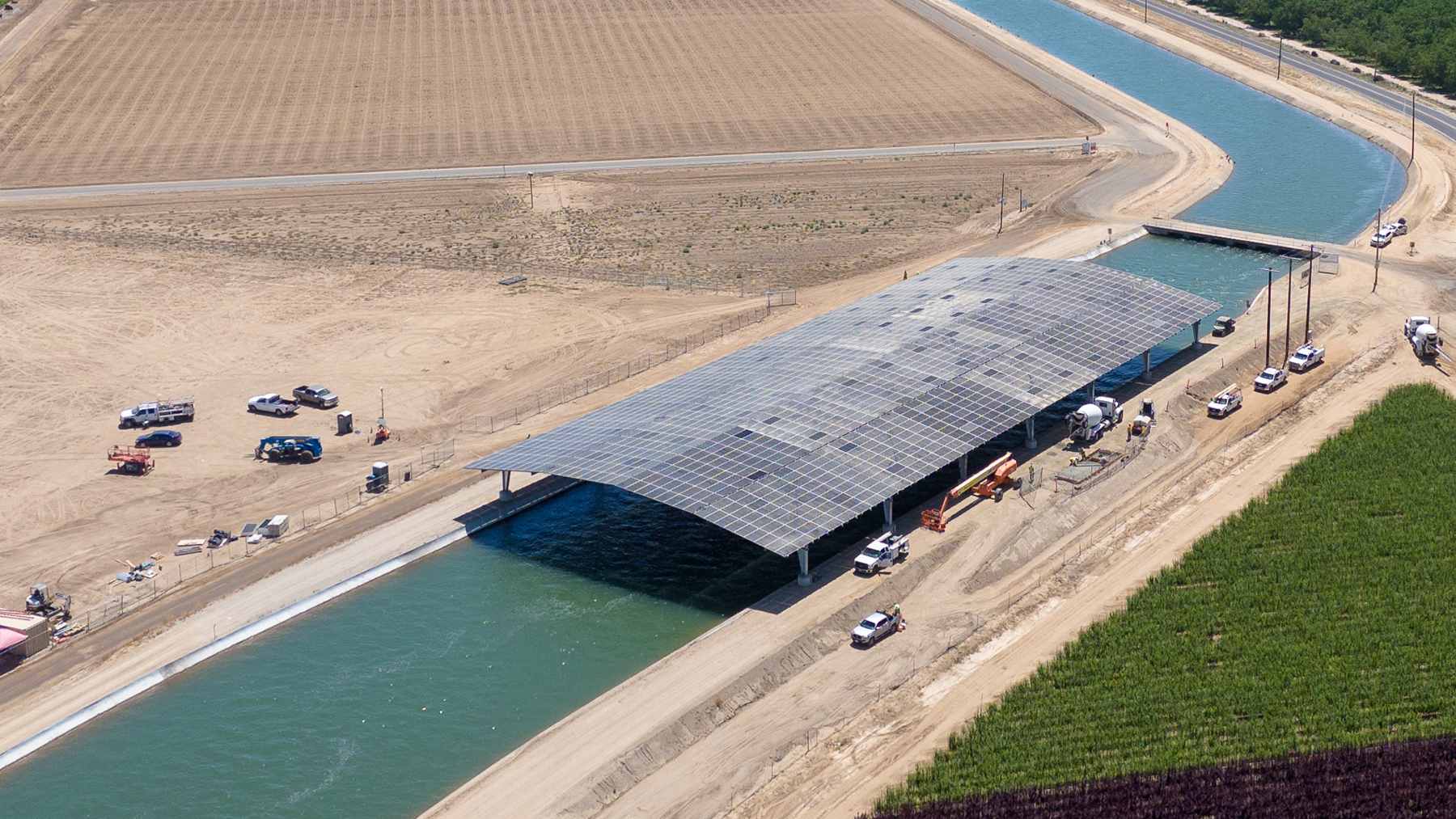
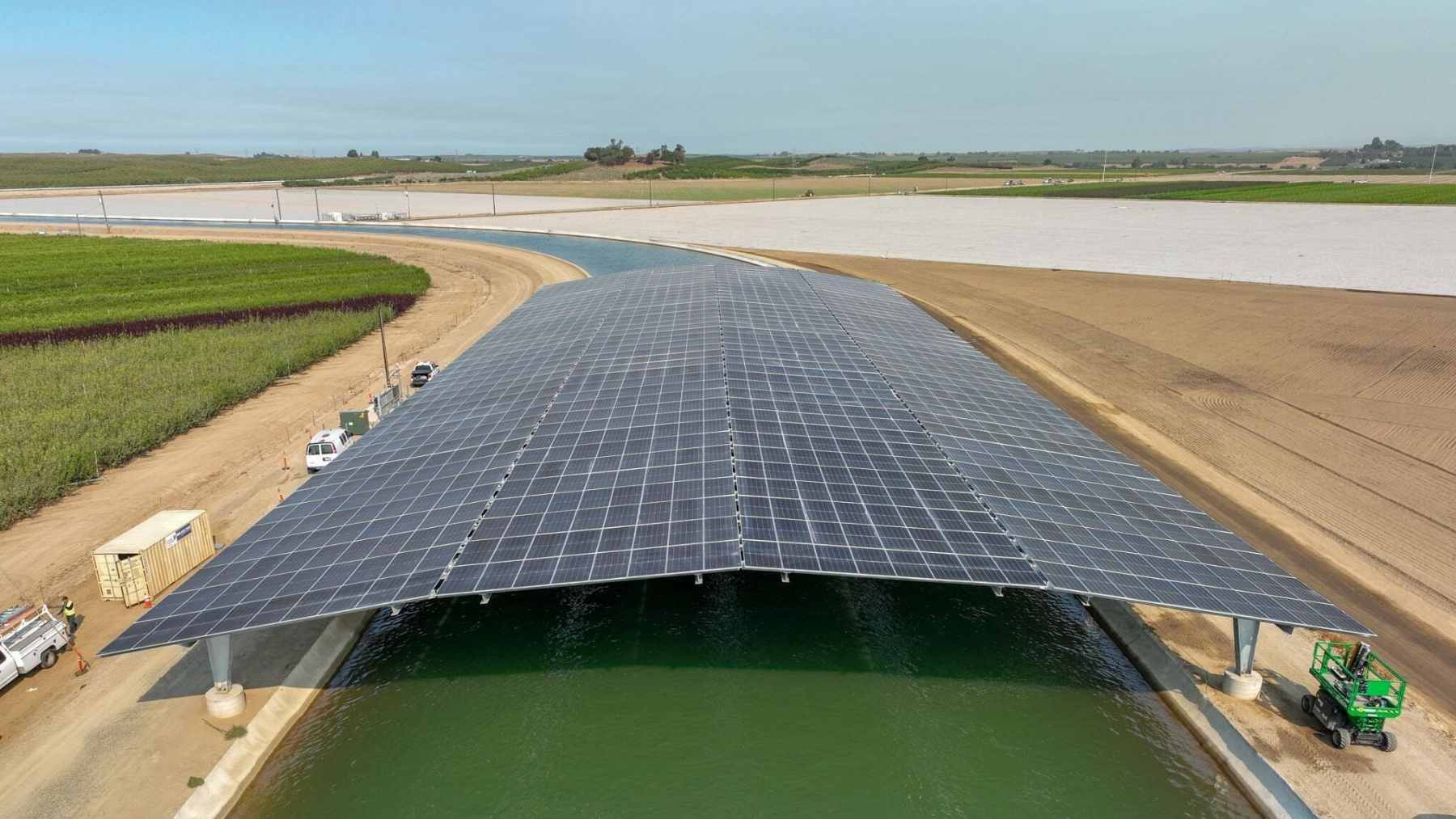
The pilot includes two different canal spans, one about 20 ft. wide and another about 110 ft. wide. Together, the installations provide more than 1.6 megawatts of renewable power generation, with a 75 kilowatt iron-flow battery included at the narrow-span site.
That is not a huge power plant. In practical terms, Project Nexus is more like a test bench sitting over moving water, built to answer a bigger question for California and other dry regions.
So far, the water results are the headline. According to UC Merced, early monitoring has shown significantly less evaporation and weed growth in the shaded canal sections.
Why the shade matters
In a hot farming region, water can disappear before it reaches a crop, a neighborhood, or a city tap. Shade slows that loss, and it also blocks some of the sunlight that aquatic weeds and algae need to grow.
That second benefit may sound less exciting than saving water, but canal maintenance is a real cost. If fewer weeds grow, districts may spend less time and money clearing canals and keeping water moving.
There is also a quiet energy bonus. Solar panels generally work better when they stay cooler, and water underneath the array can help soften the heat that panels face on exposed land.
Not the first idea
California can fairly call Project Nexus a first for the state. It is not, however, the first time anyone has put solar panels over a canal.
UC notes that India already had solar-over-canal systems in place when California researchers were studying the idea. Closer to home, the Gila River Indian Community in Arizona began generating power from a solar-over-canals project in 2024, with federal officials calling it the first completed pilot of its kind.
That does not make California’s test unimportant. The difference is scale. California has roughly 4,000 miles of exposed canals, which turns a clever local project into a possible statewide infrastructure strategy.
The bigger prize
The numbers behind the idea come from a 2021 UC Merced study published in Nature Sustainability. Researchers modeled what could happen if solar panels covered California’s canal network, which the paper described as 3,950 miles long.
Turlock Irrigation District says that study estimated annual savings of 63 billion gallons of water if all the 4,000 miles of public water delivery infrastructure were covered. That would be enough to irrigate 50,000 acres of farmland or meet the residential water needs of more than 2 million people.
The energy side is just as striking. Researchers estimated that covering the state’s canals with solar could generate about 13 gigawatts of power, making the canal system look less like a passive water channel and more like a long, narrow clean-energy platform.
The cost question
There is the catch, however. Building solar over canals is more complicated than putting panels on flat desert land, because the structures must span water, allow maintenance access, and survive real operating conditions.
That is why the next decision is not just environmental, it is financial. Irrigation districts will have to compare the higher construction cost with the value of saved water, preserved land, extra power, and reduced canal maintenance.
Roger Bales, a UC Merced professor emeritus, described the project as a search for a “triple win” involving water, energy, and land. But he also put the next step in plain terms, saying the goal is to build the “right solar over the right canals.”
What happens next
Project Nexus is small, but that is the point. California is using it to find out where solar canals make sense, where they do not, and whether the math works once real data replaces a spreadsheet.
At the end of the day, this is not just about two covered canals near Modesto. It is about whether states facing heat, drought, land pressure, and rising electricity demand can make old infrastructure do a second job.
The panels are already in place, the first results are promising, and the next phase will depend on whether the economics hold up.
The official statement was published on the California Governor’s Office website.