China is building a massive solar corridor across the Kubuqi Desert, a sandy stretch of Inner Mongolia once nicknamed the “sea of death.” The project is planned to run about 250 miles long and 3 miles wide, with a maximum generating capacity of 100 gigawatts once completed around 2030.
That is the headline, but the bigger story is not just the size of the solar panels. It is what China is trying to prove in a harsh desert landscape, where energy production, land restoration, industrial planning, and climate strategy are all being packed into one very visible project.
A wall made of sunlight
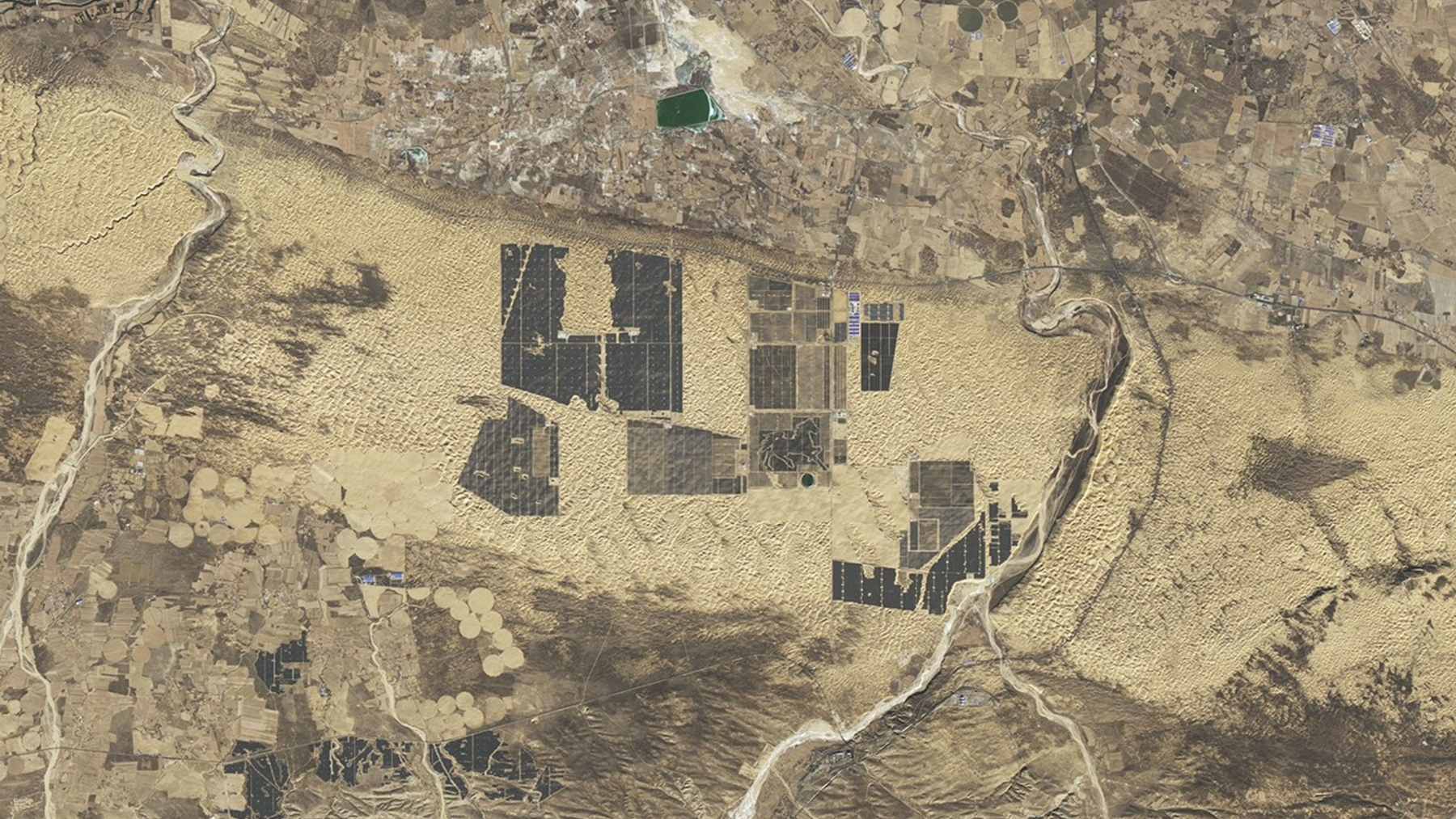
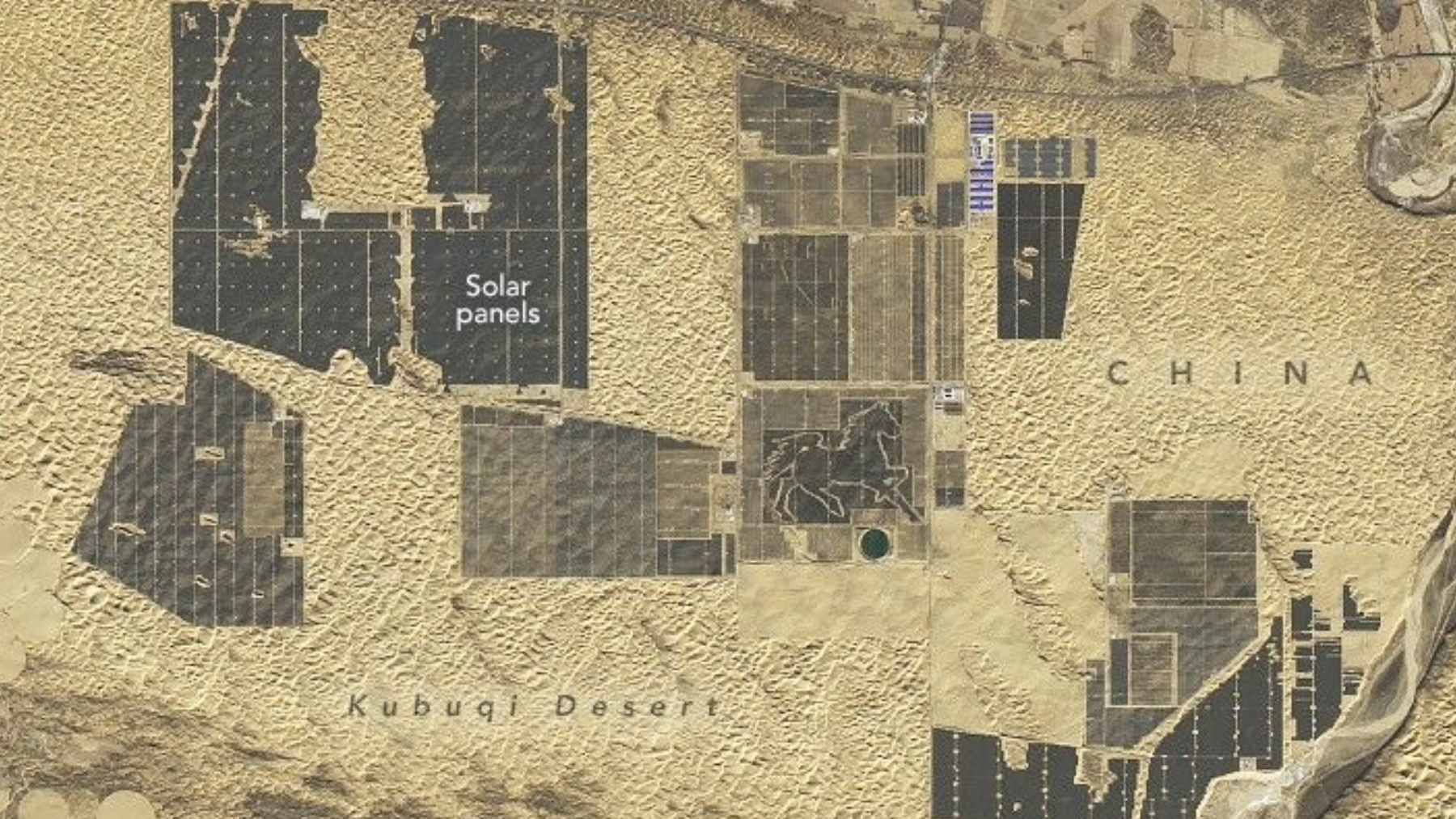
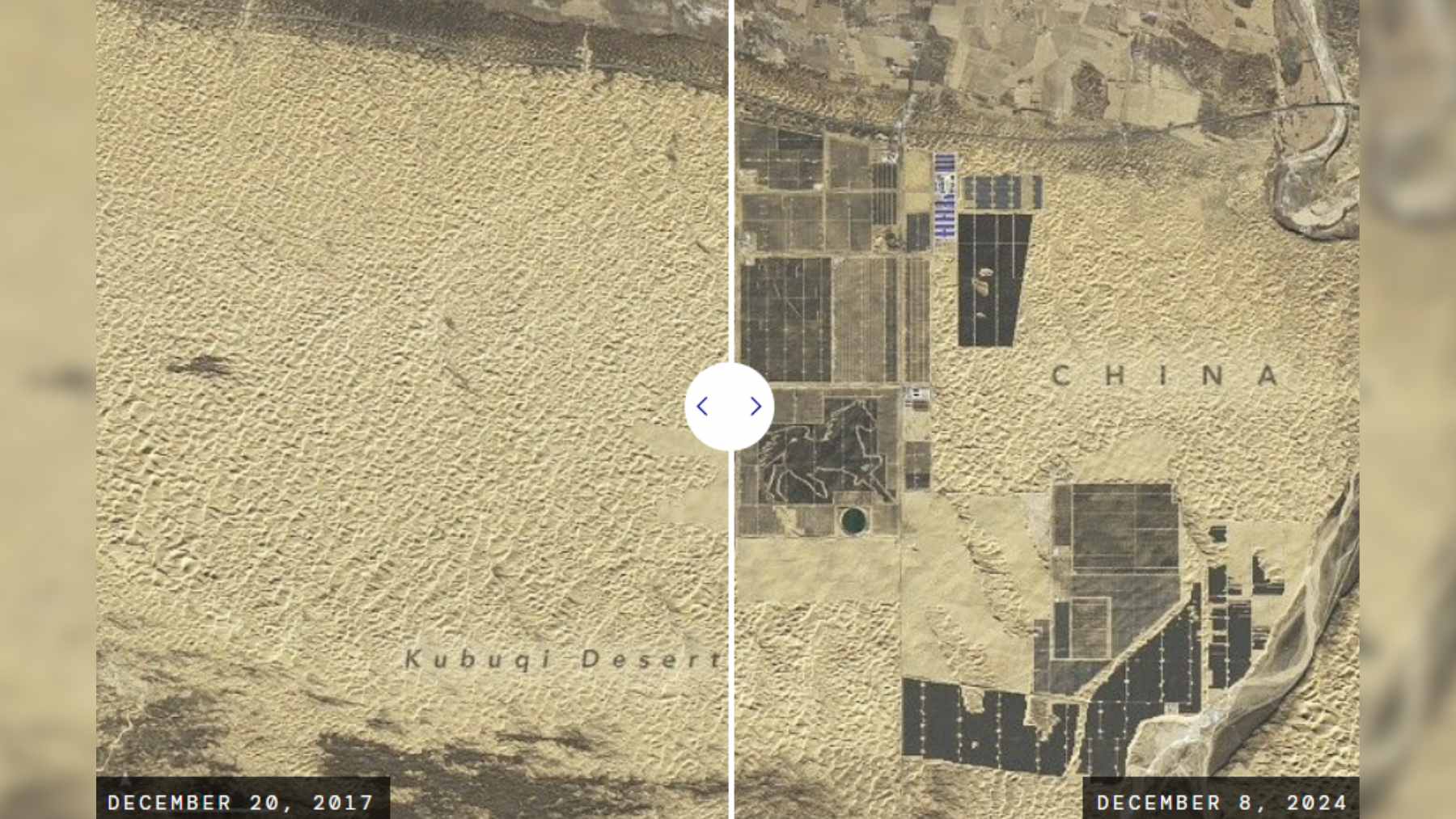
The so-called “Solar Great Wall” is being built in a long band of dunes south of the Yellow River, between Baotou and Bayannur. NASA’s Earth Observatory says Landsat images from December 2017 and December 2024 show a clear expansion of solar farms across the Kubuqi Desert.
For now, the project is still far from finished. Chinese officials reported about 5.4 gigawatts installed so far, a major amount by most standards, but still only a small share of the 100-gigawatt target. In practical terms, this is less a finished wall and more a fast-growing energy corridor.
Why put so many panels there? The answer is simple enough. The Kubuqi Desert has strong sunlight, flat land, and proximity to industrial centers, which makes it attractive for large-scale solar power. Sometimes geography does the first half of the engineering work.
Enough power for Beijing
By 2030, local authorities say the wider project could generate about 180 billion kilowatt-hours of electricity per year. That would be more than Beijing’s reported annual electricity consumption of 135.8 billion kilowatt-hours, according to China Daily’s report on the Ordos energy administration.
That comparison explains why the project has grabbed attention. Beijing has roughly 22 million people, and powering a city of that size is not a small promise. Still, readers should keep one thing in mind. A solar plant’s maximum capacity is not the same thing as constant output, because sunlight changes by the hour and by season.
That’s where grid technology matters. China is also building ultra-high-voltage transmission lines to move electricity from Inner Mongolia toward the Beijing-Tianjin-Hebei region. Without that kind of infrastructure, even the biggest solar farm can become a stranded asset.
Fighting sand with panels
The Kubuqi project is also being framed as an environmental repair effort. Solar panels can act as windbreaks, help hold sand in place, and create shade that slows soil moisture evaporation. Local officials say crops will also be planted under some panels, including on about 5,900 acres in Dalad Banner.
That sounds almost too tidy, doesn’t it? A desert becomes a power plant, and the power plant helps the desert recover. The reality is probably more complicated, but there is a serious ecological idea behind it.
By reducing wind speed and shading the ground, panel arrays can create small protected zones where grasses or commercial crops have a better chance to grow. NASA notes that planners hope the installations can help curb desertification, while satellite-based analysis has linked solar projects to greening in other parts of China in recent years.
The horse in the desert
One of the most striking pieces of the Kubuqi buildout is the Junma Solar Power Station. From above, its 200,000 panels form the image of a galloping horse, a design that earned a Guinness World Record for the largest image made of solar panels.
It is not only there for the photo. NASA says Junma generates roughly 2 billion kilowatt-hours of electricity each year, enough to meet the yearly electricity needs of about 300,000 to 400,000 people. That turns a symbolic image into a working power station.
There is something oddly human about that. In a place once described as empty and lifeless, engineers built a giant horse from solar modules, and then made it produce electricity. It is a showpiece, yes, but also a machine.
China’s solar lead keeps growing
China is not just building one ambitious desert project, it is expanding solar and wind at a pace no other country is matching. The International Energy Agency says China commissioned nearly 370 gigawatts of solar PV and 117 gigawatts of wind capacity in 2025, accounting for more than 60% of global renewable capacity growth that year.
China’s own National Energy Administration said newly installed solar and wind capacity exceeded 430 million kilowatts in 2025, up 22% from the previous year. It also said the country’s cumulative grid-connected wind and solar capacity reached 1.84 billion kilowatts, surpassing thermal power for the first time.
That gives the Kubuqi project a bigger business meaning. It is not only an environmental showcase. It is part of a national industrial strategy built around solar manufacturing, power transmission, energy security, and the global race to dominate clean technology.
The hard part comes next
For all its scale, the Solar Great Wall still faces familiar renewable-energy challenges. Solar power is variable, and desert megaprojects need long transmission lines, storage, and market rules that make electricity useful when and where people actually need it.
China is already changing those market rules. Reuters reported that China’s top economic planning agency moved in 2025 to scale back some renewable subsidies and shift new projects toward market-based electricity pricing, after a huge boom in wind and solar installations.
That could pressure smaller solar firms, especially in a market already dealing with overcapacity and falling panel prices. Big projects may keep moving, but the economics are becoming less cushioned than before.
In other words, the solar wall is not just being tested by sand and sun, but by money.
A desert becomes a test case
At the end of the day, the Kubuqi project is a glimpse of how the energy transition may look in the places with enough land, sunlight, and state backing to move fast. It is huge, highly planned, and not without risk.
It is very hard to ignore. A desert once known for sandstorms and barren dunes is being turned into a grid-scale energy machine, with hopes that the same panels producing power can also help slow the desert’s spread.
The official Earth Observatory feature was published on NASA Science.