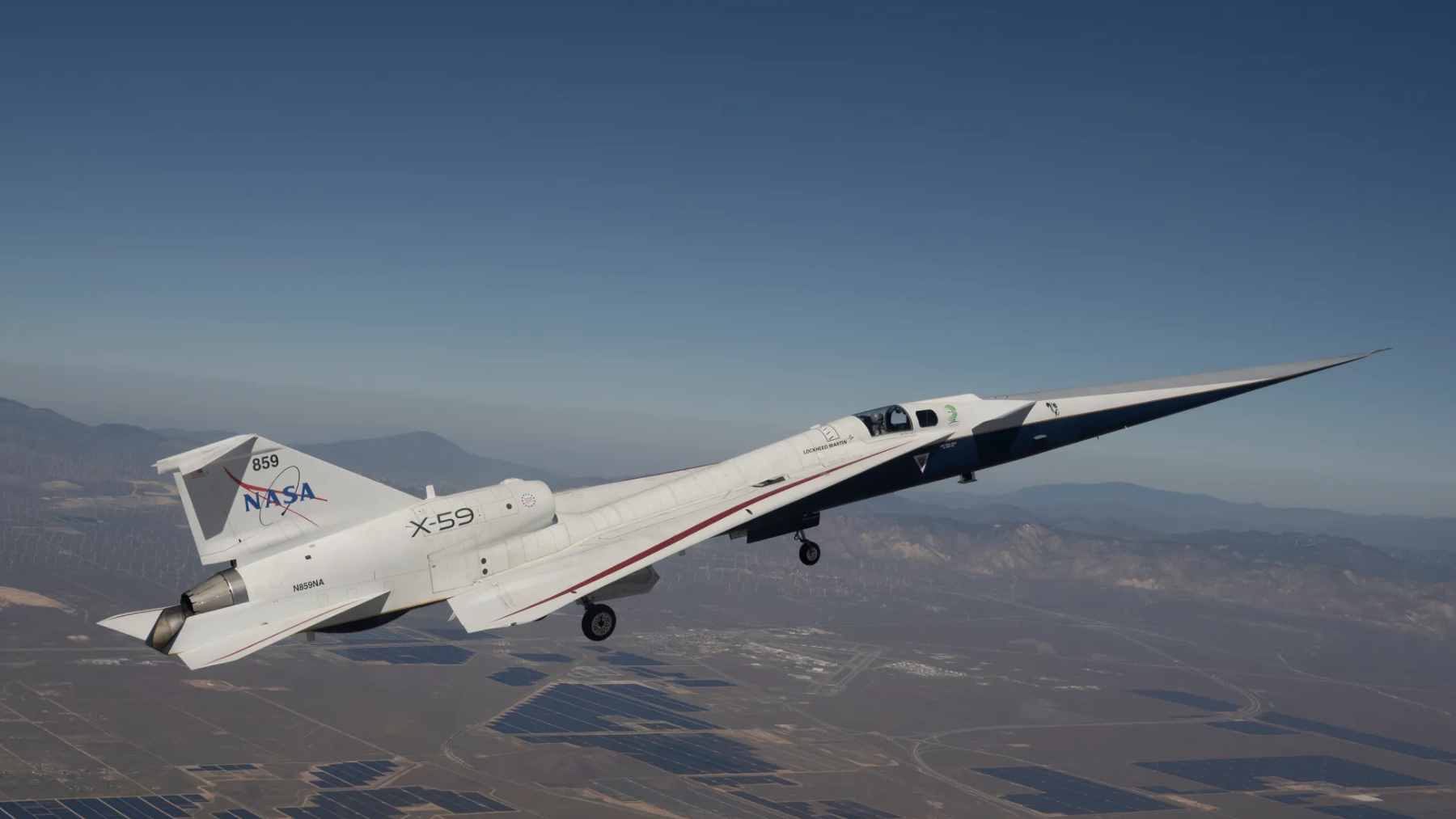
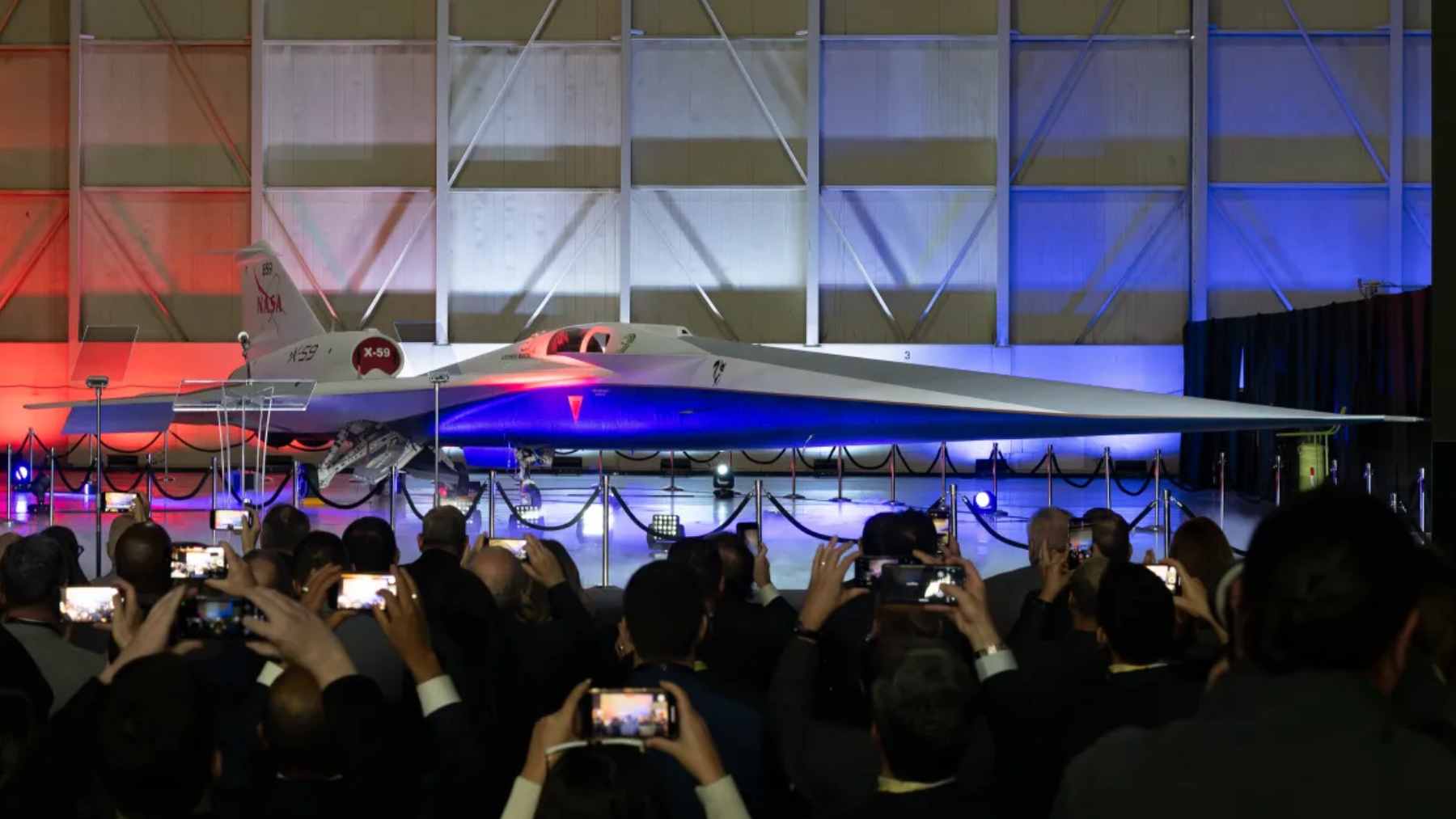
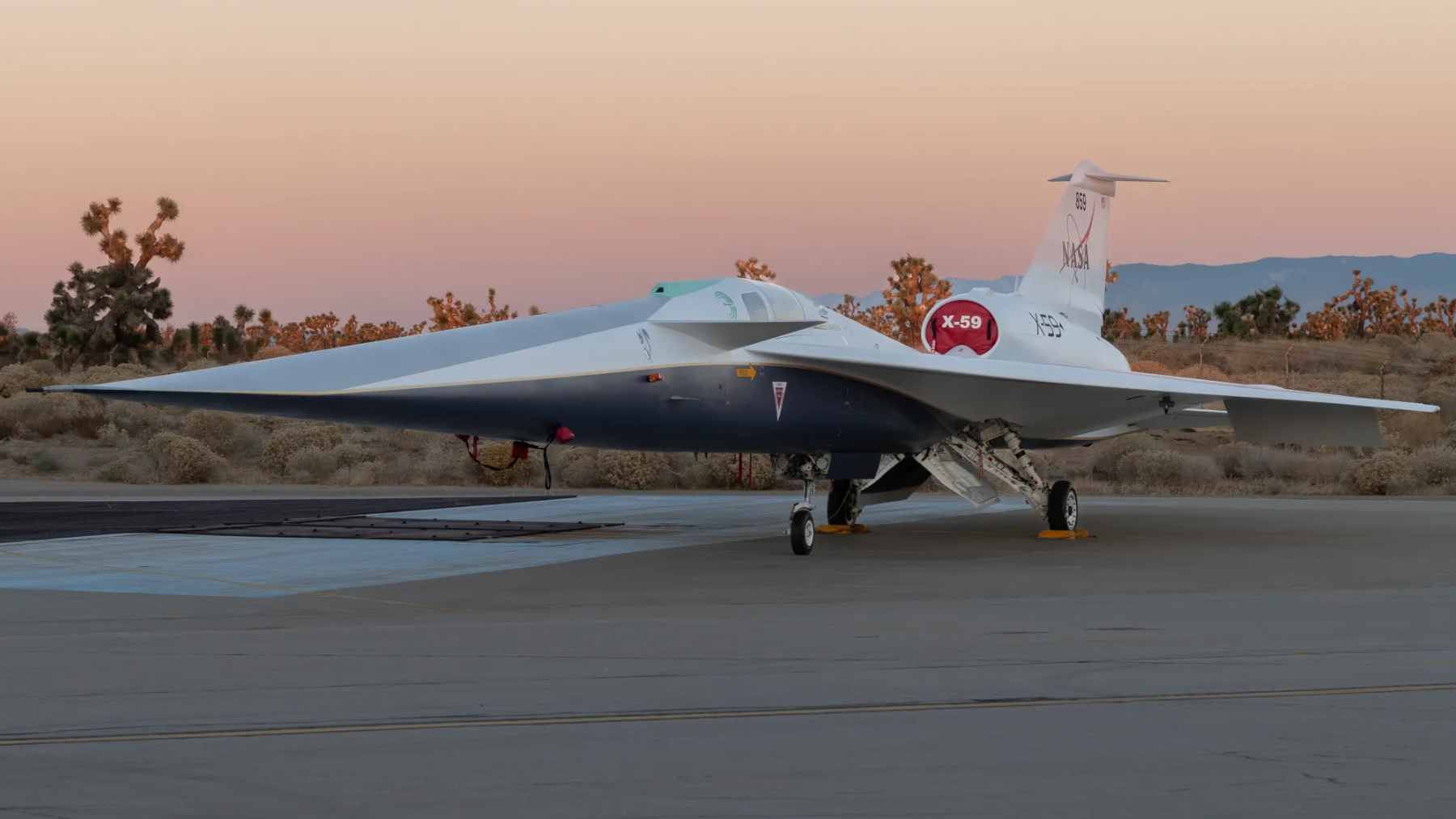
NASA’s experimental X-59 has now flown faster than sound, and the milestone could reshape one of aviation’s loudest problems. On June 5, the needle crossed into supersonic territory for the first time, with test pilot Jim “Clue” Less taking the aircraft to about Mach 1.1, or 713 mph at 43,400 ft. over California.
That would be a big deal on its own. But just days later, NASA said the X-59 reached Mach 1.4, or about 924 mph at 55,000 ft., the speed and altitude it plans to use during future community overflights. In practical terms, the question is no longer only whether the plane can go fast.
It is whether it can do so without turning everyday life below into a rattle of windows, startled pets, and angry phone calls.
A quiet boom
The X-59 is the centerpiece of NASA’s Quesst mission, a program built around a simple but difficult idea. Can a supersonic aircraft cross the sound barrier while producing a soft “thump” instead of the sharp sonic boom that has long made overland supersonic travel a regulatory nightmare?
For the first supersonic flight, the aircraft took off and landed at Edwards Air Force Base in California. NASA said the 81-minute test focused on how the plane handled at subsonic and supersonic speeds, while an F-15 chase plane flew nearby to monitor it.
There is an important catch: the F-15 produced its own loud booms, which masked whatever sound the X-59 made during the early test. So, this was not yet the big noise exam. It is more like checking the engine and steering before inviting the neighbors to listen.
Why this matters
Civil supersonic flight over land is not just a matter of faster planes and wealthy travelers. In the United States, civil aircraft flights above Mach 1 over land are currently prohibited unless they operate under special authorization, according to the FAA.
That rule exists because traditional sonic booms can be disruptive. Anyone who has heard a sudden blast from the sky knows the feeling. It is not just noise, but a startling interruption.
NASA wants to gather data that could help U.S. and international regulators consider new sound-based standards for commercial supersonic flight over land. If the data shows that people find the X-59’s quieter sound acceptable, the business case for future faster-than-sound passenger and cargo aircraft gets a lot stronger.
The next sound test
The June 12 flight was especially important because it matched the target conditions for future community response work. NASA said the aircraft flew Mach 1.4 at 55,000 ft., the approximate profile planned for flights over selected U.S. communities.
Those community flights will be the human test. Residents will be asked what they hear, how noticeable it is, and whether the sound is acceptable as part of daily life.
That is where the environmental angle comes in. The X-59 is not being presented as a climate breakthrough, and NASA has not claimed it solves aviation emissions. Its focus is narrower, but still important. It is aimed at reducing noise pollution from sonic booms, one of the biggest barriers to supersonic flight over land.
What pilots felt
For Less, the first supersonic flight was almost surprisingly calm. NASA’s Quesst blog quoted him saying, “I didn’t feel anything,” adding that the aircraft reached Mach 1.1 smoothly.
That is exactly what engineers want to hear. Experimental aircraft testing is usually about removing drama, not creating it.
Less also gave a small hint of where the team’s mind was heading next. “The plane wants to go faster,” he said after the early supersonic milestone. A week later, the X-59 did just that, reaching the mission speed and altitude NASA had been targeting.
Built for regulators
The X-59 is not a commercial airliner. It is a research aircraft, and its job is to collect evidence.
NASA plans to share the community noise data with U.S. and international regulators. The goal is to help them decide whether future rules should focus less on banning supersonic speed itself and more on limiting what people actually hear on the ground.
That shift could matter for business. A company can design a faster aircraft, but without a legal path to fly over land, the market stays limited. Routes across oceans are useful, but routes across continents could be far more valuable.
Still a long road
For now, NASA is still in the testing phase. The agency said the X-59 has months of performance testing ahead before it moves into later work focused on acoustic validation and community response.
During upcoming flights, NASA plans to use measurements from support aircraft and ground systems to better understand the X-59’s shock wave signature. That data will help confirm whether the quiet-thump design is performing as expected.
At the end of the day, this is less about one sleek plane and more about whether aviation can make speed less disruptive. Faster flights sound exciting. Quieter skies sound better.
What comes next
If the X-59 keeps meeting its targets, NASA’s Quesst mission will move closer to flying over several U.S. communities and collecting public feedback. That will be the real test because aircraft do not fly in a vacuum. They fly over homes, schools, farms, offices, and streets where people are trying to live their day.
The results may not instantly bring back supersonic passenger travel over land. Regulators move carefully, and aircraft makers would still need to prove future designs are safe, efficient, and commercially realistic.
In any case, this month’s flights show that NASA has crossed a technical threshold. The X-59 has gone supersonic, reached its mission speed and altitude, and opened the door to the question that matters most: what if the sound barrier did not have to sound like a barrier at all?
The official statement was published on NASA.