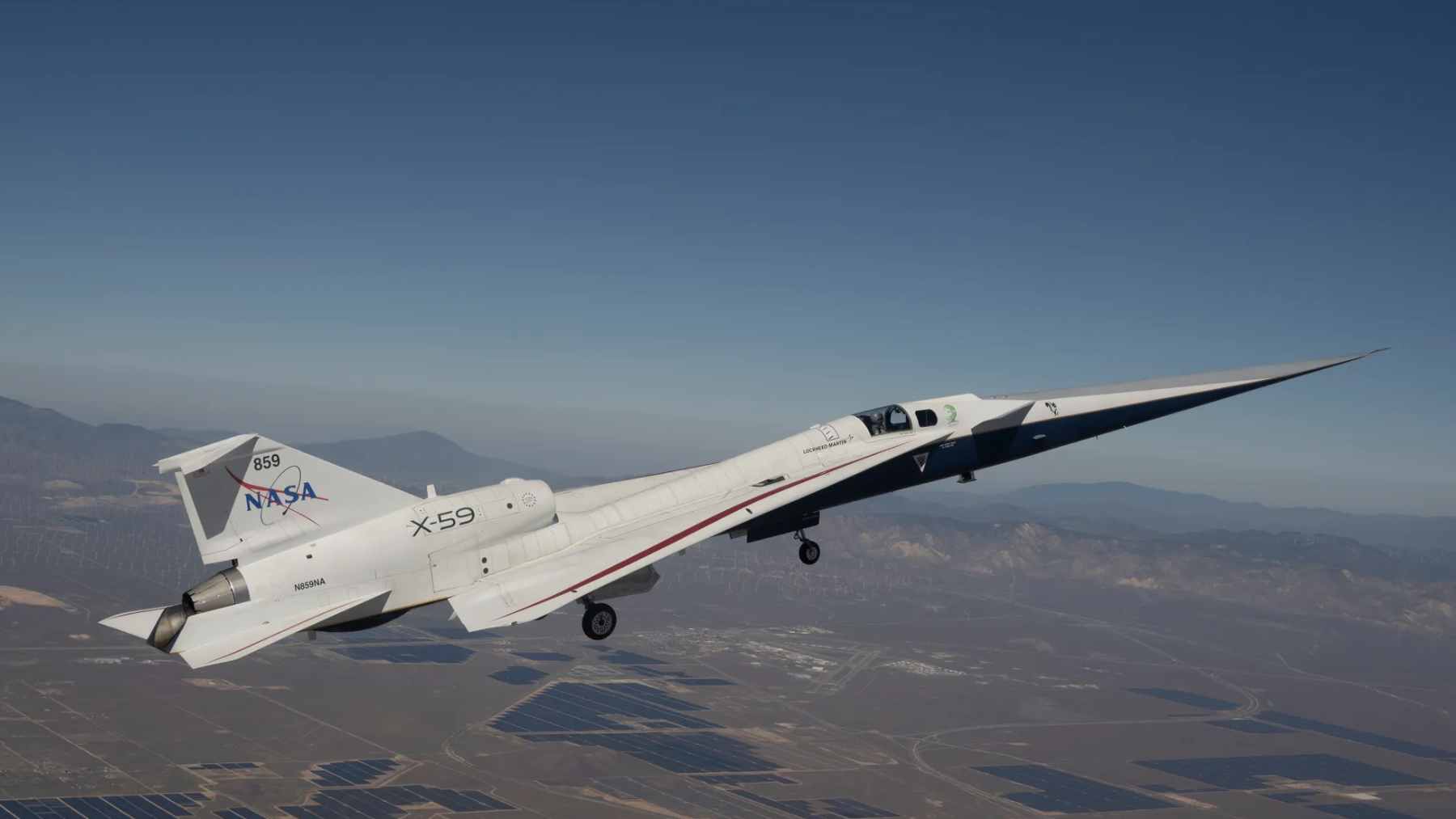
NASA’s X-59 has moved from promise to proof in the air. On June 12, 2026, the one-of-a-kind aircraft flew at Mach 1.4, about 924 mph, at 55,000 ft., matching the speed and altitude NASA needs for future community overflight tests.
That matters because the X-59 is not just chasing speed. It is trying to solve the environmental problem that helped ground the dream of supersonic passenger travel over land, the explosive sonic boom that rattles windows, startles neighborhoods, and makes fast flight feel like a nuisance instead of progress.
A new kind of supersonic test
Earlier in June, NASA said the aircraft flew faster than sound for the first time on June 5, reaching Mach 1.1, or 713 mph, and 43,400 ft. during an 81-minute flight from Edwards Air Force Base in California. The latest flight pushed the jet to the conditions it will encounter when it eventually flies over U.S. communities.
That is a key distinction. The X-59 is a research aircraft, not an airliner, and NASA describes it as an experimental airplane rather than a passenger prototype. In other words, no one will be buying a ticket on it.
Still, its mission has a very human target. Can a faster-than-sound aircraft pass overhead as a muted “thump” instead of the sharp crack people associate with older supersonic jets?
Why noise is the issue
Noise is not a minor complaint in aviation. ICAO says aircraft noise is the biggest cause of adverse community reaction related to airports, which is why reducing the number of people affected is one of its key environmental goals.
The FAA’s current rule still limits civil aircraft operating above Mach 1 in the United States unless they have specific authorization. That rule is rooted in the old problem: supersonic speed often meant sonic boom, and sonic boom meant public resistance.
That’s where the X-59 comes in. NASA’s Quesst mission is designed to gather public reaction to quieter sonic “thumps” and share that data with U.S. and international regulators so future standards can be based on acceptable noise, not just raw speed.
Built to split the boom
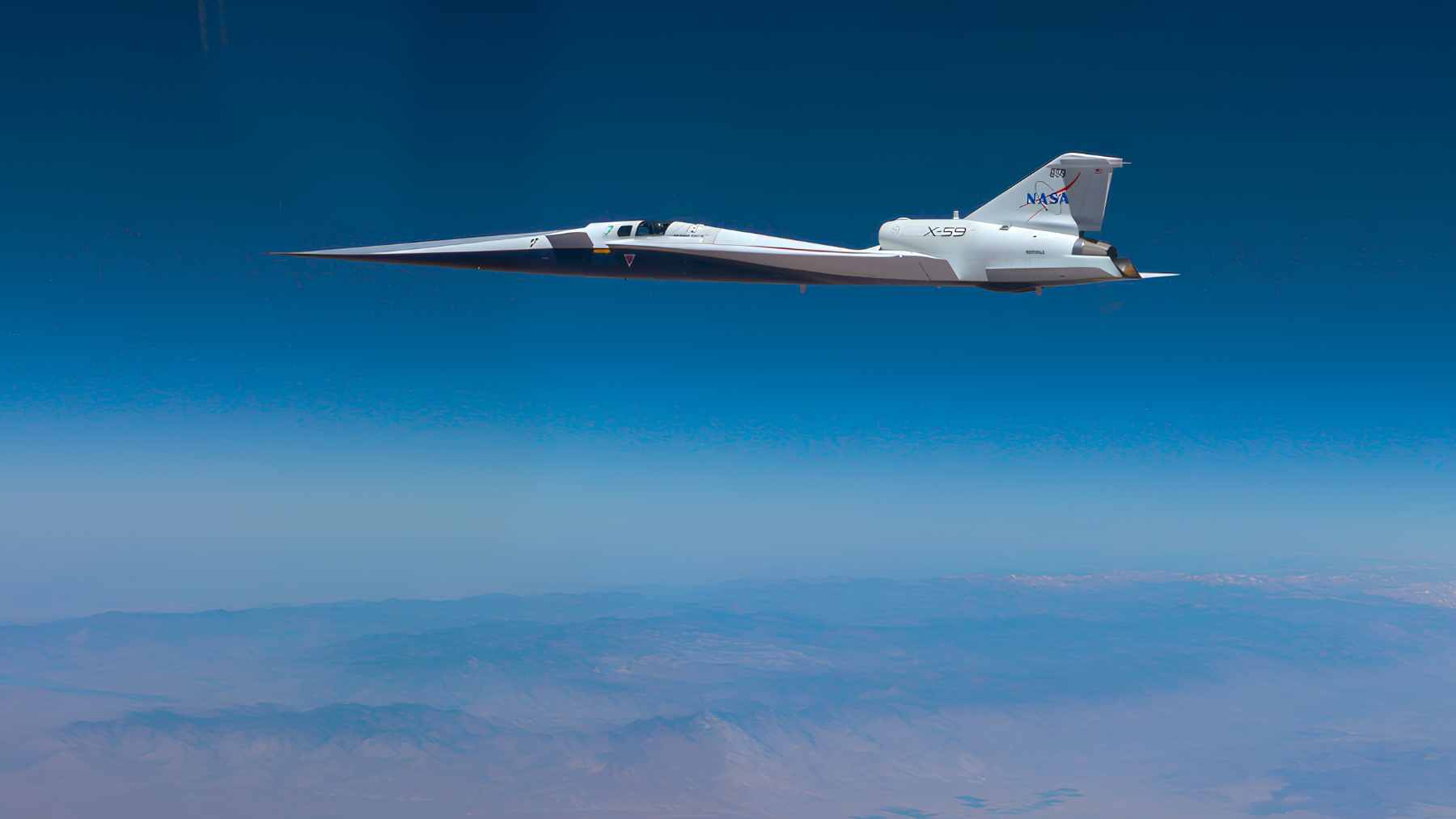
The X-59 looks strange for a reason. It is 99.7 ft. long and 29.5 ft. wide, with a thin, tapered nose that accounts for almost a third of its length.
That long shape is meant to keep shock waves from bunching together behind the aircraft. When those waves merge, people on the ground hear the classic boom. When they are spread out, the hope is that the sound becomes far less disruptive.
NASA also placed the engine on top of the aircraft and gave the underside a smooth shape. It is a small design detail from a distance, but it matters. The goal is to direct and shape the pressure waves before they ever reach the sidewalk, the schoolyard, or the backyard grill.
Flying without a front window
One of the oddest parts of the X-59 is also one of its smartest. Because the nose is so long and the cockpit sits low in the aircraft, there is no forward-facing window.
Instead, the pilot uses the eXternal Vision System, a forward-facing multi-camera setup feeding a 4K monitor that acts as the central “window.” NASA says it also overlays flight data for approaches, landings, and takeoffs.
It sounds like science fiction, but the logic is simple: if the airframe has to be shaped for quiet flight, the cockpit has to adapt to that shape. As Randy Bailey, NASA’s XVS subsystem lead put it, the aim is an “electronic means of vision” for the pilot.
The three-hour dream
The idea of London to New York in roughly three hours is the headline-friendly dream behind all of this. There is a catch, though. The X-59 itself will not carry passengers across the Atlantic.
What it could do is give manufacturers and regulators better data for the next generation of quiet supersonic aircraft. NASA says its Quesst work is meant to provide design tools and confidence for U.S. aircraft makers exploring future quiet supersonic concepts.
That could matter for business travel first. A flight that cuts hours off a route changes meeting schedules, airline economics, and maybe even where companies choose to operate. But faster is not automatically better. Fuel burn, ticket price, airport noise, and climate pressure will all remain part of the debate.
What happens next
NASA says the aircraft still has months of performance testing ahead. After that, the program will move into acoustic validation, where researchers will measure whether the quiet thump is actually as quiet as the design promises.
Only then comes the part that people outside aerospace will really notice. NASA plans to fly the X-59 over several U.S. communities and ask residents what they heard, how noticeable it was, and whether it felt acceptable in daily life.
That may sound humble for a machine flying at 924 mph, but public acceptance is the whole point. A plane can win the speed race and still lose the neighborhood.
Supersonic flight gets a second chance
Concorde made supersonic passenger travel famous, but it never solved the overland noise problem. For the most part, its speed was limited to ocean routes, where the boom would not roll across towns and suburbs.
The X-59 is trying to change the question. Instead of asking whether a civil aircraft should be allowed to exceed Mach 1, NASA is asking how loud that flight should be allowed to sound on the ground.
That is a quieter, more practical revolution. It is not as flashy as a silver jet racing across the Atlantic, maybe, but more important if supersonic travel is ever going to return without making life noisier for everyone below.
The official statement was published on NASA.