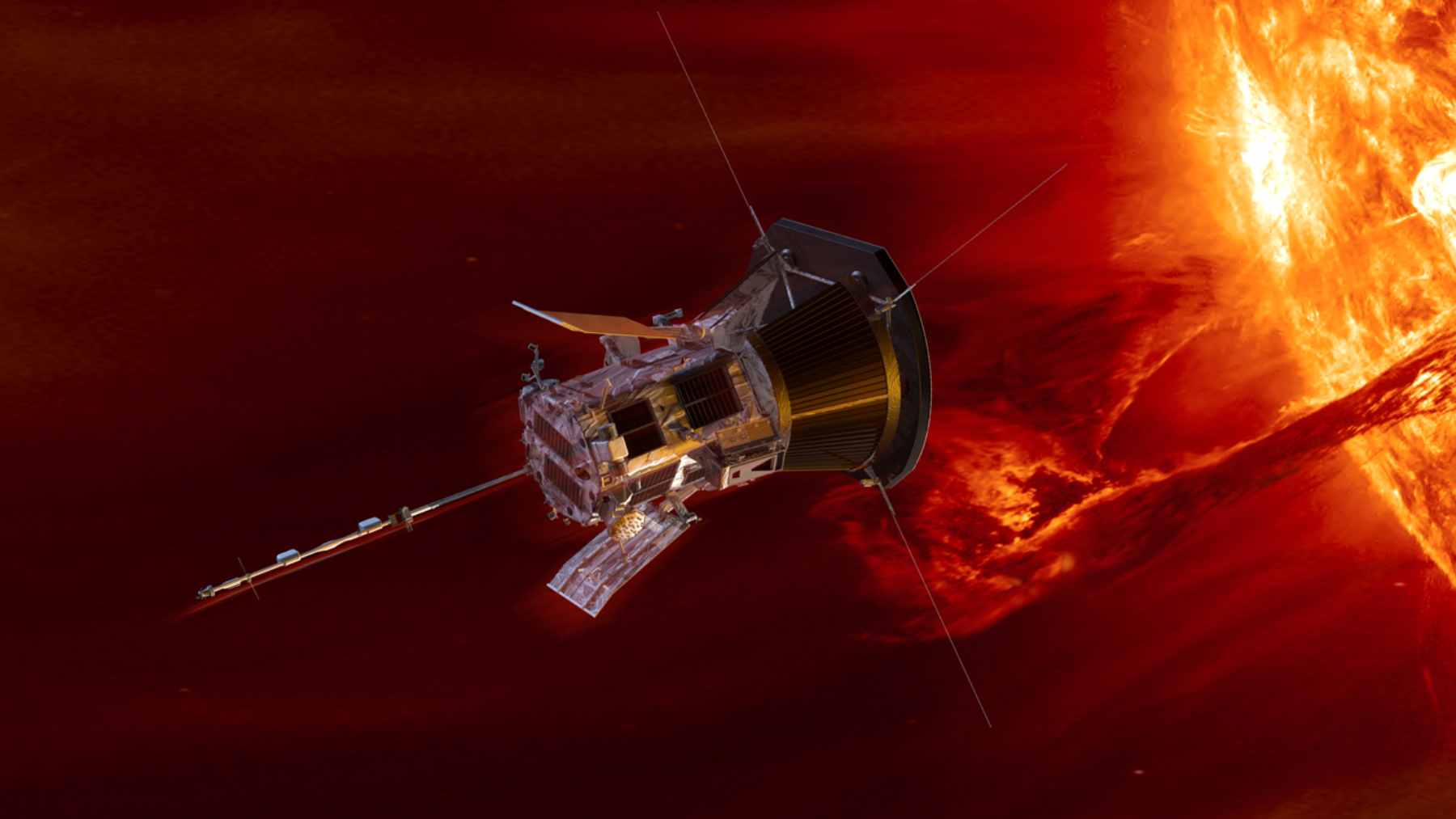
NASA’s Parker Solar Probe has done it again. The spacecraft completed its 27th close approach to the Sun on March 11, 2026, matching its record distance of about 3.8 million miles from the solar surface while flying at roughly 430,000 miles per hour.
That is fast enough to cross the continental United States in about 20 seconds, but the real story is not just speed. It is the strange little wall of carbon foam in front of the spacecraft, glowing at temperatures near 2,500°F while the instruments behind it keep working in the shade.
A shield doing the impossible
At the front of Parker Solar Probe sits its Thermal Protection System, an 8-foot-wide heat shield built around a 4.5-inch carbon foam core. NASA says the shield weighs only about 160 lbs., which is surprisingly light for a spacecraft component asked to survive one of the harshest environments ever visited by a human-made object.
The design is almost like a sandwich. Two thin carbon-carbon composite panels wrap around a foam core that is 97% air, while a bright white ceramic coating reflects sunlight away from the spacecraft. Simple idea, very tricky engineering.
That is why this mission took so long to become real. Scientists talked about sending a probe close to the Sun as far back as 1958, the same year NASA was created, but the materials had to catch up with the dream.
Why it does not melt
Here is the part that feels backward. The Sun’s corona can reach temperatures of more than 1 million°F, yet Parker does not instantly burn up when it passes through it. Why not?
Temperature and heat are not the same thing. The corona is extremely hot, but it is also incredibly thin, so there are not many particles available to slam into the shield and transfer energy. In everyday terms, it is a little like opening a hot oven for a second–uncomfortable, but not the same as touching a hot pan.
The main heating threat comes from sunlight itself. That steady blast of photons hits the front of the shield, while the white coating and carbon foam work together to reflect and slow the transfer of energy. NASA says the shield was designed for temperatures up to 2,600°F, while keeping the shaded instruments at about room temperature.
Instruments in the shadow
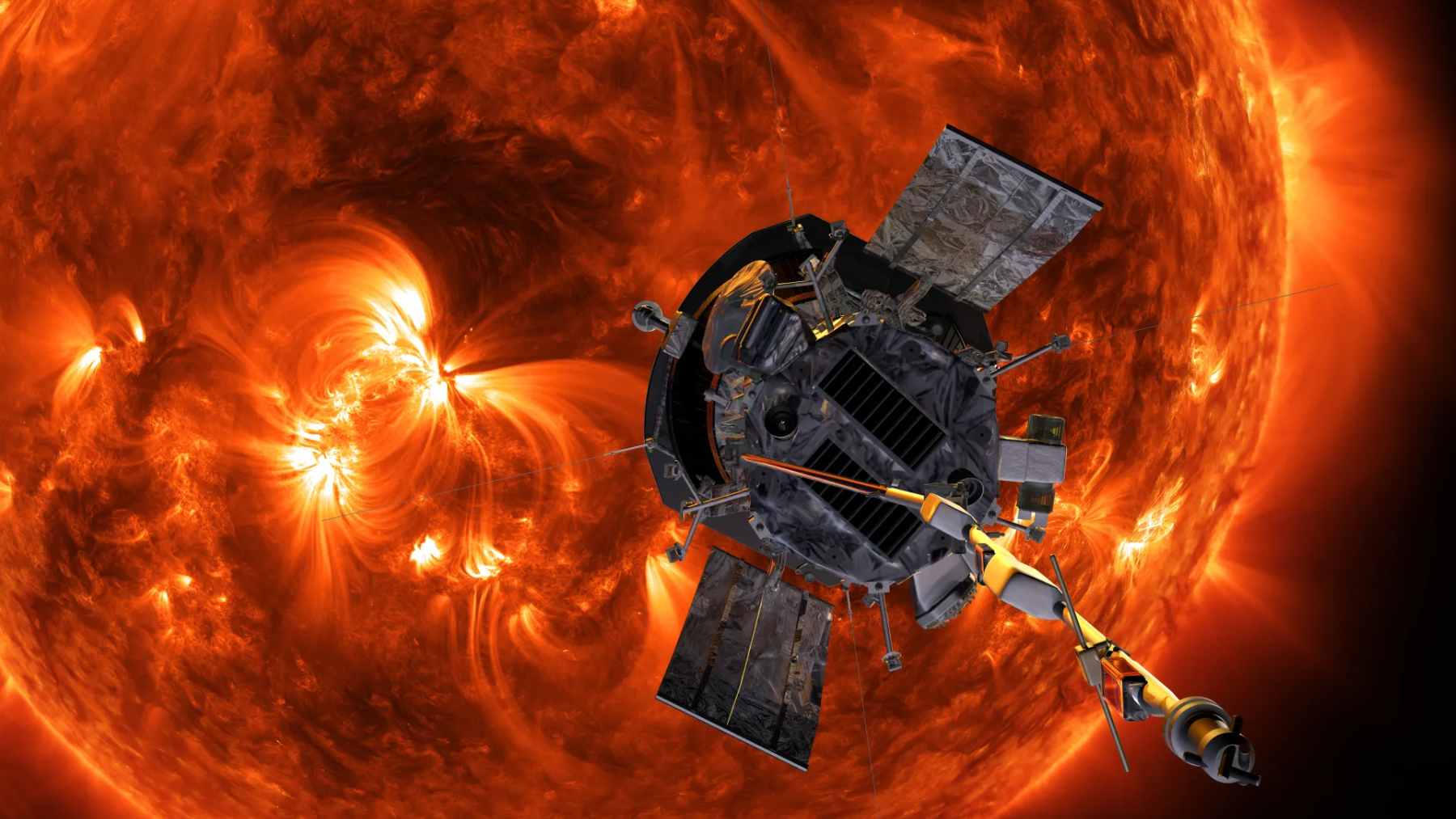
Behind the shield are four scientific instrument suites, each built to study a different part of the Sun’s outer atmosphere. NASA lists FIELDS, SWEAP, WISPR, and ISʘIS as the spacecraft’s main instrument packages, measuring particles, electric fields, magnetic fields, and visible structures in the solar wind.
Some parts have to peek out from behind the shield to do their jobs. That is not a small risk. Antennas and sensors face heat and radiation that would destroy ordinary hardware, but they are needed because the spacecraft is not just taking pictures from a safe distance.
It is sampling the Sun directly. Parker first entered the solar atmosphere in April 2021 when it crossed the Alfvén critical surface, the boundary where solar material stops behaving like part of the Sun’s atmosphere and begins streaming outward as solar wind.
Why this matters on Earth
This may sound like pure space science, but it reaches all the way down to Earth. Solar storms can disturb satellites, GPS, aviation routes, radio communications, and power grids, which means this mission has real stakes for business, defense, transportation, and emergency planning.
The National Oceanic and Atmospheric Administration (NOAA) warns that coronal mass ejections can trigger geomagnetic storms and induce currents in the ground that may degrade power grid operations. NASA’s latest Parker update also notes that space weather can pose risks to astronauts, satellites, air travel, and power grids.
That is why the Parker mission matters beyond the space community. A better understanding of the solar wind could help forecasters give utilities, satellite operators, airlines, and defense planners more useful warning before a major solar event hits. Not perfect warnings, but better warnings.
Speed is part of survival
Parker’s speed is not a stunt. The spacecraft needs to move quickly through the most intense part of each orbit, reducing the time its shield has to absorb solar energy.
The same speed also gives scientists a rare chance to study solar structures before they evolve too much. Coronal mass ejections can race outward at tremendous speeds, and Parker’s close-in position allows it to capture data near the source instead of waiting until the storm has already traveled across space.
NASA said Parker reached its optimal orbit after using seven Venus flybys to move closer to the Sun. Since the record-setting Dec. 24, 2024 pass, the spacecraft has repeatedly matched its closest distance and speed during later encounters.
What comes next
The Sun is now moving out of its solar maximum period, which means Parker’s future observations could look different from those gathered during the more active phase. There may be fewer explosive events, but that quieter period has value, too.
In practical terms, Parker can help compare the Sun when it is restless with the Sun when it is calming down. That kind of long-term record is the difference between seeing a single storm and understanding the weather system that produced it.
NASA says Parker will remain in its orbit and continue observations into the declining phase of solar activity, while the next steps for late 2026 and beyond are under formal review. The shield will keep facing the Sun, the instruments will keep hiding in the shade, and the data will keep coming home.
The official statement was published on NASA Science.