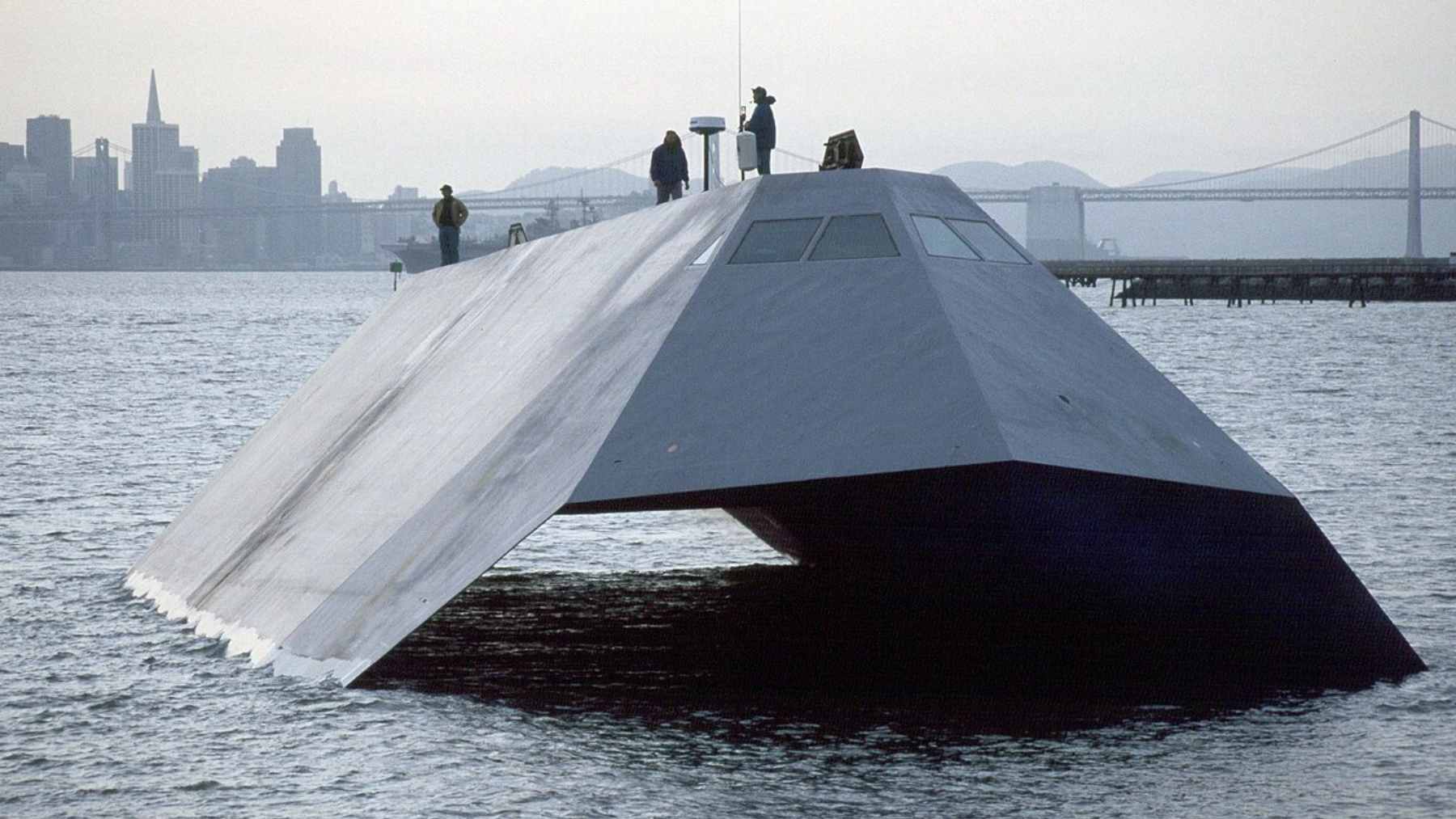
The U.S. Navy once built a warship that looked as if it had slipped out of a science fiction movie. Its name was Sea Shadow, and the idea behind it was simple but daring. Could the stealth concepts used on aircraft be pushed onto the ocean, where radar, waves, saltwater, and maintenance crews make everything harder?
Only one prototype was ever made. Official records describe Sea Shadow (IX-529) as an experimental surface stealth ship, not a submarine, built to reduce radar profile and test a Small Waterplane Area Twin-Hull design.
The vessel was completed in 1985, shown to the public in 1993, never fully commissioned, and later sold after entering the Suisun Bay Reserve Fleet. That is where the story turns from military innovation into something more grounded: even futuristic defense technology leaves a real-world footprint when the experiment ends.
A Cold War stealth experiment
Sea Shadow was born from the same era that produced the F-117 Nighthawk, the angular stealth aircraft that made sharp edges look like a military advantage.
The Defense Advanced Research Projects Agency (DARPA) says Ben Rich, then head of Lockheed’s Skunk Works, first explored applying aircraft stealth ideas to undersea vessels before the concept shifted toward surface ships.
The goal was not to build a normal destroyer with a strange paint job, which was to find out whether shape, materials, automation, and hull design could make a ship harder to detect at sea. In practical terms, it was testing how stealth behaved outside the cleaner world of aircraft, with ocean spray, wakes, and corrosion entering the picture.
Built inside a secret barge
The ship itself was assembled out of sight inside the Hughes Mining Barge 1 in Redwood City, California. That alone tells you how sensitive the program was. If satellites were watching shipyards, the Navy and Lockheed wanted the important work hidden under a roof.
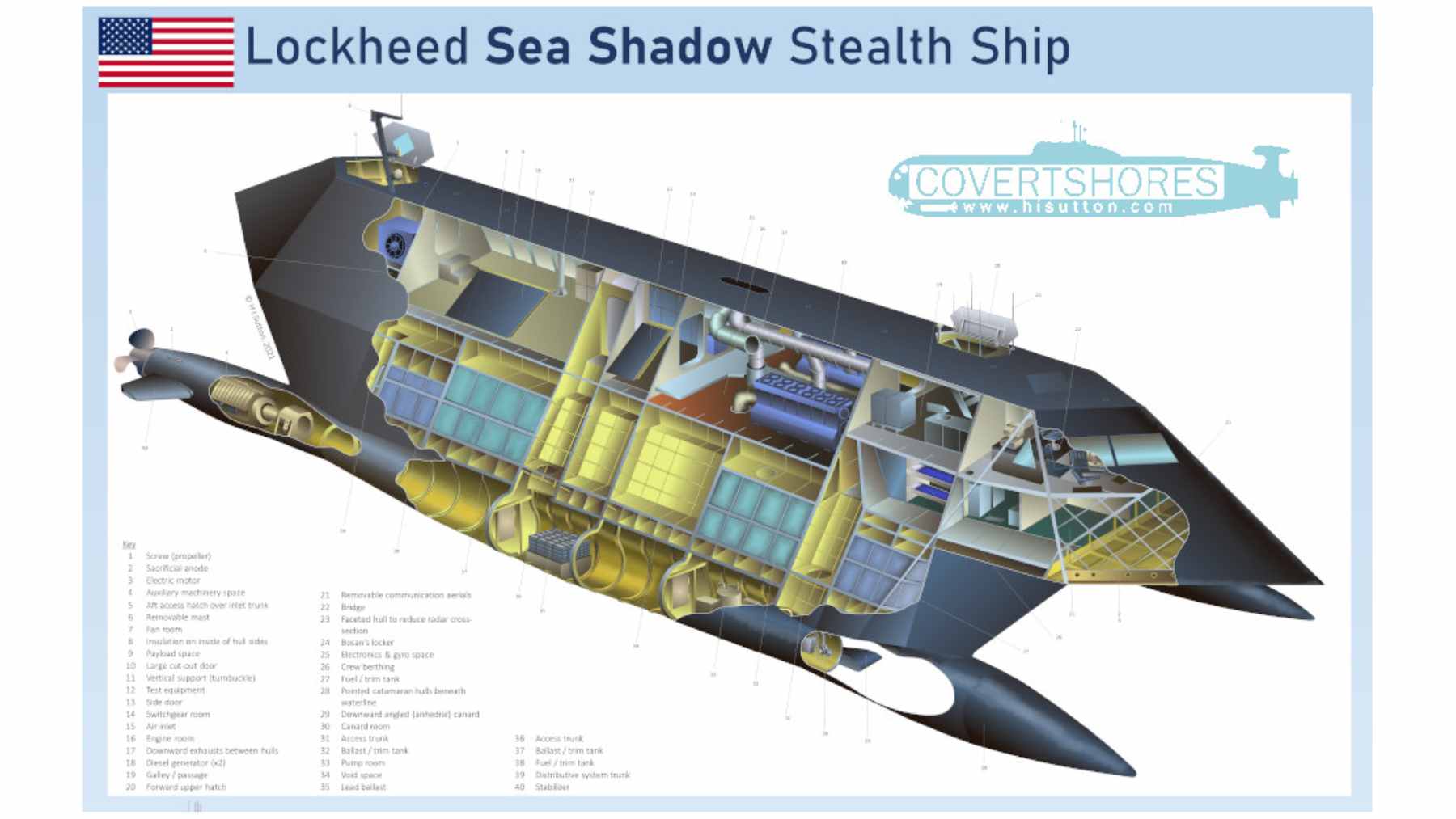
Sea Shadow measured 164 ft. long and 68 ft. wide, with a displacement listed by The U.S. Maritime Administration (MARAD) at 563 tons.
Lockheed’s own 2006 statement described it as drawing 14.5 ft. of water, powered by twin diesel engines, and capable of about 14 knots. Those numbers made it small by warship standards, but very big for a prototype that would ultimately never become a fleet.
The 18-ship carrier shield
The most eye-catching claim around Sea Shadow came from the idea that a small number of stealth missile ships could protect U.S. aircraft carriers. A recent article based on Ben Rich’s account says an analysis suggested that 18 such vessels, armed with surface-to-air missiles, could help defend the entire carrier fleet by operating far ahead of carrier groups.
It sounds dramatic. Still, the real Sea Shadow carried no weapons. Lockheed stated plainly in 2006 that the actual ship “never had weapons” and served instead as a test platform for automated ship control, advanced structures, reduced crew needs, seakeeping, and stealth. The difference matters. One version was a combat vision, the ship that existed was a laboratory.
Why the Navy walked away
So why did such a futuristic project fail to become a fleet? Part of the answer is that proving a technology is not the same as making it useful, affordable, and welcome inside a military service.
DARPA says Sea Shadow’s first trials in 1981 were disappointing because its wake was unexpectedly large and could be spotted by sonar and from the air.
The issue was later traced to motor propellers installed backward, and the project moved forward, but that early problem showed how fragile stealth can be at sea. Hide the ship from radar, and the water may still give you away.
There was also the human side. Radical designs can face resistance not because they are silly, but because they challenge routines, staffing models, and career paths. Ben Rich’s account described a four-person crew concept, while Lockheed later listed a typical underway crew of eight, excluding engineers conducting experiments.
Either way, Sea Shadow pointed toward smaller crews and automation, ideas that were ahead of their time but not always easy to absorb.
The environmental lesson
Sea Shadow was not an environmental project, but its story has an environmental edge. A 563-ton experimental ship does not simply vanish when the Navy loses interest. It has to be stored, maintained, donated, deactivated, sold, or dismantled.
That is the hidden side of high-tech defense work. The public often sees the dazzling part, the stealth angles, the secret tests, the carrier defense theories.
What comes later is less glamorous. Where does the hull go? Who pays to preserve it? Can the material be reused safely? Without detailed public disposal records for every component, it is not possible to quantify the full environmental footprint, but the life-cycle question is hard to ignore.
Not a total failure
Calling Sea Shadow a failure would be too easy. It never became the 18-ship shield imagined by its supporters, but DARPA says lessons from the program later informed applications such as submarine periscopes and newer Navy destroyers, including the Zumwalt class. Lockheed also said the ship supported risk reduction for the Navy’s next-generation destroyer program.
That is often how experimental technology works. The prototype may die, but the ideas scatter. Some end up in later ships, some in sensors, and some in the quiet engineering notes that shape what comes next. For the most part, Sea Shadow seems to belong in that category.
From secret weapon to scrap
By 2006, Lockheed announced that the Navy had awarded a $1.1 million, 12-month contract to finish experiments aboard Sea Shadow and then deactivate it.
MARAD records show the vessel entered the Suisun Bay Reserve Fleet on September 12, 2006, became available for Navy donation later that month, and departed the fleet on July 13, 2012, after being sold by the Navy.
That ending feels almost too ordinary for such a strange machine. A ship designed to hide from radar could not hide from budgets, storage limits, and the practical problem of what to do with a Cold War prototype in peacetime.
Sea Shadow’s legacy is not just that stealth can work at sea, it is that even the most advanced military ideas need an exit plan. At the end of the day, innovation is not only about what a machine can do in combat. It is also about what happens when the mission ends.
The official vessel history was published on the MARAD Vessel History Database.