Before Snowy 2.0 can store clean power for millions of homes, some of its biggest pieces have to make a much more visible journey. In Cooma, New South Wales, a 152-wheel transport vehicle hauled the center section of TBM Monica’s cutterhead through town at night, carrying a steel part that weighed more than 302,000 lbs. and measured about 23 ft. wide.
It looked like a moving construction site, but the convoy was more than a spectacle. It was a key step in assembling the fourth tunnel boring machine for Snowy 2.0, a pumped-hydro project designed to act like a giant water battery as Australia leans harder on wind and solar power.
A night move through Cooma
Snowy Hydro said the center cutterhead piece passed through Cooma in early October 2025 on its way to the Marica worksite north of Kiandra. The transfer was about 240 ft. long as it traveled up Sharp Street, then headed for the final leg of the trip on the Snowy Mountains Highway.
For anyone nearby, this was infrastructure at sidewalk level. Big clean-energy projects usually sit behind fences or deep underground, but this one rolled past shops, traffic lights, and local streets in the dark.
Imagine stepping outside and seeing a 23-ft.-wide steel face crawling through town. That is what the energy transition can look like before it disappears beneath a mountain.
Why the cutterhead mattered
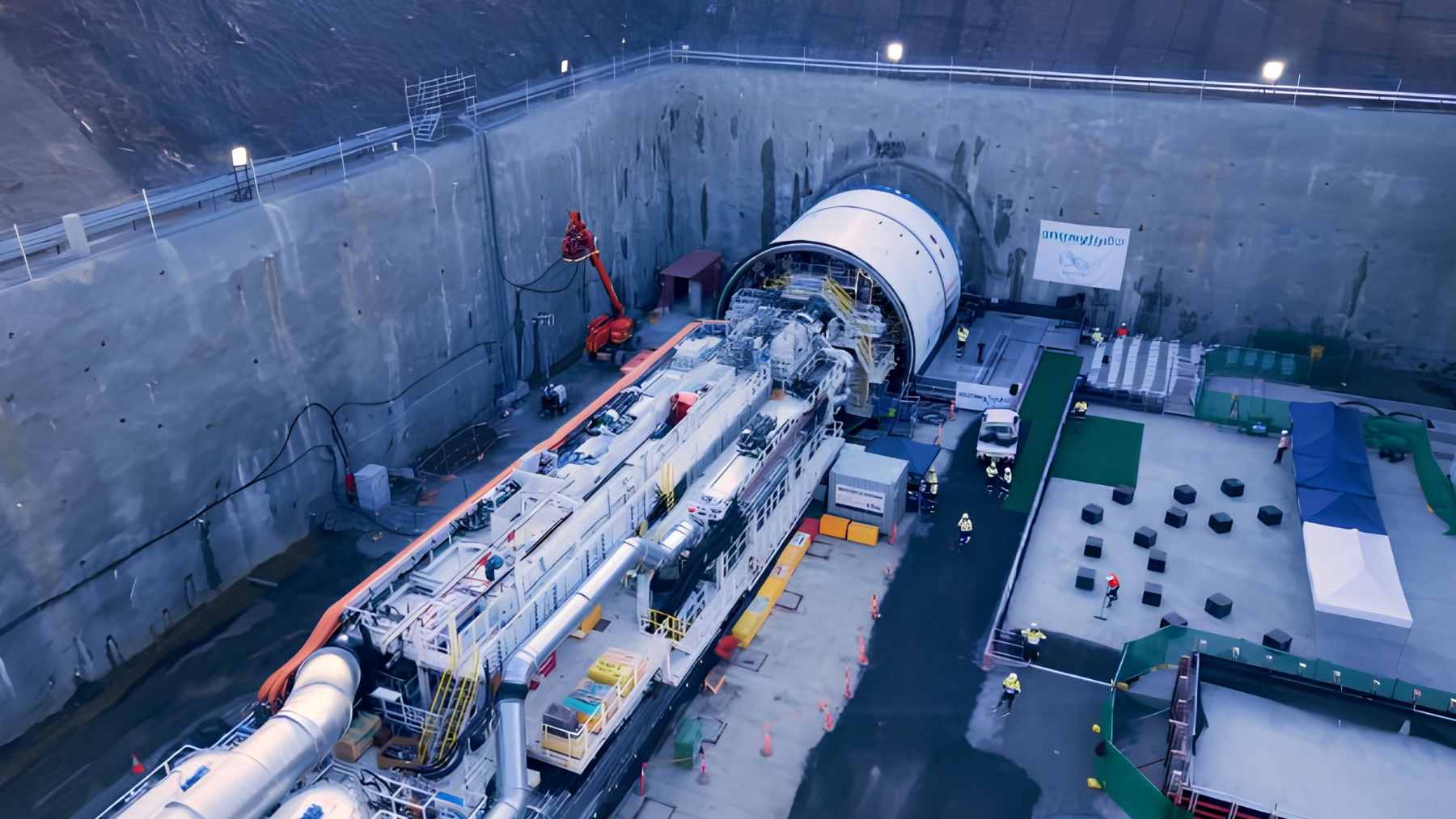
A tunnel boring machine, often called a TBM, is basically a mobile underground factory. Its cutterhead is the rotating front face that grinds through rock and soil, while the rest of the machine supports and builds the tunnel behind it.
That is why this single part mattered so much. Without the cutterhead, Monica could not begin its work on the Snowy Mountains section assigned to it, and without careful transport, the machine could not even reach the remote site where crews needed it.
The cutterhead was too large to move in one piece, so it had to be split into five sections. Snowy Hydro Chief Delivery Officer Dave Evans said the transfer followed months of planning and credited the transport team with completing the complex operation safely.
More than one massive load
The cutterhead move was part of a much larger delivery campaign. Snowy Hydro said more than 140 big loads had been delivered from Port Kembla to Marica in recent weeks, all feeding the assembly of Monica.
A TBM does not arrive in one superhero entrance. It comes piece by piece, then crews assemble the cutterhead, shields, drive systems, gantries, and support equipment until the whole machine is ready to dig.
That detail matters. Clean energy is not only solar panels, control rooms, and glossy renderings. It is also night convoys, road planning, steel, workers in high-visibility gear, and a lot of slow, practical engineering.
Snowy 2.0 works like a battery
Snowy 2.0 is meant to link the Tantangara and Talbingo reservoirs through about 17 miles of tunnels and a new underground power station at Lobs Hole. Six reversible turbines will let water run downhill to generate electricity when demand is high, then pump it back uphill when extra wind and solar power is available.
Snowy Hydro says the project will have 2,200 megawatts of capacity and 350 gigawatt hours of energy storage. By the company’s estimate, that is enough stored energy to power 3 million homes for a week, or roughly the equivalent of 23 million home batteries.
For households, the idea is pretty easy to grasp. On a hot summer evening, when air conditioners are humming and rooftop solar is fading, long-duration storage can help keep electricity available when the grid needs it most.
Monica heads underground
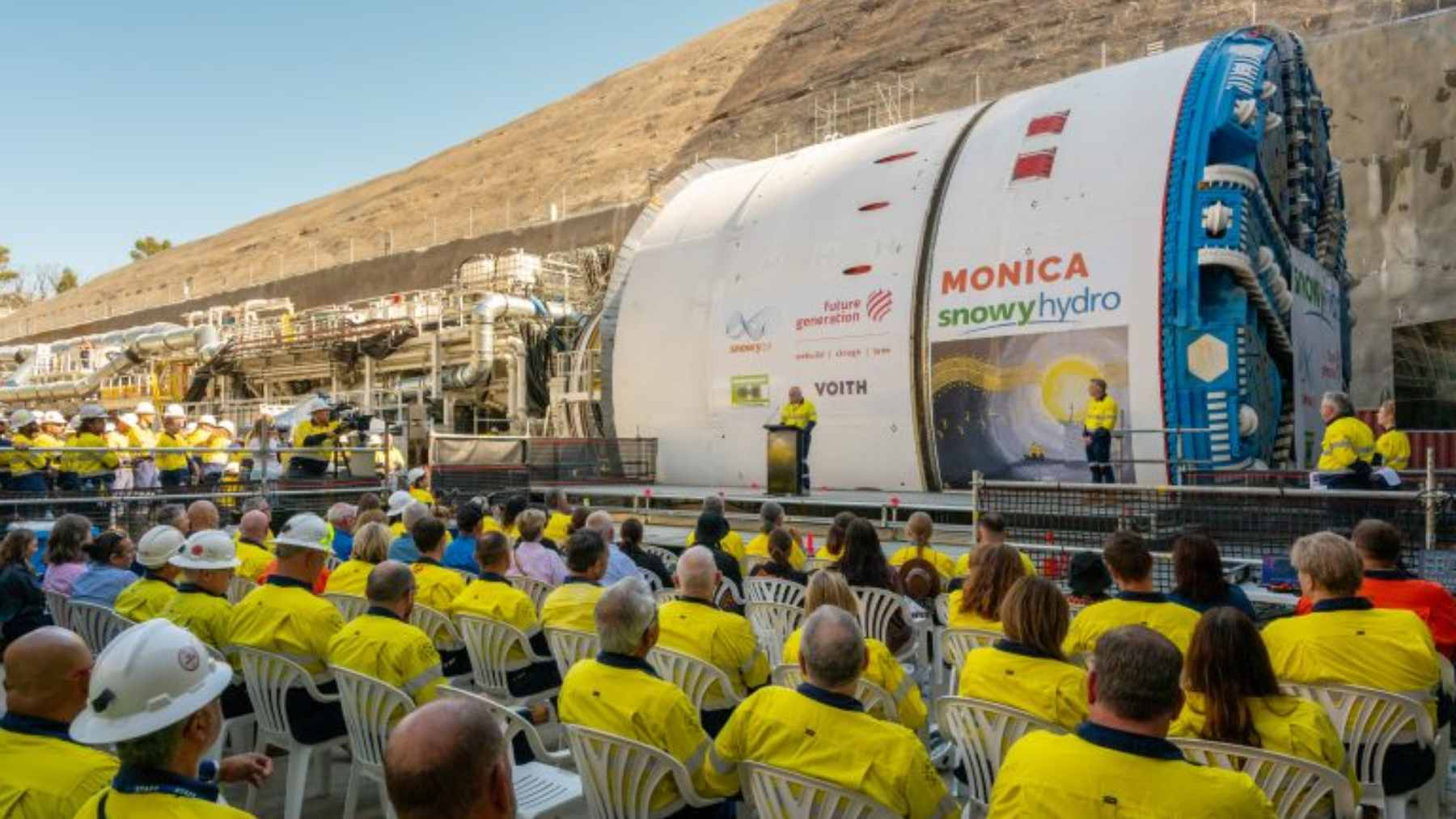
In February 2026, Snowy Hydro said Monica had been commissioned, marking a milestone as Snowy 2.0 passed 70% completion. The machine was named for Monica Brimmer, a Tumut High School student who won a First Nations art and storytelling competition.
Monica was built for difficult ground. The company said the machine would excavate part of the roughly 10.6-mile headrace tunnel that passes through the Long Plain Fault Zone, an area described as geologically challenging.
By May 2026, Snowy Hydro said Monica was excavating from the opposite end of the same tunnel as TBM Florence. The plan is for the two machines to meet in the middle before both are disassembled deep underground.
The debate is not over
Snowy 2.0 may be central to Australia’s renewable energy plans, but it has also faced intense scrutiny. ABC News reported on June 3, 2026, that the project was years behind its original schedule, that the last official cost estimate of about $8.6 billion in U.S. dollars had already come under pressure, and that the company had acknowledged the final price would be higher.
That does not make the engineering less impressive, but it does make the public question sharper. How much should a country spend on long-duration storage when batteries are improving, demand is changing, and major infrastructure costs keep climbing?
On the other hand, supporters argue that short-term batteries and pumped hydro solve different problems. Batteries can react quickly, while pumped hydro is built for longer stretches when the wind is low, the sun is gone, and the grid needs backup that can keep going.
A glimpse of the hidden work
The 152-wheel move through Cooma offers a useful reminder. Before clean energy can feel simple at home, it often requires complicated work far away from the light switch.
There is also something human in the name Monica. Behind the megawatts and steel is a student’s artwork about water, mountains, energy, and connection to land, now attached to one of the largest machines in the project.
At the end of the day, Snowy 2.0 is not just a story about a giant truck or a tunnel cutter. It is a story about what it takes to build energy dostorage at national scale, one huge load at a time.
The latest official update was published on Snowy Hydro.