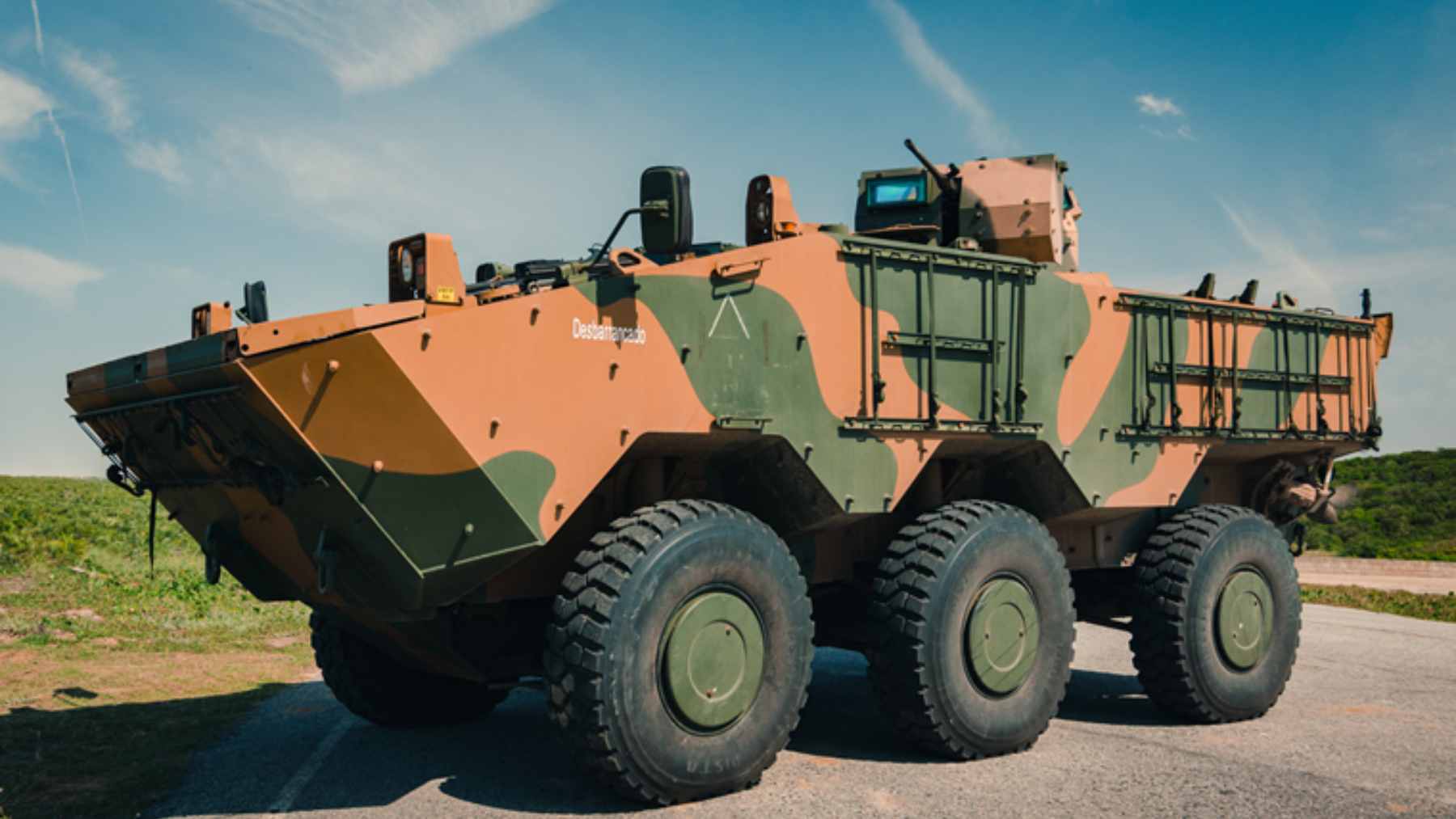
Brazil’s Guarani armored vehicle was built for the battlefield, but its story now reaches far beyond military patrols. The 6×6 vehicle carries troops, crosses difficult terrain, moves through controlled water conditions, and shows why modern defense technology is increasingly tied to climate emergencies and disaster response.
At about 39,700 lbs., with room for up to 11 people, amphibious capability, and a top road speed of about 68 mph, the Guarani is not a tank. It is something more specific, and in many ways, more practical for Brazil’s geography.
It is a protected troop carrier designed for roads, mud, river regions, flooded streets, and border zones where bridges and clean pavement cannot always be counted on.
A vehicle built for Brazil
The Guarani, officially known as the VBTP-MR Guarani, was developed through a partnership between the Brazilian Army and Iveco. Brazil’s Ministry of Defense has described it as part of the modernization of the Army’s armored fleet, with the Army keeping the vehicle’s intellectual property.
That detail matters. In practical terms, Brazil is not only buying military hardware from abroad, but also building a domestic industrial chain around armored vehicles, maintenance, training, and future upgrades. For a country with long borders and huge river systems, that kind of control can become a strategic advantage.
Why six wheels matter
The Guarani’s six-wheel drive is one of the keys to its usefulness. On paper, it can reach about 68 mph on roads, but real missions are rarely that simple. Mud, sand, broken roads, debris, floodwater, and security risks all change how a vehicle moves.
That’s why the 6×6 layout matters. It spreads power across the vehicle and helps it keep moving in places where ordinary trucks may lose grip. For soldiers inside, and sometimes for civilians waiting for help, that difference is not theoretical.
Crossing water
One of the Guarani’s most important features is its amphibious capability, as the Ministry of Defense has said the vehicle can operate in water. Earlier official material also noted that the Guarani is prepared for navigation with rear propellers.
Does that make it a boat? Not exactly. It is still an armored vehicle, and water crossings depend on conditions, training, and safety limits. But in a country where floods, rivers, and wetlands can cut off communities fast, the ability to move through controlled water environments gives commanders another option.
Floods changed the picture
The environmental angle became impossible to ignore during Operation Taquari II in Rio Grande do Sul in 2024. Heavy rains and flooding damaged roads, isolated communities, and forced a wide emergency response involving the Armed Forces, civil defense teams, firefighters, police, volunteers, and local agencies.
In that operation, the Brazilian Army’s own blog said the Guarani showed strong performance in flooded urban areas, including navigation in current, rescue support, and supply distribution. That is where military technology meets everyday life–not in a parade, but in a neighborhood where roads have vanished under brown water.
Protection from below
The Guarani’s V-shaped hull is designed to help redirect the energy of blasts from mines or improvised explosive devices away from the center of the vehicle. This kind of protection is common in modern armored troop carriers, because the danger often comes from below.
Protection is not only about thick armor. Suspended seats, elevated cabin design, internal materials, and modular armor all help reduce risk to the crew. The idea is simple enough to understand, even if the engineering is not: keep the shock away from the people inside.
Remote weapons, safer crews
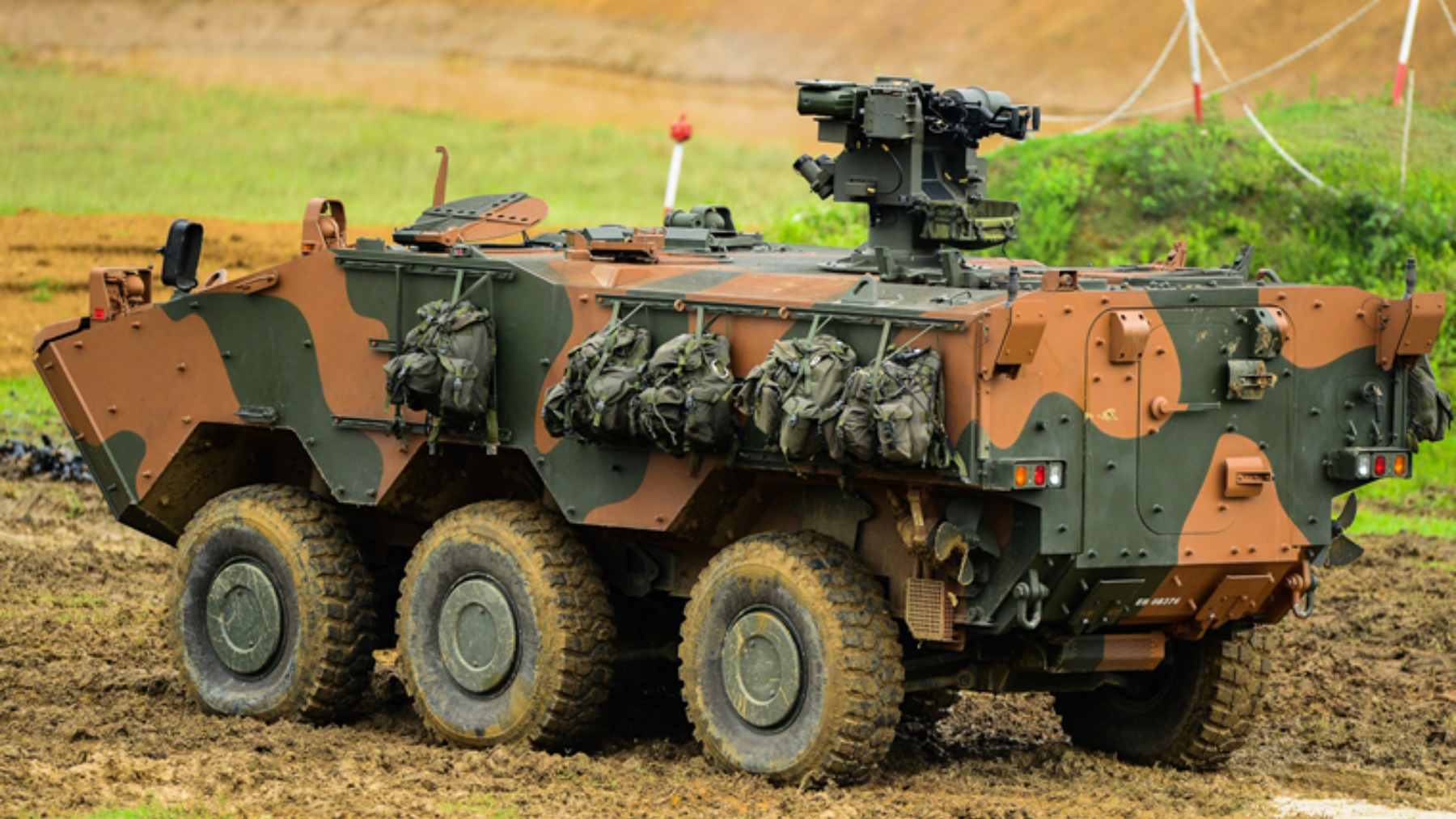
The Guarani can also receive remote weapon systems, allowing an operator to aim and fire from inside the armored vehicle rather than standing exposed outside.
One system linked to the platform is REMAX, a remotely controlled machine gun station developed from Brazilian Army requirements with ARES and the Army Technology Center. ABIMDE says REMAX can use .50-caliber and 7.62 mm weapons.
ARES describes REMAX as a gyro-stabilized, remotely operated system with two-axis stabilization, protected operation from inside the vehicle, day and thermal cameras, a laser rangefinder, and a full HD touchscreen monitor. In plain English, the gunner can watch, aim, and respond while staying under armor.
More than one model
The Guarani was never meant to be just one vehicle doing one job. The platform was designed to support a family of versions, including command, communications, mortar carrier, recovery, workshop, and ambulance roles–all critical for logistics.
Armies like common platforms because they simplify training, spare parts, and maintenance. It is the same reason many families prefer one charger type or one brand of tools. When things break under pressure, fewer differences can mean faster fixes.
Production keeps moving
The Guarani program has also become a business and industrial story. In 2012, the Defense Ministry said the vehicle would be produced at a dedicated Iveco facility in Sete Lagoas, Minas Gerais, and that local content was expected to involve about 110 direct suppliers and up to 600 indirect suppliers as production expanded.
Recent official monitoring shows the program is still active. Brazil’s Ministry of Defense reported that 60 Guarani 6×6 vehicles, eight REMAX weapon systems, and three command-and-control systems were delivered in 2024.
In 2025, the same monitoring document said 60 more Guarani vehicles were delivered, alongside one modernized Cascavel and two 8×8 Centauro vehicles.
A mobile fortress, with limits
Calling the Guarani a mobile fortress makes sense as a shorthand. It has armor, six-wheel drive, amphibious capability, remote weapons, sensors, and enough space for a small military team. Still, it is not a heavy battle tank, and it does not replace tracked armored vehicles designed for different combat roles.
Its strength is balance. The Guarani is built to move troops with protection, support mechanized units, operate in border areas, and help in emergencies when geography turns hostile. At the end of the day, that may be its most important lesson.
The next generation of defense vehicles will not only be judged by firepower, but also by how well they move through a changing planet.
The official statement was published on Brazilian Army.