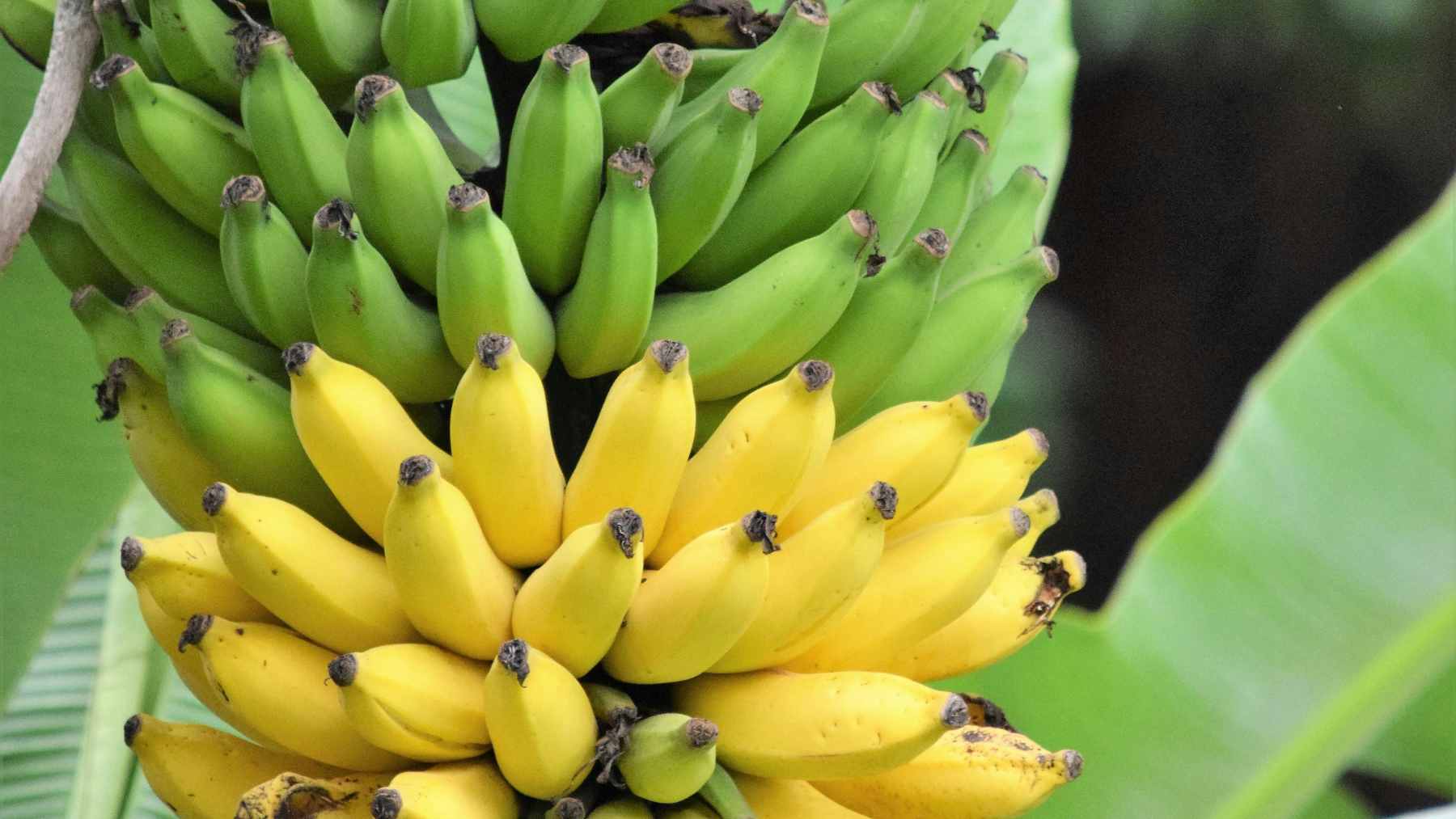
Taiwan’s Livestock Research Institute says it has found a practical way to turn banana harvest leftovers into high-quality feed for sheep.
The new silage, made from off-grade bananas, banana pseudostems, and bran, can replace up to 20% of a growing sheep’s total mixed ration without hurting growth or blood health indicators, while trimming feed costs by about NT$2 (USD $0.06) per kilogram at that substitution level.
That may sound like a niche farm story, but it lands at the intersection of environment, business, and security.
Taiwan’s feed system relies heavily on imports, and policymakers have even waived a 5% business tax on corn and soybean imports to help stabilize prices during volatile periods. So what happens when the “waste” left in a banana field becomes part of a buffer against the next price shock?
A waste pile that keeps coming back
Bananas are grown widely in Taiwan, with about 13,000 hectares (32,000 acres) under cultivation, according to the institute. After harvest, thick trunk-like pseudostems are left behind, and they are labor-intensive to move and cut, so they often end up rotting in the field.
The scale is not small. The institute puts the annual buildup at about 1.67 million tons of pseudostems, which can create pest problems and even obstruct farm access and operations.
In day-to-day terms, this is the kind of biomass that turns into a recurring headache. Farmers see it as an obstacle, neighbors see the pest pressure, and the environment gets stuck with the leftovers.
How banana silage works
Silage is basically controlled preservation through fermentation in low-oxygen conditions, a little like “pickling” for animal feed. Done right, it locks in nutrients, improves handling, and helps farmers store bulky plant material for later use.
The Livestock Research Institute says its team fine-tuned a formula that combines off-grade bananas, pseudostems, and bran into a silage designed for livestock. It also reports strong storage stability, saying the product can be kept unopened for up to three months without quality loss.
That storage window matters more than it sounds. When feed prices jump, or when a shipment is late, the scramble is real, and it tends to show up downstream at the grocery store in the price of meat, milk, or eggs.
What the sheep trials found
The institute’s trials focused on growing sheep and tested whether this banana-based silage could safely substitute for part of a standard ration. Its conclusion was clear and measured: replacing up to 20% of a growing sheep’s total mixed ration had no negative impact on growth performance or blood biochemical indicators.
Then there’s the money question, since farmers live and die by input costs. At a 20% replacement rate, the institute estimates feed costs can drop by about NT$2 per kilogram, which can add up fast when you are buying feed by the ton.
This is also why the timing is important. USDA reporting on Taiwan notes that the feed industry relies heavily on imports, and that the government has used tax policy, including waiving a 5% business tax on corn and soybean imports, to ease inflation pressure and stabilize feed prices.
A circular economy play with real business hurdles
The institute is positioning this as more than a one-off experiment. It says the results show strong industrial potential, and its next steps include helping businesses standardize production processes and expanding the approach to other ruminants, including beef cattle.
For business, the opportunity is straightforward. If a country can turn a disposal problem into a feed ingredient, it can redirect spending from imports into local processing, logistics, and farm services, even if it only replaces a slice of the ration.
But there are constraints worth keeping in mind. Collection, chopping, transport, and consistent fermentation quality all have to work at scale, and “works in trials” is not the same as “works across hundreds of farms” unless standards and training keep pace.
The institute’s own push for standardized production is a hint that execution will decide whether the idea stays local or becomes a real supply chain input.
Why defense planners pay attention to feed
Feed is not just an agriculture issue anymore, it is a resilience issue. USDA reports describe how dependent Taiwan is on imported feed ingredients, including soybeans, with imports meeting 98% of soybean demand and forecasts around 2.9 million tons in recent marketing years.
That dependence runs through shipping and logistics, and the same USDA reporting notes that trade can be affected by chokepoints and disruptions, including references to logistical issues in places like the Panama Canal and the Red Sea region.
When supply lines tighten, the pressure shows up quickly in farm input costs, and then in the price tags families see.
No one should pretend banana silage replaces corn or soy at national scale overnight. Even with efforts to expand domestic corn production, USDA reporting suggests that hitting Taiwan’s goal to double corn area would still cover only about 5% of total corn demand, which is a reminder of how hard full self-sufficiency is.
It is not flashy tech, but it is the kind of practical innovation that can matter when prices swing and ships run late.
The official statement was published on Taiwan Livestock Research Institute.