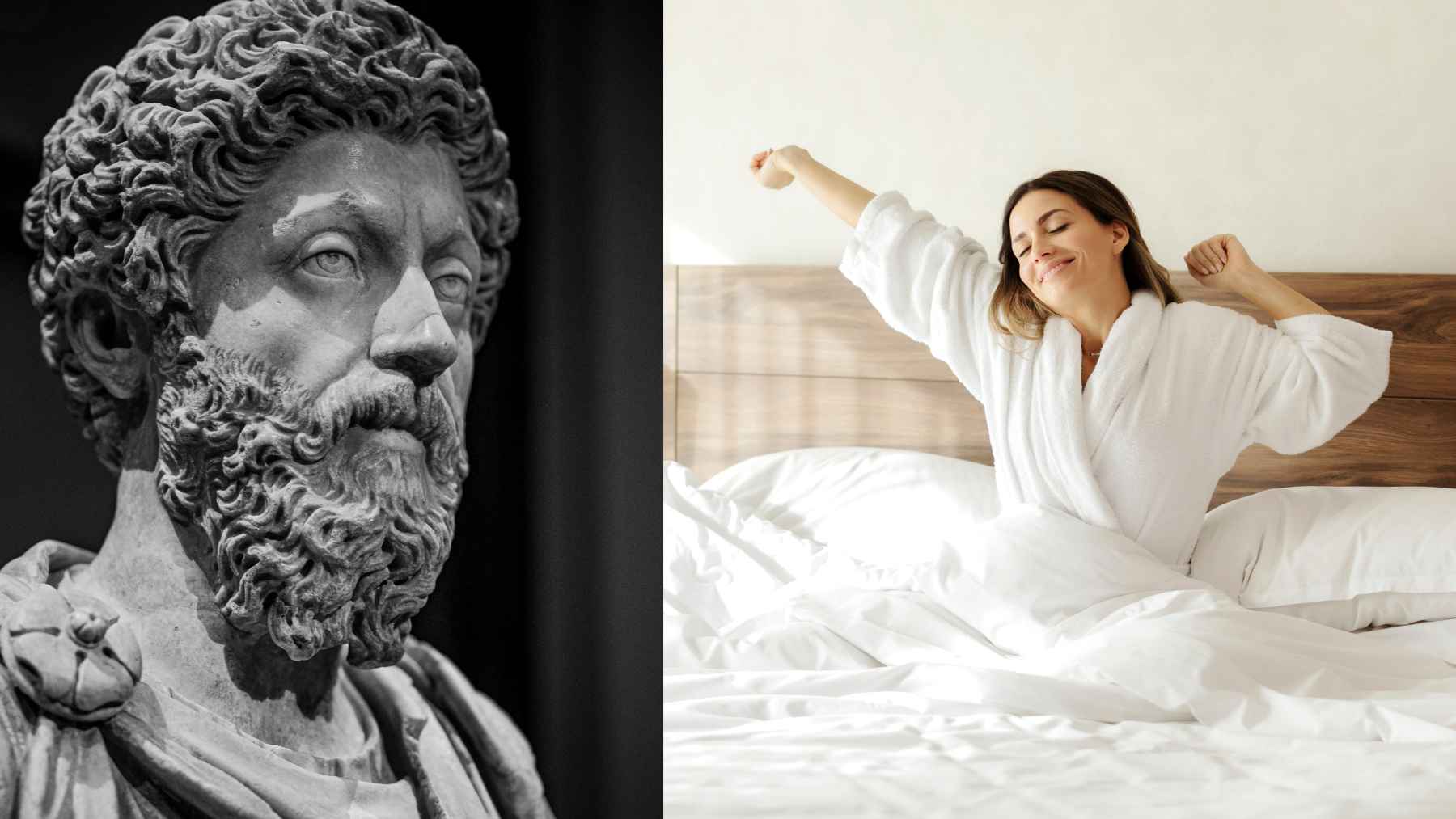
Every morning can look ordinary. The alarm rings, the bed feels too comfortable, and the day starts asking for attention before the mind is fully awake.
In one well-known passage from Book Five of Meditations, Marcus Aurelius tells himself, “I am rising to the work of a human being,” as he pushes back against the urge to stay under the covers.
That line is not just a slogan for waking up early, it is a reminder that each day carries a choice. Do we move through it half asleep, or do we treat it as another chance to act with purpose, patience, and responsibility?
A morning thought with weight
The quote speaks to a moment almost everyone knows. You wake up tired, the room is quiet, and the easiest answer seems to be staying still for a few more minutes.
Marcus Aurelius turns that small struggle into something larger. For him, getting up was not only about work, status, or routine. It was about remembering what kind of creature a human being is supposed to be.
What human work meant to him
What is the “work of a human being”? In Stoic thought, it is not just earning money, checking boxes, or surviving another busy day. It means using reason, choosing fairness, and living in a way that helps others.
The Stanford Encyclopedia of Philosophy explains that Stoics placed virtue at the center of human life, tying it closely to reason and the effort to live according to nature. In plain words, Marcus was saying that people are built for thoughtful action, not endless comfort.
Not a productivity trick
This is where the quote can be misunderstood. Marcus was not telling people to grind themselves down or treat rest as weakness. Even in the same passage, he accepts that humans need sleep.
The point is balance. Rest has a purpose, but so does effort. At the end of the day, what he is trying to do is move the mind from “I have to” toward “this is part of being alive.”
Nature gives the example
Marcus uses a simple image from nature. Plants grow, birds move, ants work, spiders build, and bees help keep their small world in order. None of that sounds terribly profound, but it makes the point.
Humans, in his view, have their own role, too. The difference is that people can think about their choices. That means the morning is not just a biological restart, but a moral one.
Time gives the quote urgency
There is another message tucked inside the line: each sunrise is a limited resource. Once a day is spent, it does not come back.
That does not mean every hour must become a heroic achievement. Some days are messy, slow, or heavy. But the quote asks a useful question when the routine feels dull: what can still be done with this day?
Who Marcus Aurelius was
Marcus Aurelius was born in 121 and ruled the Roman Empire from 161 to 180. Britannica describes him as a Roman emperor best known for Meditations, his reflections on Stoic philosophy.
Those reflections were not written as a polished public book. They were private notes, shaped during years of leadership, military pressure, and personal discipline. That makes the morning passage feel less like a lecture and more like a man talking himself through the day.
Why it still lands today
Almost 2,000 years later, the same resistance still shows up in modern life. It may come before school, a shift at work, a packed commute, or the first glance at a phone full of messages.
That is why the quote still travels so easily. It does not depend on ancient Rome to make sense–it reaches anyone who has ever looked at the ceiling and wondered why getting started feels so hard.
A lesson for hard mornings
The strength of the quote lies in its calmness. Marcus does not promise that the day will be easy. He simply says there is work to do, and that the work is tied to being human.
In practical terms, that means showing up with honesty, cooperation, and self-control, even when comfort is calling loudly. Not perfect, just awake to the responsibility of being here.
The main work behind this reflection has been published in Meditations.