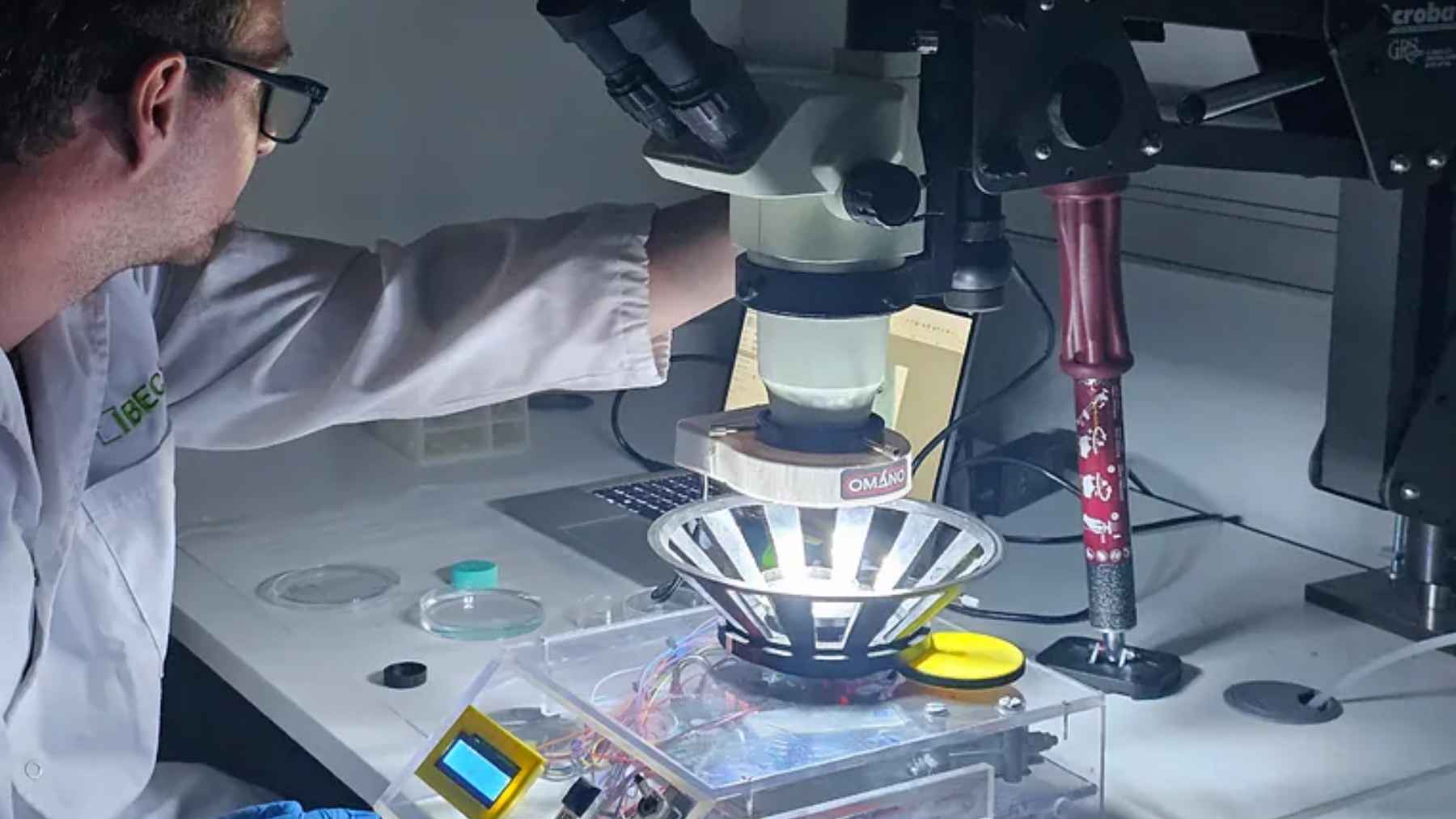
An international consortium led by the Institute for Bioengineering of Catalonia has used light-activated drugs to restore key visual behaviors in blind mice. The compounds worked after eye injections and as drops under ordinary white light, without changing genes or implanting a device.
The result is preclinical, but it points to a simpler way to reconnect a damaged retina.
The strategy addresses diseases that destroy photoreceptors, the eye’s natural light detectors. These conditions affect about 200 million people worldwide, while vision loss carries an estimated global cost of more than $400 billion a year.
Behind those numbers are daily problems such as reading, working, and moving safely through a familiar room.
Why the retina goes silent
The retina is a thin layer of nerve tissue at the back of the eye. Photoreceptors catch light and feed information into a network of cells that turns a scene into signals the brain can understand.
Age-related macular degeneration mainly damages central vision, while retinitis pigmentosa often begins with night blindness and shrinking side vision. As photoreceptors die, much of the deeper retinal circuit can remain alive but inactive. The wiring is still there, but the first signal never arrives.
A molecular stand-in
So how do you restart a circuit when its light detectors are gone? The new method uses photopharmacology, which means controlling a drug with light. Researchers created small, water-soluble molecules called prosthe6 that attach to mGlu6, a protein on ON bipolar cells.
Those retinal cells normally receive messages from photoreceptors. When visible light enters the eye, prosthe6 changes shape and activates mGlu6, restarting that step in the circuit. “Our goal was to restore vision using a molecular mechanism that is as close as possible to how the healthy retina works,” said co-first author Rosalba Sortino.
What happened in animals
The team first tested the compounds in blind zebrafish larvae. Treated fish recovered rapid eye movements used to follow moving stripe patterns, a response that requires more than sensing a simple flash.
The researchers then treated mouse models of age-related macular degeneration and retinitis pigmentosa. Blind mice normally lose their preference for dark spaces, but after treatment they again avoided bright areas without training. That suggests they could detect light and use it to guide a choice.
Two versions called prosthe6-12 and prosthe6-15 performed especially well. The effects appeared after an injection and after topical delivery as drops, under lighting similar to an indoor room or an overcast day. This showed functional light perception, not proof that the mice regained normal sharp vision.
Why the target matters
Electronic implants and some experimental treatments introduce signals later in the visual pathway. Prosthe6 instead targets ON bipolar cells, which sit close to the lost photoreceptors and pass information deeper into the retina.
That position may allow more of the retina’s built-in processing to remain involved before a signal travels to the brain. This is the study’s key design choice. Still, animal behavior cannot reveal how detailed human vision might become.
A separate first-in-human phase 1 study led by Robert Casson at Adelaide University tested another photoswitch drug, KIO-301, in six people with advanced retinitis pigmentosa.
It targeted retinal ganglion cells and was generally well tolerated, but the small safety study was not designed to prove useful sight had returned. The trial shows that light-controlled retinal drugs are entering human research, though prosthe6 has not reached that stage.
Eye drops are the big promise
The delivery method may be the most practical part of the work. A future treatment based on drops could fit into familiar eye care and avoid surgery, implanted chips, special goggles, or lengthy training.
That could make treatment easier to use outside a specialist clinic, but it remains only a possibility.
“These molecules do not cure blindness,” said study co-leader Pau Gorostiza, because the compounds do not stop photoreceptors from dying. They temporarily give surviving retinal cells a new way to respond to light. The difference matters.
The decade-long project also involved a team led by Pedro de la Villa at the University of Alcalá, the Institute for Advanced Chemistry of Catalonia, the University of Barcelona, the Ramón y Cajal Institute for Health Research, the Autonomous University of Barcelona, and the Eduard Soler Foundation.
The patented technology is now being evaluated for safety, formulation, and a longer-lasting effect.
What comes next
Before prosthe6 could reach patients, researchers would need reliable dosing and evidence that drops can deliver enough medicine through a human eye. Clinical trials would also need to test harder tasks such as finding objects, recognizing shapes, and navigating a room.
The mutation-independent design is one reason the approach stands out. Because it acts on surviving retinal circuitry rather than one faulty gene, it could potentially apply to several causes of photoreceptor loss, but that remains unproven in humans. The next studies will determine whether this molecular switch can become practical medicine.
The work was released on July 15, 2026. The official study was published in the Journal of the American Chemical Society.