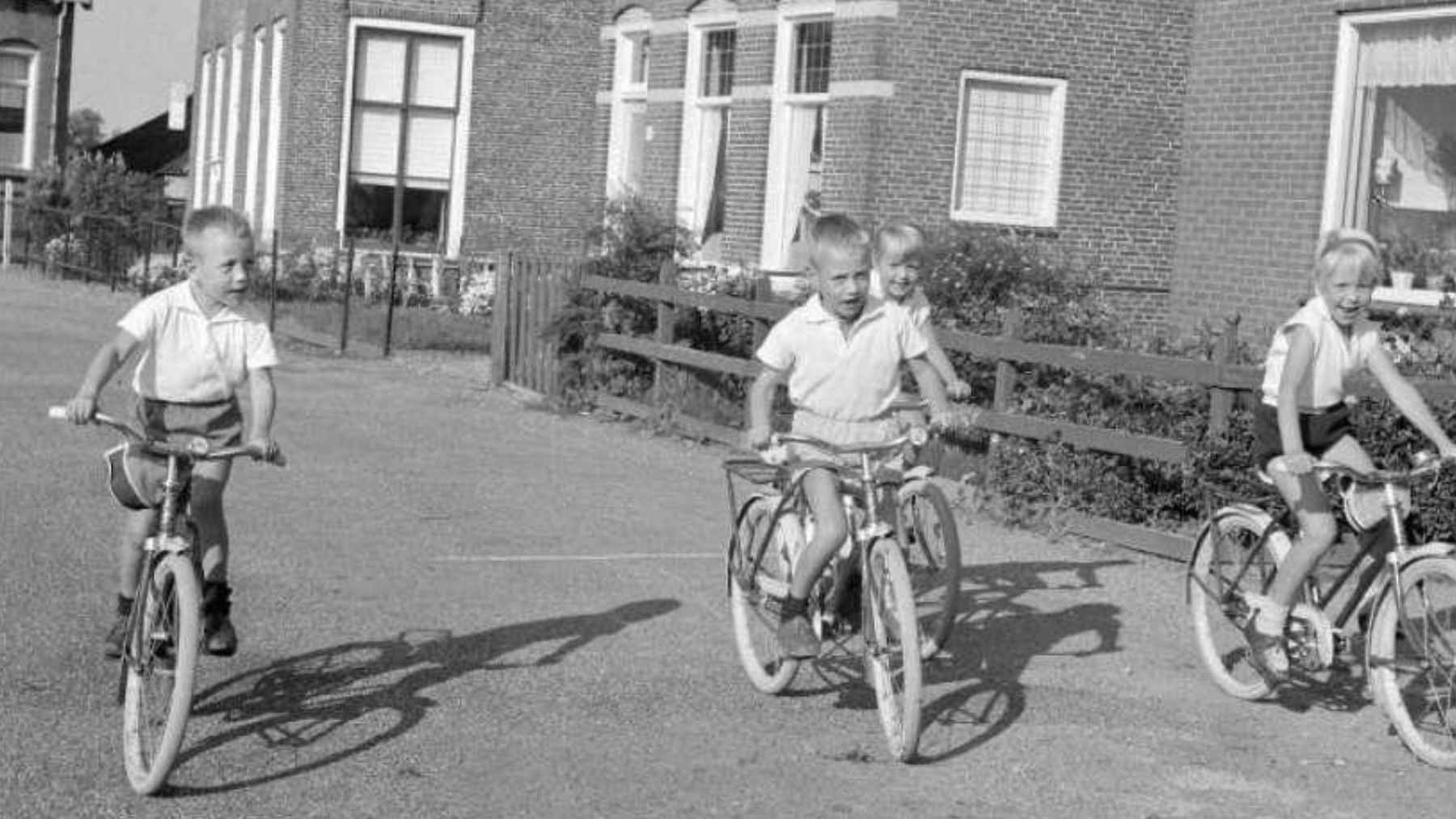
People born between 1960 and 1970 did not all have the same childhood, and nobody can prove that one decade was simply happier than another. Still, developmental psychology helps explain why many in this age group look back on childhood as freer, rougher, and somehow more solid.
Their daily lives often included street games, long bike rides, boredom, chores, and small problems adults did not instantly solve.
Those ordinary experiences may have trained autonomy, patience, social confidence, and resilience, the kind of skills that do not always grow in a schedule packed with screens, alerts, and adult supervision.
A freer kind of childhood
For many children of that era, the neighborhood was not just a place to live, it was a training ground. Kids walked to school, played outside after class, made up games, and came home when the streetlights turned on.
Research on children’s independent mobility gives this memory some weight. In England, 80% of surveyed 7 and 8 year olds were allowed to go to school without an adult in 1971, but that number had dropped to 9% by 1990, according to a Policy Studies Institute report archived by Oxford.
That does not mean the past was safer or better for everyone. It does suggest that children once had more chances to practice being alone in public, judging distance, handling traffic noise, and sorting out little conflicts without a parent nearby.
Play built the basics
Free play is not just fun, although it often feels that way. It is how children test limits, read other people’s moods, and figure out what happens when a rule feels unfair. Who gets the ball first?
The American Academy of Pediatrics says play supports planning, organization, emotional control, social skills, language, and stress coping. In practice, tag, pretend games, and backyard forts can do serious developmental work without looking like schoolwork.
That may be one reason people from this cohort often remember childhood as happy. Not because every day was easy, but because many days gave them space to feel capable.
Small problems, real confidence
There were no family group chats, location-sharing apps, or instant searches when a bike chain slipped off or a shortcut turned confusing. A child had to ask a neighbor, walk back, wait, or try again. Inconvenient? Definitely. Useful? Often.
Psychology has a name for part of this feeling, “locus of control.” The idea, linked to Julian Rotter’s work and later discussed by Harold Lefcourt, describes whether people believe outcomes are mostly shaped by their own actions or by outside forces.
A childhood with small responsibilities can strengthen that inner message. Not always, and not for every child, but when a young person learns, “I can handle this,” the lesson can stick for decades.
Boredom had a job
Today, boredom is easy to escape. A phone can fill a grocery line, a quiet car ride, or five lonely minutes before dinner. For children growing up in the 1960s and 1970s, boredom was not a glitch in the day.
That empty time may have helped imagination do its work. Sandi Mann and Rebekah Cadman of the University of Central Lancashire tested boredom and creativity in two studies involving 80 participants and then 90 more, finding that boring activities were linked with higher creativity on later tasks in some conditions.
Anyone who has turned a cardboard box into a spaceship understands the point. When entertainment is not handed over instantly, the mind starts rummaging around for something to make.

Registered dietitian Sophie Gastman encourages a simple approach to protein by stocking three versatile, protein-rich foods instead of counting macros.
Chores made children useful
Many children in this generation were also expected to help. They watched younger siblings, set tables, ran errands, carried groceries, swept floors, or helped in family businesses. It was not glamorous work, but it gave children a role.
A La Trobe University study of parents and guardians of 207 children ages 5 to 13 found that regular chores were associated with stronger executive functions, including planning, self-regulation, task switching, and remembering instructions.
Study leader Deanna Tepper said, “Parents may be able to use age and ability-appropriate chores” to support those skills.
That does not mean childhood should become unpaid labor. The key is scale. A task that fits a child’s age can say, in a quiet way, “You matter here.”
The happy childhood claim
So, were people born between 1960 and 1970 really the last generation with a happy childhood? That claim goes too far. Childhood happiness depends on family stability, health, money, safety, school, friendships, and plain luck.
On the other hand, the phrase points to something real. Many children then had more unstructured time, more face-to-face play, more boredom, more chores, and fewer digital interruptions.
The same pediatric group now advises families to consider the quality and context of screen use, not only the number of hours, because digital life affects children in different ways.
The useful lesson is not to romanticize the past. It is to recover the parts that helped children grow, including more free play, reasonable independence, fewer automatic distractions, and small responsibilities.
The main research work referenced here, by Peter Gray, has been published in American Journal of Play.