Alberta and Ontario have put a 2,050-mile oil pipeline route on the map. The proposed Northern Shield Energy Corridor would run from Hardisty, Alberta, through Saskatchewan and Manitoba to Sarnia, Ontario, carrying 500,000 barrels of crude per day at first and as much as 800,000 later, all without crossing the United States.
This is still a proposal, though, not a construction-ready project.
That distinction matters because no total cost, final schedule, committed shipper, or major private-sector proponent has been announced. A feasibility study is expected to finish by the end of 2026, and its job is to test costs, commercial models, and development options.
The map answers where, but not who pays or whether the project can clear its environmental and indigenous hurdles.
Why governments want it
Premier Danielle Smith said pipelines had gone from “impossible to a national imperative,” while Ontario Premier Doug Ford called Northern Shield a “win-win-win.” Their pitch is straightforward: keep more Canadian oil moving inside Canada, add a backup to existing routes, support Sarnia’s industrial base, and eventually reach overseas buyers.
Canada already has a west-to-east oil link, but it is not fully domestic. The Enbridge Mainline travels from Alberta through the U.S. Midwest before re-entering Canada at Sarnia, where average flows reached 733,000 barrels per day in 2024, including 104,000 barrels per day of U.S. crude.
Northern Shield is therefore less about connecting two isolated markets and more about creating an all-Canadian alternative.
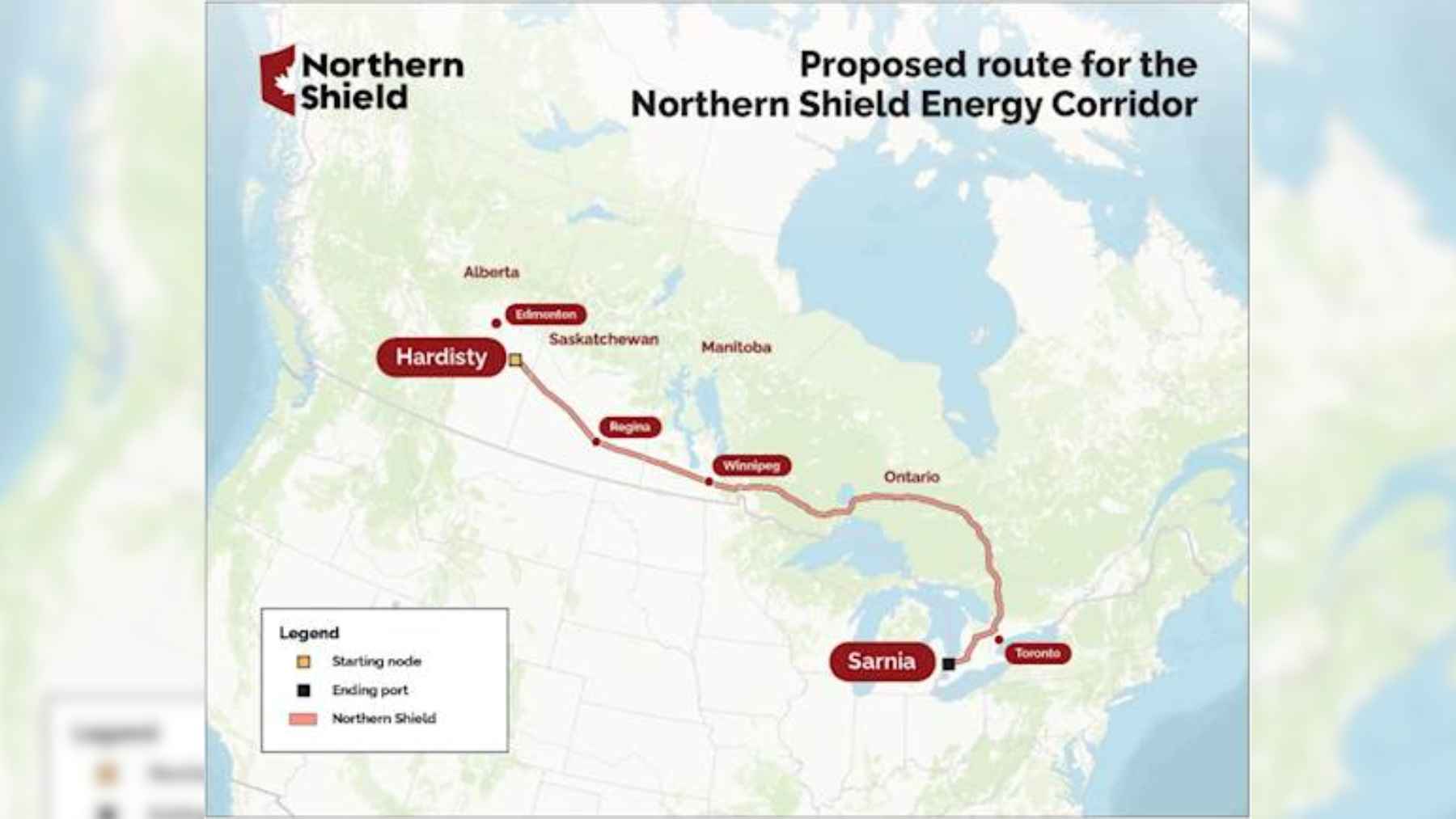
Saskatchewan Premier Scott Moe supports the plan, saying energy revenue can help fund public services. Manitoba has not clearly endorsed it, although Ford has suggested a future link to the Port of Churchill could create another export route. That political gap matters because a 2,050-mile corridor cannot move ahead on support from Alberta and Ontario alone.
The capacity math
Ontario’s four refineries processed about 386,000 barrels per day in 2025, while crude imports totaled 87,000 barrels per day and came almost entirely from the United States. Northern Shield would start at nearly six times that imported volume and could eventually carry more than twice Ontario’s current refinery throughput. So where would the rest go?
In essence, the business case depends on more than replacing imported oil. It likely requires new or expanded refineries, storage, exports, or onward pipeline connections, and Ontario has since outlined a vision for Sarnia expansion and a possible strategic petroleum reserve.
No specific refinery project, financing commitment, participating company, or construction timeline has been disclosed.
Who will pay
Engineering and consulting firm GHD is leading the feasibility work with AtkinsRéalis, EY Canada, Mokwateh, Turner & Townsend, and Wood. The team will estimate costs, examine commercial models, and study how the corridor could integrate with existing infrastructure. Those answers are due before the end of the year.
For now, neither Northern Shield nor Alberta’s separate West Coast proposal has a major private backer. Ford has said private participation and public financing are both under study, which puts taxpayers near the center of the debate before the economics are known.
Greenpeace’s Keith Stewart responded by asking why Canadians should not simply “send their tax dollars directly to ExxonMobil.”
The line is sharp, but the financing issue is real. Large pipelines normally need long-term shipping contracts to support construction debt and spread risk over many years. Without firm customers, governments would be taking a bigger bet on future oil demand, construction costs, and export prices.
The environmental test
A red line on a map can look simple. On the ground, Environmental Defence says the Ontario section could affect the lake-rich Canadian Shield, Muskoka, the Niagara Escarpment, the Bruce Trail corridor, and productive farmland. Construction could involve clearing, trenching, and blasting, while any future spill would put waterways and soils at risk.
There is also the climate question. The Canadian Energy Regulator’s 2026 outlook shows refined-product demand in Ontario and Quebec staying broadly stable or declining slightly in several scenarios, but falling much faster in a net-zero pathway. A pipeline built to operate for decades is therefore being weighed against more than one credible demand future.
Supporters see security, jobs, and better access to world markets. Critics see public money locked into long-lived fossil fuel infrastructure while electric vehicles, heat pumps, wind, and solar grow. Both arguments lead back to the same missing document, a transparent feasibility study that tests demand as hard as it tests engineering.
Indigenous consultation could reshape the plan
Ontario says it has begun consultation and is considering equity partnerships, training, and community investment for indigenous communities. However, the Anishinabek Nation said First Nations were “blindsided” by the route announcement and that no meaningful discussions took place before it was made public–not a side issue.
A route crossing four provinces and many traditional territories will have to address land, water, treaty rights, and economic participation in concrete terms.
Even a strong engineering design can stall when consultation starts late or communities believe the outcome was decided first. In everyday terms, partnership cannot be taped onto the project after the map is printed.
What happens next
The end-of-2026 study must provide the facts now missing, including a realistic cost, construction schedule, financing plan, likely shippers, crude specifications, refinery requirements, and environmental path.
It should also explain whether the pipeline’s main purpose is domestic supply, exports, or both. Those are different business cases, and Canadians will ultimately be asked to carry some of the risk if public financing moves ahead.
For now, Northern Shield is a national ambition with an address, not an approved pipeline. Smith and Ford have shifted the political conversation, but steel will not move until the economics, consultations, and approvals catch up with the map.
The latest official press release was published on Ontario Newsroom.