Electric cars are already changing the way people think about driving, energy, and pollution. But one stubborn problem still hangs over the industry: what happens when a battery starts losing capacity after years of charging, fast charging, heat, vibration, and everyday use?
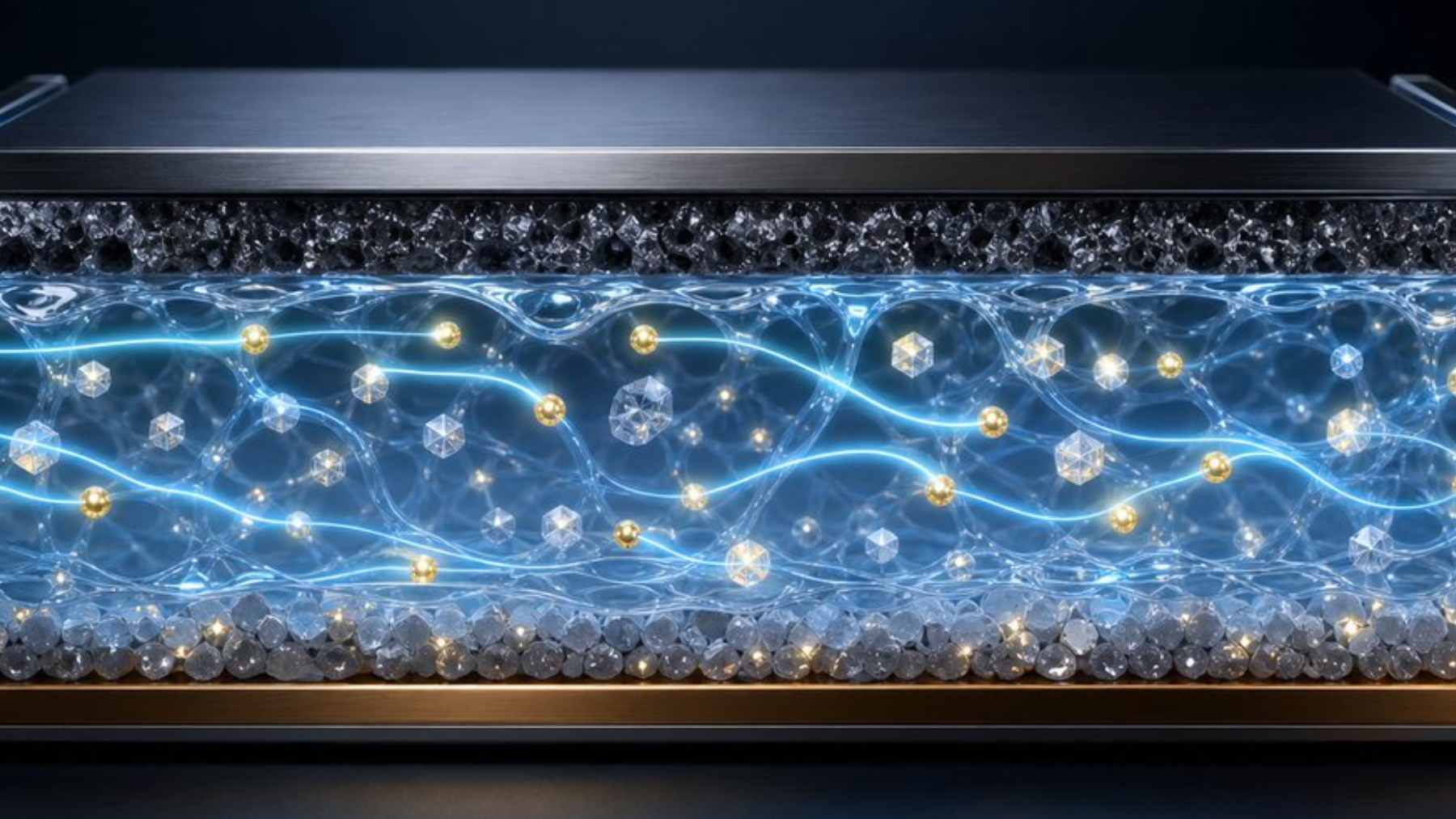
A research team at the Dalian Institute of Chemical Physics, part of the Chinese Academy of Sciences, says it has found a promising way forward. The team developed a new organic-inorganic gel electrolyte for solid-state batteries, a technology often described as one of the most important next steps for cleaner, safer, longer-range electric vehicles.
A battery breakthrough with a practical goal
Solid-state batteries are safer because they replace the flammable liquid electrolyte used in many lithium-ion batteries with a solid or solid-like material. That’s not just better safety, it’s more energy packed into the same space with faster charging.
The trouble is, the technology has been difficult to move from the lab to the road. Solid electrolytes can be brittle, their contact with electrodes can be poor, and lithium ions may not move quickly enough through the material. That’s where this new electrolyte comes in.
According to the institute, the researchers used lithium oxychloride, known chemically as Li3OCl, to trigger a chemical reconstruction of polyvinylidene fluoride, or PVDF, inside the battery cell. That reaction helped form a lower-resistance pathway for lithium ions, while keeping the flexibility that battery engineers need.
Why this tiny material matters
Think of lithium ions as commuters trying to move through a packed city. If the roads are broken or poorly connected, traffic slows down. In a battery, that slowdown means lower performance, more heat, and faster wear.
The Chinese team’s approach is meant to create smoother routes inside the electrolyte. The official statement describes the strategy as a way to combine the high conductivity and stability of inorganic materials with the flexibility and interface-matching advantages of polymers.
That may sound like a small materials-science detail, but it goes straight to one of the biggest environmental questions around EVs. A cleaner car is not just one that produces no tailpipe emissions. It is also one whose battery lasts long enough to reduce waste, lower replacement costs, and make the whole ownership experience less risky.
The numbers are getting attention
In lab testing, the new electrolyte reached room-temperature ionic conductivity of 2.73 × 10⁻⁴ siemens per centimeter, or about 6.93 × 10⁻⁴ siemens per inch. It also showed a lithium-ion transference number of 0.90 and an electrochemical window above 4.78 volts.
Its mechanical strength also stood out. The material had a Young’s modulus of 892.53 MPa, which is roughly 129,500 lbs. per square inch. That stiffness matters because EV batteries have to survive more than tidy lab benches. They face potholes, heat, cold, road vibration, and the occasional hard bump.
The battery system also remained stable for more than 2,500 hours in a symmetric cell test. In a full cell using an NCA cathode, the battery kept 84.15% of its original capacity after 350 cycles at a 1C rate, meaning a charge or discharge pace often treated as a one-hour benchmark in battery testing.
EVs need better batteries, not just more batteries
The timing is important–electric vehicles are no longer a niche experiment. The International Energy Agency reported that global electric car sales grew by 20% in 2025 to more than 20 million vehicles, equal to one-quarter of all new cars sold worldwide.
Battery demand is rising just as fast. In 2025, EV battery deployment reached 1.2 terawatt-hours, nearly 30% more than in 2024 and more than seven times the level seen in 2020. That scale is good news for cutting oil use, but it also means the world needs batteries that are safer, longer-lasting, and easier to justify economically.
There is an everyday side to this, too. Drivers do not only ask how far an EV can go on day one. They want to know how it will perform after five winters, hundreds of fast charges, and thousands of school runs, grocery trips, and highway miles.
The road to production is still complicated
This discovery does not mean solid-state EVs will flood dealerships overnight. Battery history is full of impressive lab results that took years to become products, and some never made it at all.
Dongfeng has reportedly targeted the second half of 2026 for mass production and vehicle integration of solid-state batteries that could support more than 620 miles of range. Its reported energy density is 350 watt-hours per kg., or about 159 watt-hours per lb.
On the other hand, CATL has sounded more cautious. Reporting on comments from CATL chairman Robin Zeng suggests the world’s largest EV battery maker sees true large-scale solid-state deployment as unlikely before 2030, with the technology still facing manufacturing, cost, and readiness hurdles.
A greener car depends on a tougher cell
For the most part, EVs already help reduce oil demand. The IEA estimates that the global EV fleet displaced about 1.7 million barrels of oil per day in 2025, roughly equal to Indonesia’s total oil demand that year.
The next phase of electrification will be judged by more than sales charts, though. Consumers, automakers, fleet operators, and governments will look closely at battery durability, charging speed, safety, raw materials, and total cost over time.
That is why this electrolyte research matters. It targets the hidden weak point inside the battery, the place where chemistry, mechanics, and manufacturing all have to work together. Not glamorous, maybe, but essential.
What comes next
The new gel electrolyte still needs more testing before anyone can call it road-ready. Lab cells are one thing. A battery pack in a family SUV, delivery van, or emergency fleet vehicle is another challenge entirely.
Still, the work points to a possible path for solid-state batteries that do not trade flexibility for performance. If that balance can be scaled, it could make EVs more dependable, and to a large extent, more environmentally valuable over their full lifetime.
The official statement was published on Dalian Institute of Chemical Physics, and the study was published in the “Journal of Colloid and Interface Science.”