Could a train station help build a city before the city itself is fully finished? In northern China, Xiong’an Railway Station was designed to do exactly that, acting as a transport hub, clean-energy platform, and smart-building test case all at once.
Opened on December 27, 2020, the station covers about 5.1 million ft.², roughly 117 acres, and connects Xiong’an New Area with China’s high-speed rail network. The project used solar panels, digital modeling, welding robots, and real-time building systems, giving the station a bigger role than simply moving passengers from one platform to another.
A station built for a new city
Xiong’an Railway Station was the first major infrastructure project completed in Xiong’an New Area, a planned urban zone south of Beijing. Official Chinese sources describe the area as a key destination for functions moved out of Beijing that are not essential to the capital’s role.
That matters because the station is not just serving an existing city. For the most part, it is helping create one. The Xiong’an official website says the station opened alongside the Beijing-Xiong’an intercity railway and became a major link for the movement of people, goods, and information across the Beijing, Tianjin, and Hebei region.
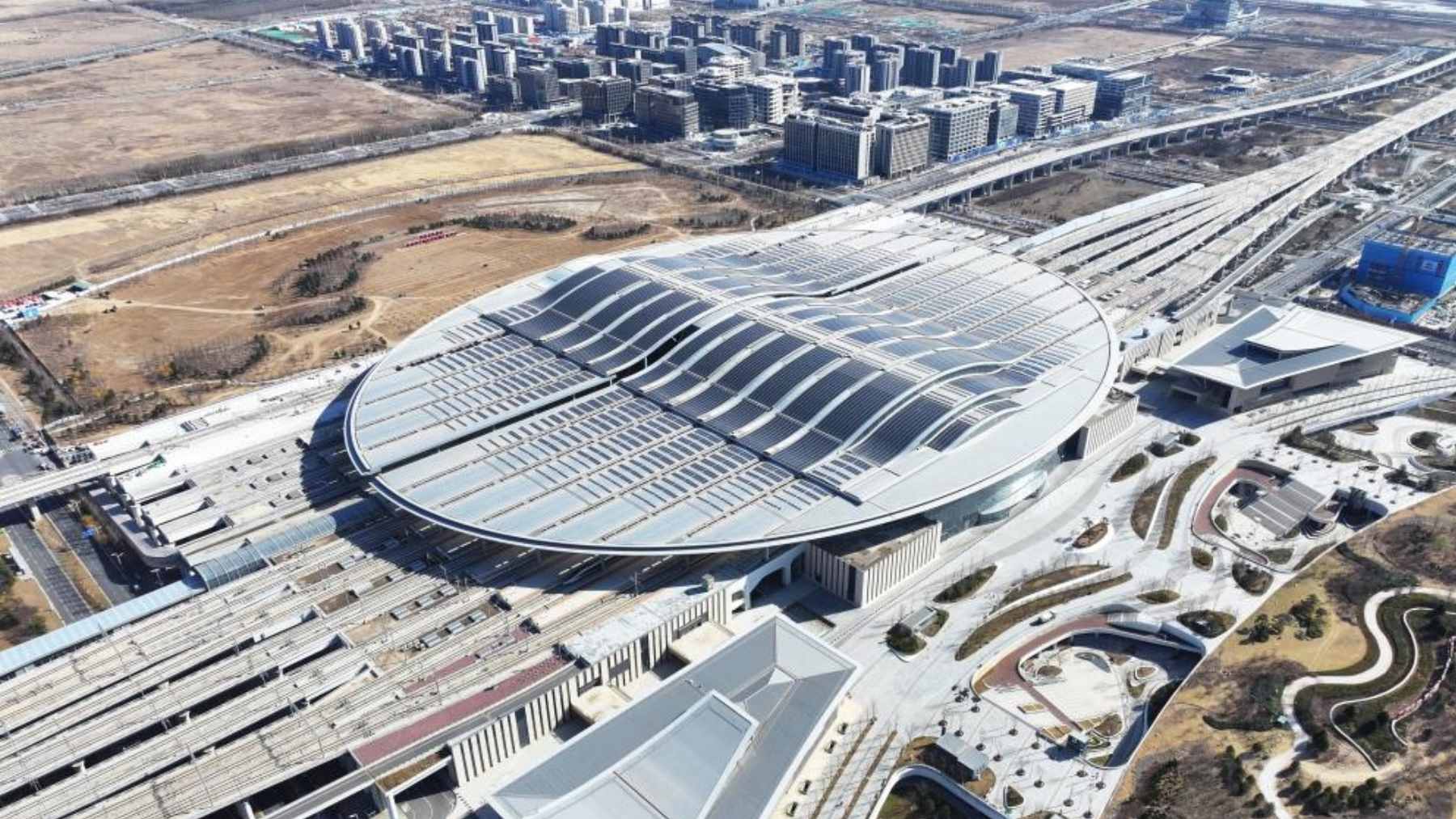
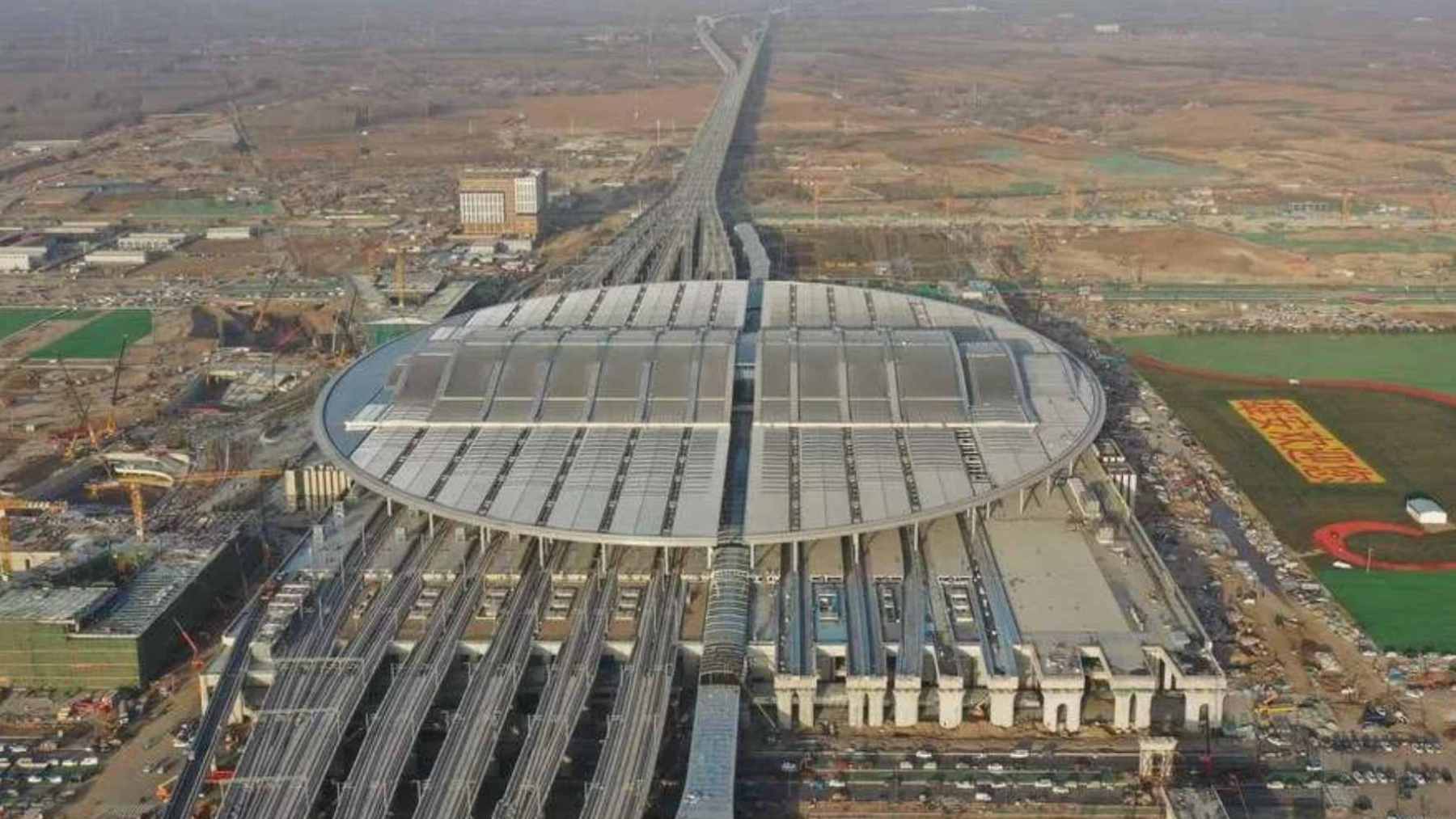
The scale is hard to picture. Xiong’an officials put the station’s total building area at about 475,200 m² (5.1 million ft.²), with five levels and a large oval shape inspired by a drop of water on a lotus leaf.
Built fast, but not simply
The speed of construction is one of the details that stands out. Xiong’an official reporting says the station began construction on December 1, 2018, and was ready for service by late December 2020.
How does a project that large move so quickly? One answer is digital construction. China State Construction Engineering Corporation said the project used artificial intelligence, big data, cloud computing, the Internet of Things, and building information modeling throughout the construction process.
In practical terms, engineers could monitor and coordinate many moving pieces before mistakes became costly. The station was less like a traditional job site and more like a giant live model, with planners, builders, and operators working from a shared technical picture.
Robots joined the crew
The steel structure was one of the project’s biggest challenges. China State Construction Engineering Corporation described it as the station’s core frame, with around 144,400 tons of steel used in the main structure.
The project also used automatic welding robots alongside skilled manual welding. That may sound like a small detail, but it matters on a job where thousands of repeated connections must be strong, uniform, and finished under pressure.
There is a lesson here. Big infrastructure is not only about pouring concrete faster. It is also about keeping quality steady when the clock is moving and the building is too large for guesswork.
A roof that earns its keep
The station’s roof is not just an architectural gesture. It is also a solar power station, with about 452,000 ft.² of photovoltaic panels built into the oval structure.
According to Xinhua, the rooftop system generates about 5.8 million kilowatt-hours of electricity a year. State Grid Xiong’an Integrated Energy Services project manager Luo Xiaodong said the system can save about 1,984 tons of standard coal annually and reduce carbon dioxide emissions by about 4,960 tons.
That is the green part that travelers may never notice while checking a departure board or looking for coffee, but it is built into the everyday operation of the station. The solar system was connected to the grid on December 25, 2020, two days before the station officially opened.
Faster trips, cleaner choices
The Beijing-Xiong’an link changed the travel math around the new area. Xinhua reported that passengers can reach Beijing West Railway Station from Xiong’an in as little as 50 minutes, while the trip to Beijing Daxing International Airport can take about 19 minutes.
That is the practical side of high-speed rail. It may look like a national planning project from far away, but for travelers it often comes down to something simpler. Less time in traffic, fewer long waits, and a better chance of getting home before the day disappears.
The line also supports a larger environmental argument. When fast rail connects airports, business districts, and new urban zones, it can reduce dependence on car trips for regional movement. The benefit is not automatic, of course, but the infrastructure makes cleaner choices easier.
Comfort was part of the plan
Xiong’an Station was also designed around passenger experience. The official Xiong’an website says the station connects high-speed rail, buses, taxis, and other transport services so travelers can move through the area with fewer breaks in the trip.
The building includes extensive exposed concrete, a choice that requires unusually precise execution because the surface is not hidden behind later finishes. Xiong’an officials said the station became China’s first railway station to use exposed concrete columns on a large scale inside a waiting hall.
There are also quieter details, the kind passengers feel before they notice. Acoustic treatment, natural light, and smart operations can turn a huge station from an echoing box into a place where people can actually wait without feeling swallowed by the building.
Why Xiong’an still matters
Xiong’an remains a long-term project, not a finished city. Reuters reported in March 2026 that the area is still under construction and that central Xiong’an remains sparsely populated, with basic completion targeted for 2035.
That makes the station even more interesting. It is not the final answer to Xiong’an’s future, but it is one of the clearest signals of what Chinese planners want the city to become. Fast rail, smart systems, clean power, and regional integration are being placed at the center from the start.
The bigger question is whether people, companies, schools, and everyday routines will fill in around the hardware. Steel and solar panels can be built quickly. A living city takes longer.
The official project information was published on China State Construction Engineering Corporation.