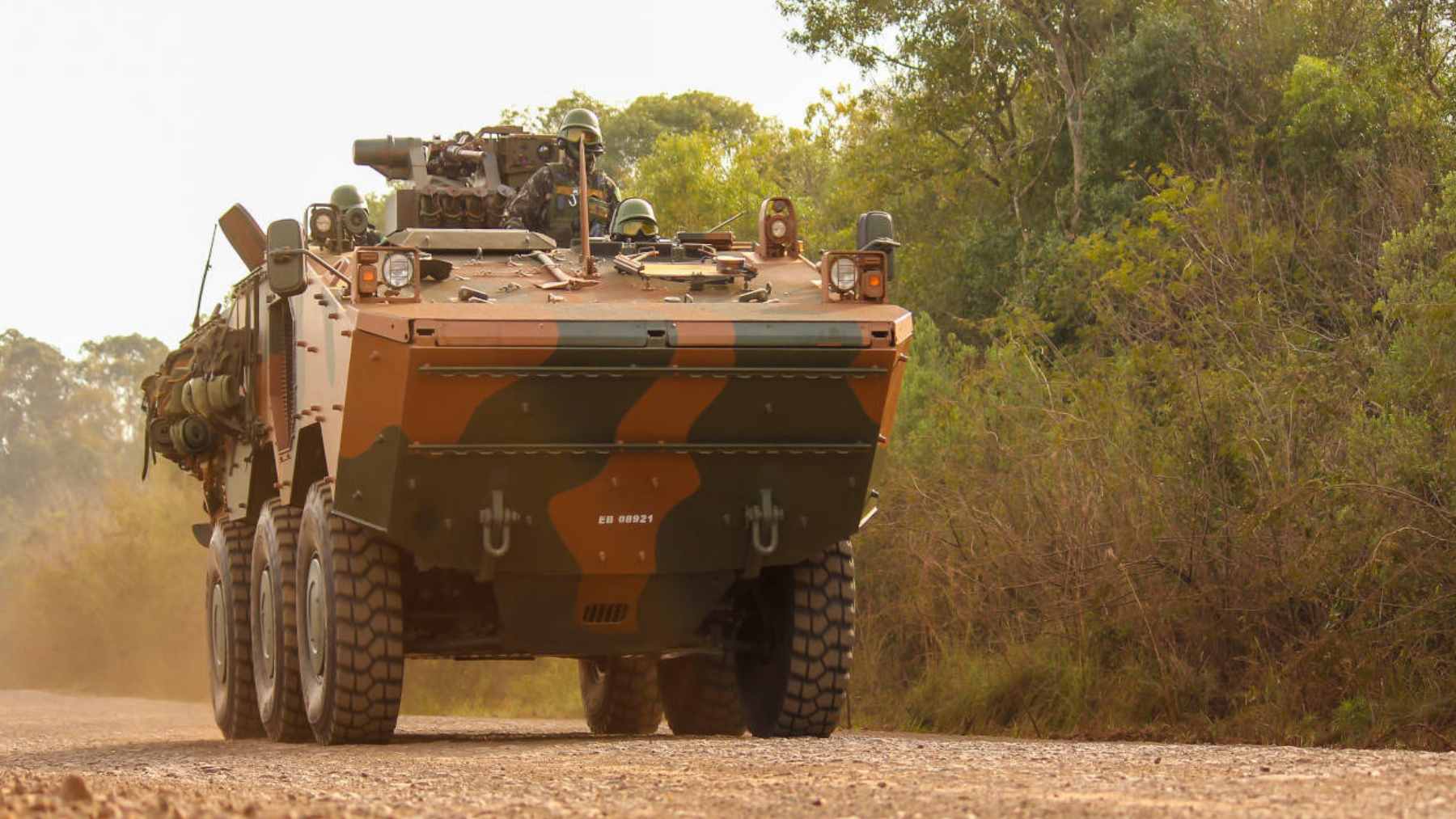
Brazil’s Guarani 6×6 looks like a military machine at first glance, with six driven wheels, a V-shaped hull, amphibious capability, and enough room for up to 11 people. But its story is also about something more familiar now, which is what happens when floods erase the line between roads and rivers.
At roughly 39,700 lbs., it is not a tank. It is a protected mobility vehicle, and Brazil’s Army has tied it to two goals at once: moving troops across difficult terrain and strengthening the country’s defense industry.
A vehicle shaped by terrain
Brazil is not an easy place to design for. Long borders, rural roads, flooded crossings, mud, and remote regions all change what a military vehicle has to do on a normal day.
That is why the VBTP-MR Guarani uses a 6×6 wheeled layout rather than tracks. Wheels usually make more sense when a force needs to cover long distances on roads and dirt routes without the heavier logistics of tracked armor.
The public specifications put the Guarani near highway speed for a wheeled, armored troop carrier, with official summaries listing about 68 mph on roads. In practice, speed depends on load, terrain, visibility, and mission needs.
Why amphibious mobility matters
The Guarani’s amphibious capability is not just a brochure feature. During the 2024 floods in Rio Grande do Sul, the Brazilian Army said the vehicle was used in Operation Taquari II because of its amphibious ability and logistics strength.
That matters in a climate-stressed world. World Weather Attribution reported that more than 16.5” of rain fell in Rio Grande do Sul between April 24 and May 4, 2024, affecting more than 90% of the state.
When a street becomes a canal, a normal truck is suddenly not enough. The Guarani does not remove the need for bridges, boats, or civil defense planning, but it gives commanders another tool when access breaks down.
Protection starts underneath
The Guarani’s protection is not just about thick armor plates. Its V-shaped hull, raised cabin, suspended seating, and internal materials are meant to reduce the force transmitted to the people inside.
The basic idea is easy to picture. If a blast comes from below, the lower shape helps push some of that energy away from the center of the vehicle rather than straight into the crew compartment.
Still, no armored vehicle is invulnerable. Protection depends on the exact configuration, added armor, the type of threat, and the conditions in which the vehicle is operating.
Remote weapons, safer operators
The Guarani can also carry remote weapon systems, including REMAX. ARES describes REMAX as a gyro-stabilized remote system for .50 and .30-caliber machine guns, operated by a person inside an armored vehicle.
That changes the daily risk for a crew. Instead of standing exposed outside the vehicle, the operator can use screens, a day camera, thermal imaging, a laser rangefinder, and a touch monitor from inside the protected space.
Does that make the system perfect? No. Smoke, bad weather, vegetation, rough ground, and damaged sensors can still limit what a crew sees.
Built as an industry project
The Guarani is also an industrial story. The Brazilian Army says the project began in 2005, now has more than 700 units in operation, and helped push forward domestic research, development, and innovation in defense products.
Iveco’s senior executive Humberto Spinetti said the project led the company to install an armored-vehicle production capability in Brazil. He also pointed to knowledge transfer, new suppliers, jobs, and regional development around Sete Lagoas in Minas Gerais.
In practical terms, the Guarani is not just one vehicle rolling out of a factory. It is a platform around which engineers, suppliers, mechanics, training teams, and Army units have organized.
A family, not just one vehicle
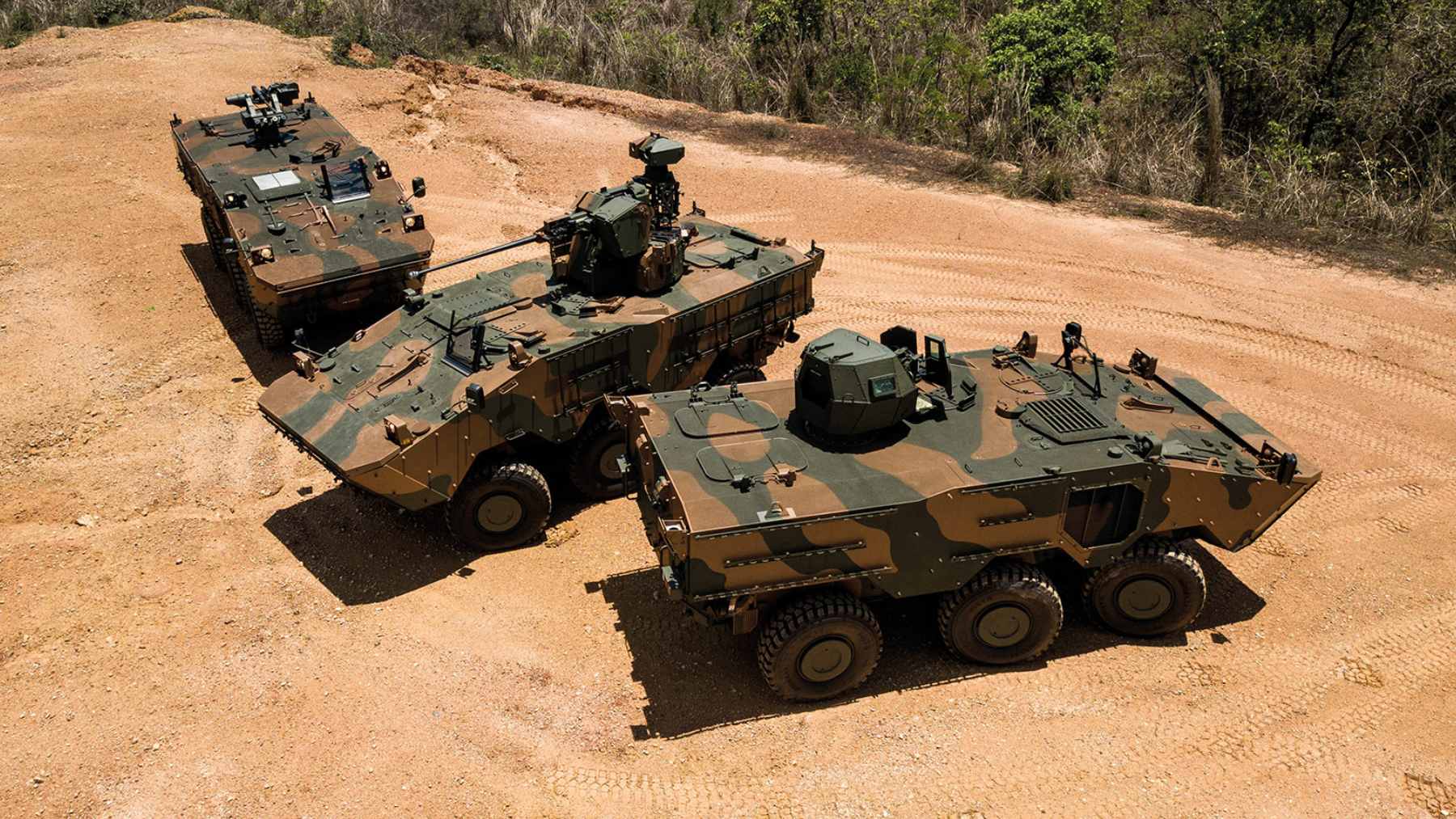
The Army has described the Guarani as modular, with versions planned or developed for command posts, mortar carriers, ambulances, air defense, and other missions. That kind of common base can make training and maintenance easier over time.
This matters because militaries rarely buy just one machine. They buy a system of spare parts, classrooms, repair shops, software, sensors, and people who know how to keep it running.
The Army commander, Gen. Tomás Miguel Miné Ribeiro Paiva, called the Guarani “a product tested and approved.” He also said it has export potential, which would further support Brazil’s defense industry.
Deliveries show momentum
Recent official monitoring documents show the program is still moving. Brazil reported 60 Guarani 6×6 vehicles delivered in 2024, along with eight REMAX automated weapon systems and three command-and-control systems.
For 2025, the Ministry of Defense reported 63 armored vehicles delivered, including 60 Guarani 6×6 vehicles, one modernized Cascavel, and two Centauro 8×8 vehicles. The same document said the result was considered adequate despite budget restrictions and supplier delays.
That last detail is important–modernization is not a straight line. Even a program with clear demand can run into money, production, and schedule problems.
What the Guarani really signals
Calling the Guarani a mobile fortress sounds dramatic, but the more useful phrase is “protected mobility.” It is designed to move a small military group through difficult conditions while keeping them under armor and giving them onboard support.
At the end of the day, that is the key question. When mud, water, broken roads, and distance make everything harder, can a squad still get through?
For Brazil, the Guarani is part military vehicle, part industrial policy, and part reminder that mobility now means more than speed on pavement. In a flood-prone, climate-stressed world, getting across the ground safely may be one of the hardest technologies to master.
The official monitoring statement was published on Gov.br.