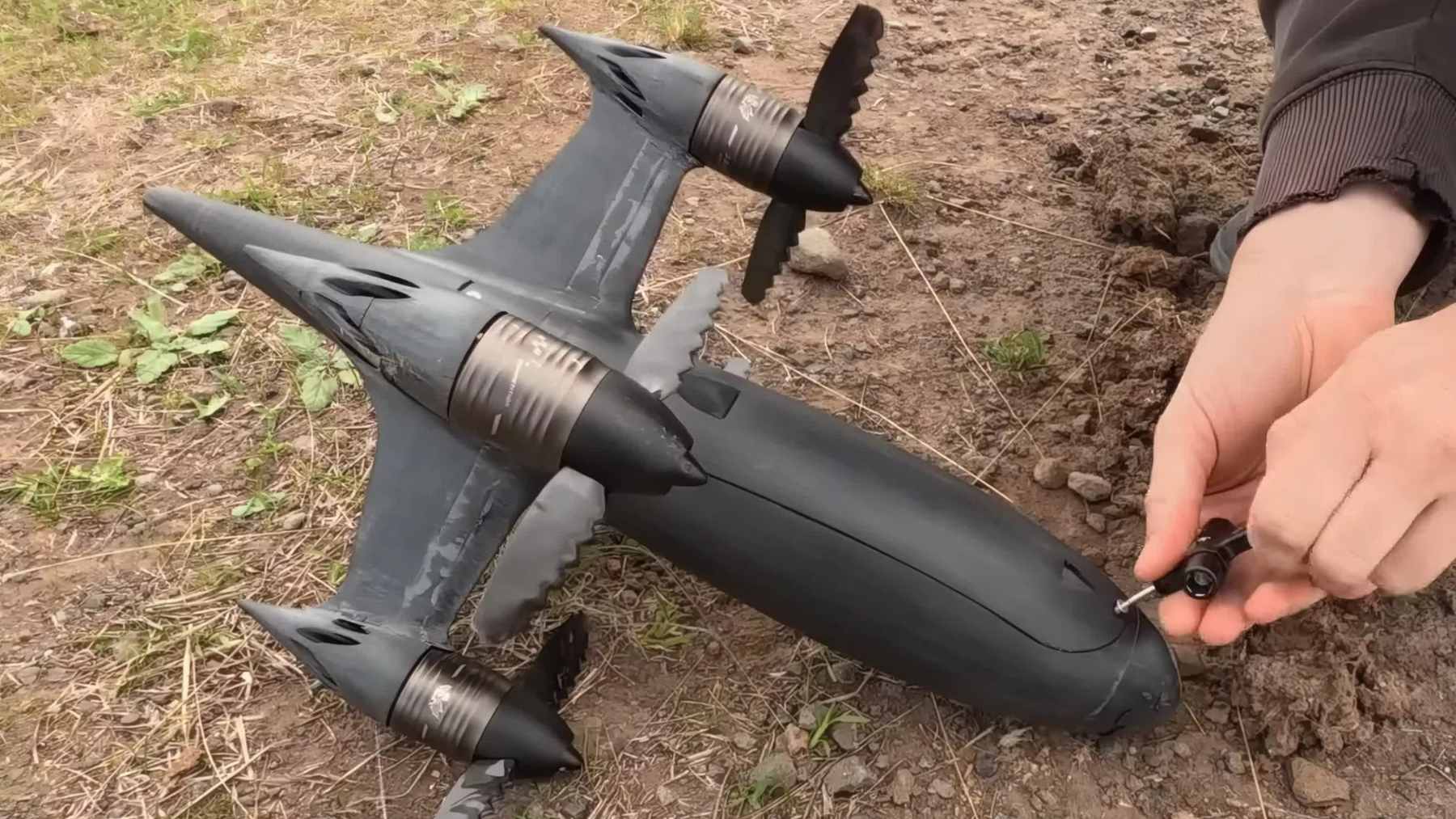
A custom-built drone called Blackbird has reached an unofficial top speed of 453 mph, putting a garage-style engineering project uncomfortably close to the cruising speed of some passenger jets. The test, shared by Drone Pro Hub, was not yet certified by Guinness World Records, but the two-way average of about 425 mph would still beat the current official quadcopter record if verified.
At first glance, this looks like a speed stunt, until you look again. The same ideas behind Blackbird (lighter parts, smarter airflow, stronger electric propulsion) point toward a future where drones could move faster during wildfire mapping, disaster response, environmental monitoring, and defense missions.
Not tomorrow morning, of course, but the direction of travel is hard to miss.
A record with a catch
The Blackbird drone was built by Ben Biggs and Aidan Kelly of Drone Pro Hub, who have been trading speed milestones with South Africa’s Luke and Mike Bell. Guinness currently lists the official battery-powered RC quadcopter speed record at 408.60 mph, set by the Bells in Cape Town on December 11, 2025.
Blackbird’s latest run went much faster. The drone hit about 453 mph with a tailwind and about 397 mph against the wind, giving the team an average of about 425 mph across two directions. That matters because two-direction averages help reduce the effect of wind, which can make a single pass look better than the aircraft really is.
Still, the attempt remains unofficial. TechRadar reported that the record was not ratified because a professional observer was not present, even though GPS and on-camera telemetry backed the team’s figures.
The propeller trick
So what changed? Not a giant engine, not a military lab, not some secret fuel. The big breakthrough appears to be a set of handmade carbon-fiber propellers with aggressive pitch and sawtooth leading edges.
In practical terms, those blades are designed to work better when the drone is already moving extremely fast. Their angle points more toward the direction of travel, which can make them more efficient at high speed but less useful during slow takeoff or hovering.
The sawtooth edges are the eye-catching part. They help guide airflow over the blade instead of letting it slide sideways, creating tiny vortices that can stabilize the boundary layer and reduce drag. It sounds small, but at more than 400 mph, small things become the whole game.
Speed comes at a price
Blackbird’s first major test did not end neatly. The drone reportedly reached about 393 mph before losing connection, with the team pointing to antenna geometry, Doppler effects, and signal overload as possible reasons the video link failed.
That is where this story stops being just fun and starts feeling serious. A drone traveling at that speed can cover huge distances in seconds, and a lost link is not the same thing as a dropped toy in the backyard.
The second drone survived, but barely. Reports say the system pulled roughly 400 amps for about 10 seconds, the batteries reached around 176°F, and parts of the wiring showed heat damage after landing.
Why environmental teams care
What does a 453 mph racing drone have to do with ecology? More than it seems. The U.S. Geological Survey says uncrewed aircraft systems already support environmental monitoring, climate impact analysis, natural hazard response, wildland fire assessments, wildlife inventories, and emergency missions.
Most of those missions do not need a drone flying at jet-like speed. A wildlife survey, for example, is usually about endurance, stability, sensors, and careful flight paths. But in emergencies, the first minutes matter. A faster electric aircraft could one day help get eyes on a spreading fire, a toxic plume, a flood zone, or a damaged power line before crews can safely reach the area.
NASA is also studying AI-enabled drone swarms for wildfire detection, mapping, and modeling. Its project focuses on real-time fire analysis, prediction, sensor fusion, and communication between higher-altitude platforms and lower-altitude drones.
The dual-use problem
There is another side to this: fast drones are useful, but they are also dual-use technology. The same performance that could help emergency crews map a wildfire could interest military planners, border agencies, smugglers, or anyone looking to move a payload quickly through low airspace.
That does not mean the Blackbird team is building a weapon. It does mean speed, autonomy, and open technical know-how need guardrails. A drone that is exciting in a test field can be dangerous near people, aircraft, highways, or fire crews.
The U.S. Forest Service warns that unauthorized drones near wildfires can interfere with firefighting aircraft, which often fly only a few hundred feet above the ground. In 2019, officials documented at least 20 unauthorized drone incidents over or near wildfires in seven states, with aerial firefighting operations temporarily shut down nine times.
The rulebook is catching up
The Federal Aviation Administration has been gradually integrating drones into the National Airspace System, while also reviewing advanced drone operations under environmental rules. Those reviews can consider issues such as noise, land use, community impacts, and effects on sensitive environmental resources.
That is important because drone progress is not just about what engineers can build. It is also about where these machines fly, who controls them, how loud they are, how much energy they use, and what happens when something fails.
For now, Blackbird is not a public safety drone. It is a record-chasing machine built around an extreme trade-off. But breakthroughs often start that way, as odd-looking prototypes that test the limits before safer, slower, more practical versions appear.
What comes next
Biggs and Kelly may try again under official Guinness conditions. If they can repeat the two-way average with observers and proper verification, the record could change hands once more. That rivalry alone has already pushed electric quadcopters into territory that sounded unrealistic only a short time ago.
The bigger question is not whether a hobby drone can go even faster–it probably can. The real question is how much of this engineering can be turned into reliable tools for the places that need them most, from wildfire lines to storm-hit communities.
At the end of the day, Blackbird is a warning and a glimpse of the future at the same time. Fast drones could help protect people and landscapes, but only if speed is matched with safety, regulation, and a clear public purpose.
The test video was published on Drone Pro Hub.