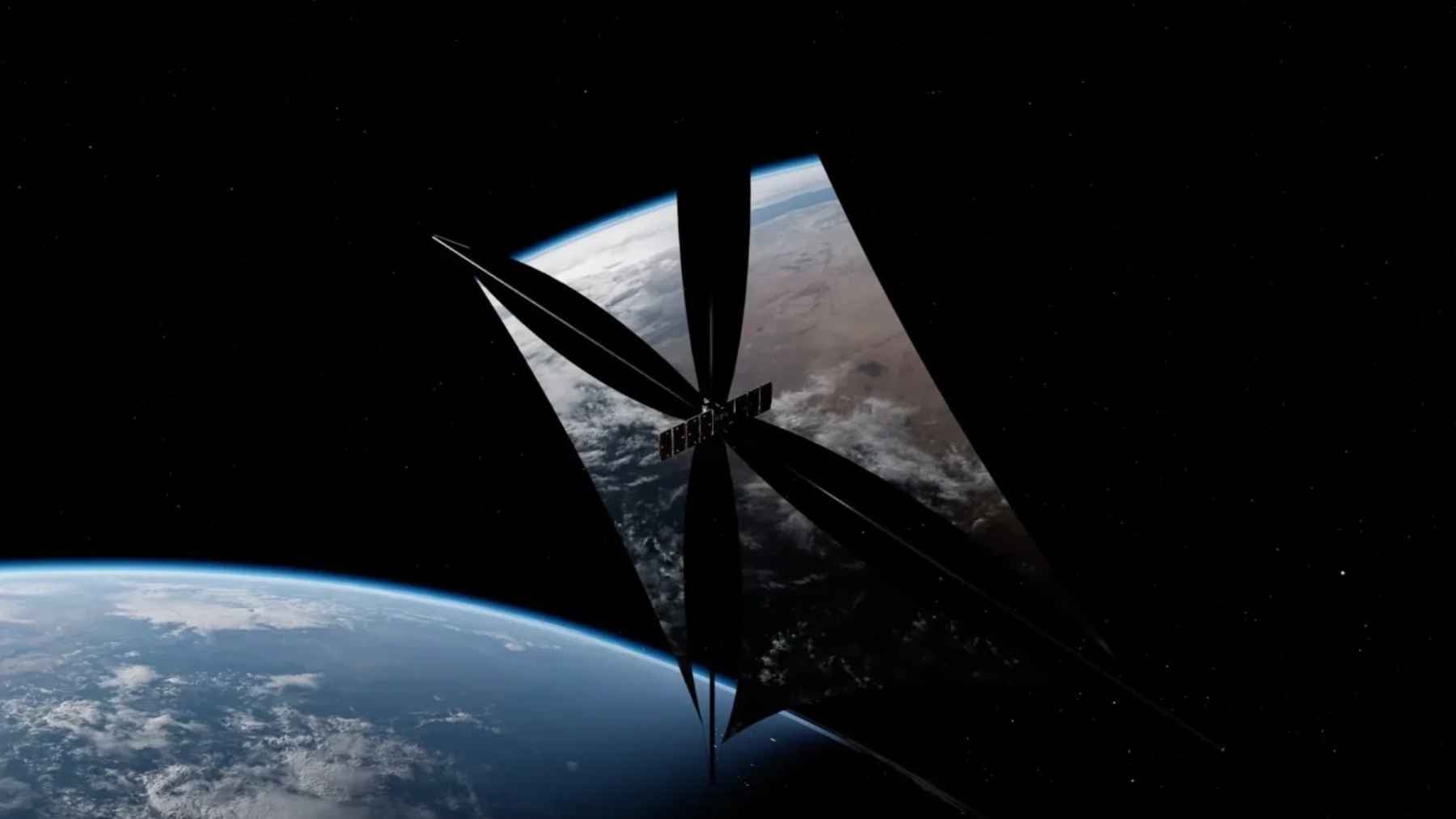
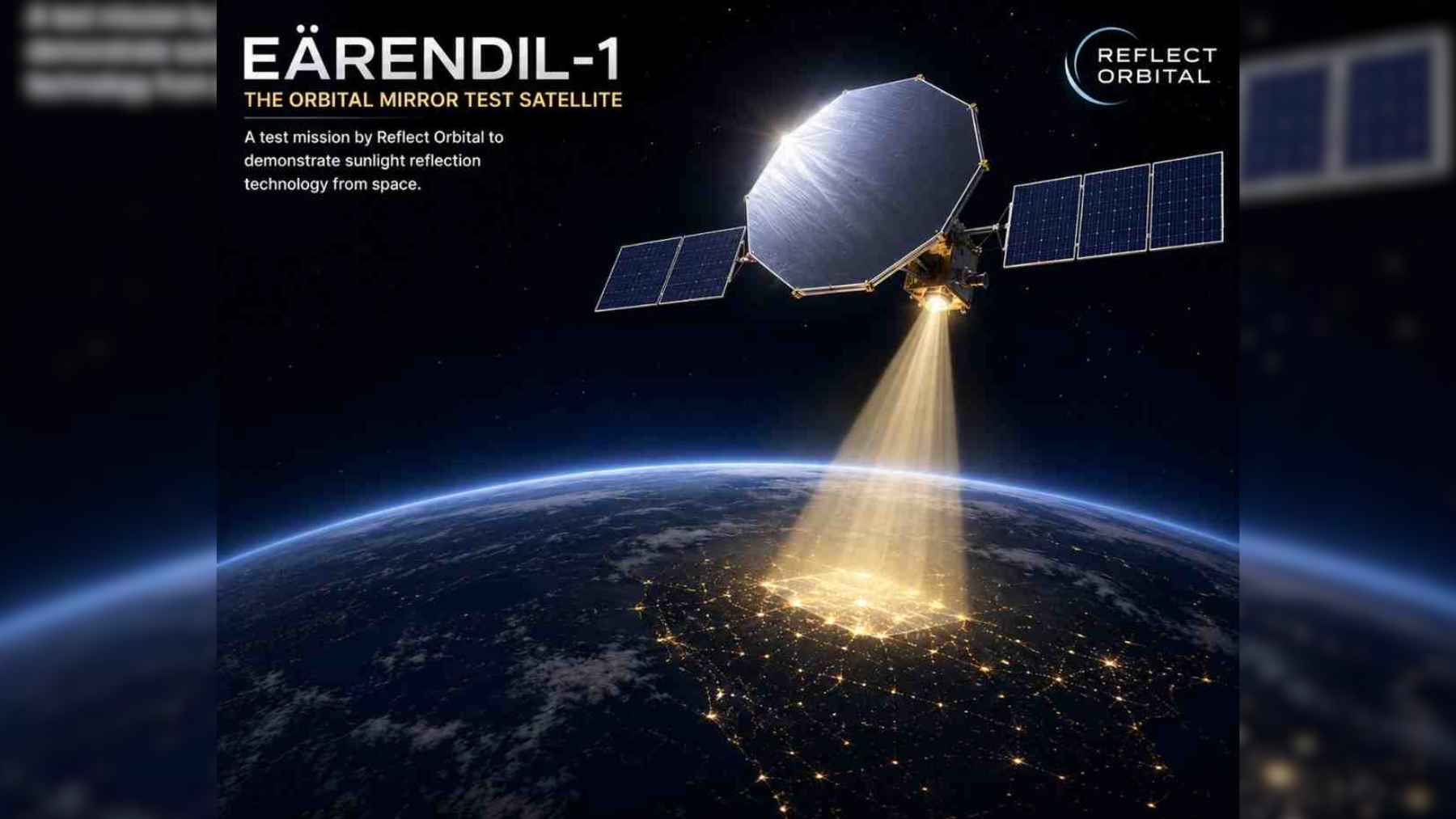
The U.S. Federal Communications Commission has granted the radio authorization needed for Reflect Orbital to deploy and operate Earendil-1, a demonstration satellite built to steer reflected sunlight onto a chosen patch of Earth after sunset.
The decision covers one experimental spacecraft, not the startup’s much larger constellation, but it moves the idea of selling nighttime sunlight from a pitch deck toward orbit.
Reflect Orbital markets the idea as “sunlight on demand” and presents the technology as clean infrastructure for solar farms, emergency response, agriculture, cities, industrial sites, and defense. Yet the central question is bigger than whether a thin mirror can bounce light.
Who gets to commercialize darkness, and what evidence should be required before the night sky becomes a service?
The first test is only the beginning
The FCC authorization allows Earendil-1 to operate about 388 miles above Earth in low-Earth orbit. The satellite will carry a motorized thin-film reflector reported to measure about 59 feet on each side, producing a moving illuminated area roughly 3.1 miles wide. The company says its 2026 demonstration will last up to five minutes and be close to full-moon brightness.
That sounds modest. Reflect Orbital’s own roadmap, however, shows two satellites in 2026, more than 5,000 by 2030, and more than 50,000 by 2035, with later services intended to reach daylight-like intensity for hours. The FCC did not approve that future system and explicitly treated concerns about a huge constellation as outside the single-satellite case before it.
The business has serious backing. Reflect Orbital announced a $20 million Series A led by Lux Capital in 2025, saying the money would support its first missions and a market spanning energy, remote operations, civil infrastructure, and defense. That is why Earendil-1 matters even if its first beam is faint, since it is a market test as much as an engineering test.
Selling sunlight meets hard physics
A mirror in orbit does not deliver a tight flashlight beam. Because the Sun appears as a disk rather than a point, reflected light spreads over distance, while a low-orbit satellite races across the sky and can reach most locations mainly around dawn or dusk. That limits both brightness and the time any one spacecraft can serve a customer.
Astronomers Michael Brown of Monash University and Matthew Kenworthy of Leiden University estimated that a future satellite with a 177-foot mirror would be about 15,000 times dimmer than midday sunlight. Their calculation suggests roughly 3,000 such satellites would be needed to provide 20% of midday illumination to one area, and only for around 3.5 minutes during a pass.
That makes the energy pitch difficult. Battery pack prices fell about 20% in 2024 and another 8% in 2025, according to the International Energy Agency, while battery storage systems in 2025 cost about one-third of their 2020 level.
For a solar farm, ground storage is becoming cheaper while orbital sunlight still requires launch capacity, spacecraft control, and enough mirrors in the right place at the right time.
Darkness is part of the ecosystem
Night is not simply unused daylight. Plants, insects, birds, mammals, and humans evolved around repeating light and dark cycles, and artificial light can alter migration, feeding, sleep, and reproduction. In one field experiment, nighttime lighting reduced nocturnal pollinator visits by 62% and harmed plant reproductive success.
That study involved fixed ground lights, not a brief beam from space, so it cannot tell us exactly what Earendil-1 will do. This distinction matters. The first mission may create little measurable harm, but evidence from streetlights also shows that biological systems can respond at light levels far below anything resembling noon.
Reflect Orbital says its beams will be targeted, scheduled, and quickly switched off by rotating the satellite. It also promises to avoid observatories and protected habitats, share orbital information, and keep the demonstration near full-moon brightness.
DarkSky International argues that those commitments are not a substitute for an independent environmental assessment before the technology is scaled.
The FCC approved radios, not darkness
The FCC’s order is unusually revealing. It authorizes radio frequencies and accepts the satellite’s orbital debris plan, but says most concerns about reflected light, optical astronomy, and local nighttime illumination fall outside the agency’s communications mandate.
It also declined additional environmental review for one short-duration test, concluding that the available evidence did not show a significant effect from Earendil-1 alone.
More than 1,800 people filed letters, while the American Astronomical Society submitted a petition to deny the application. The agency still approved the mission because it judged a limited technology test to be in the public interest and refused to treat the possible 50,000-satellite network as part of the current decision.
That leaves what is, in effect, a regulatory gap. A U.S. license can support a satellite with a global service area, yet no single review in this case assessed the wider ecological and cultural value of darkness across borders. The test may be local and brief. The precedent is not.
What Earendil-1 must prove
The first beam should be treated as data, not advertising. Independent researchers need actual measurements of brightness, atmospheric scattering, off-target light, telescope interference, wildlife responses, and human eye safety, along with a public schedule showing where and when reflections occur.
The company also needs to show that the economics work against rapidly improving batteries and ordinary ground lighting. A spectacular glow over a desert event is one thing. Reliable, affordable energy for a utility is another.
Earendil-1 could demonstrate a useful new tool for emergencies or remote work. It could also reveal that the physics, cost, and environmental tradeoffs are too large for a global constellation. Either result would be valuable, provided the evidence is public before thousands of mirrors follow, because darkness is not space.
The official authorization was published on the U.S. Federal Communications Commission website.