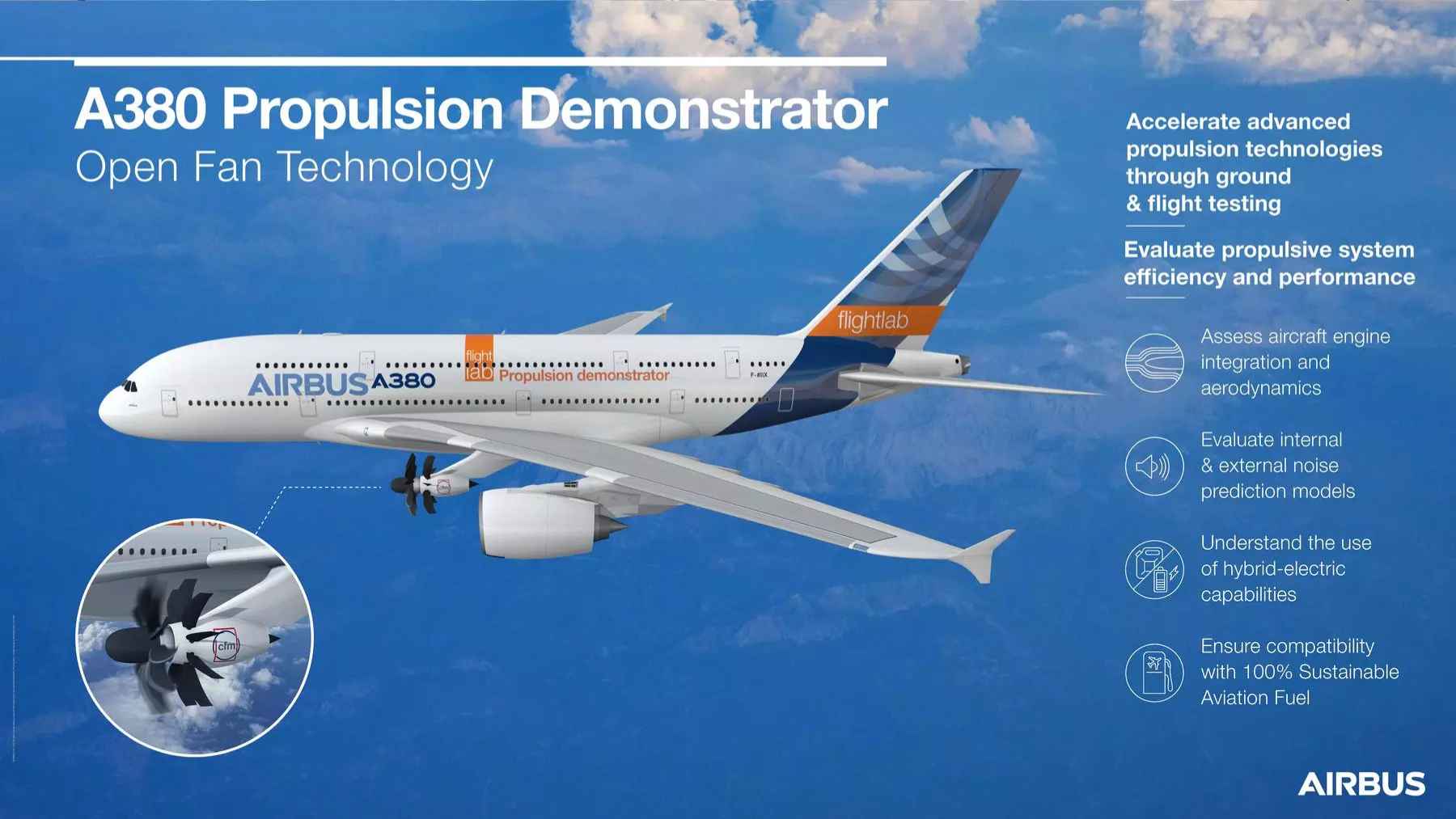
Airbus is preparing the first A380 ever built for a job no passenger airline could offer. The double-deck superjumbo will become a flying laboratory for CFM International’s exposed-blade Open Fan engine, with a full-scale flight campaign planned from Toulouse by the end of the decade.
The program moved another step forward at the Farnborough International Airshow on July 21, 2026, when Airbus and CFM revealed the A380 Flight Lab’s new livery and confirmed that teams had completed the first conceptual flight-test design review.
The target is striking, more than 20% lower fuel use and carbon dioxide emissions than today’s most efficient engines, but the aircraft must first prove that the design can meet tough standards for safety, noise, durability and integration.
Why the A380 fits the job
The aircraft is Airbus MSN001, the first A380 produced. Its enormous cabin gives engineers space for workstations and test equipment, while its four-engine layout gives the flight-test team a robust platform for evaluating an unusual propulsion system. The superjumbo may be far larger than the technology’s eventual market, but that is exactly why it works as a laboratory.
Airbus says the plane will carry hundreds of sensors, including microphones, cameras, accelerometers and pressure instruments. Those devices will help engineers examine thrust, drag, vibration, structural loads and cabin noise through different phases of flight.
In practical terms, the A380 will be less an airliner than a giant flying data center.
How an open fan works
A modern turbofan hides its front fan inside a rounded casing known as a nacelle. CFM’s Open Fan architecture removes that casing, allowing a much larger rotor to move more air around the engine core. Moving a greater mass of air more slowly can produce thrust with less fuel, which is the basic efficiency advantage.
The new layout is not simply a return to the noisy open-rotor experiments of the 1980s. The Airbus and CFM design uses one rotating front fan followed by stationary variable-pitch blades that shape the airflow, a simpler arrangement intended to reduce weight and noise while preserving jet-like cruise speed.
CFM’s broader RISE program also includes a compact core, advanced materials and hybrid-electric systems.
The 20% promise
The headline figure needs context. The goal is a reduction of more than 20% in fuel consumption and carbon dioxide compared with the most efficient engines flying today, not a 20 percentage-point cut in all aviation emissions and not zero-emission flight.
Even so, a gain of that size on future single-aisle aircraft could matter because those jets fly dense schedules across the world.
Fuel savings would also lower operating costs, which gives airlines a commercial reason to care beyond environmental targets. Every gallon not burned means less carbon released and less fuel carried, but the final benefit will depend on the complete aircraft, its route, payload and the fuel used. Clean technology still has to survive the economics of a Tuesday morning timetable.
Europe is helping push the concept from models to flight hardware. The OFELIA research effort established the technical path, while the 2026 TAKE OFF project covers engine assembly, aircraft integration, flight clearance and post-flight analysis. Its current roadmap points to an A380 demonstration in 2029.
Noise and safety decide everything
Exposed blades are the source of the efficiency gain, but they also create some of the hardest questions. Engineers must control external noise for communities near airports, cabin noise for passengers, vibration through the engine mounting structure and the consequences of bird strikes or blade damage.
A cleaner engine that cannot be certified is just an impressive workshop project.
Airbus has already completed more than 500 hours of early wind-tunnel testing with scaled engine and wing models. Those tests studied high-speed flight, takeoff and landing, including how the open fan interacts with flaps and slats. Airbus said full-aircraft model work would follow in 2026 before the leap to a functioning engine.

Safety work goes beyond the fan itself. Teams must modify controls, fuel distribution, power management and the aircraft structure, then demonstrate that the A380 behaves predictably with the unusual engine installed. CFM has said the design process includes stronger fan blades and protection for the fuselage against conceivable blade failures.
One of several bets
Airbus is not treating Open Fan as the only route forward. The separate SWITCH project, led by MTU with Airbus, Pratt & Whitney, Collins Aerospace and GKN Aerospace, was created to combine hybrid-electric assistance with a water-enhanced, heat-recovering turbofan.
Airbus originally described potential fuel-efficiency improvements of up to 25% compared with state-of-the-art propulsion systems.
These technologies are complementary rather than interchangeable. Open Fan targets propulsive efficiency, SWITCH works on energy recovery and electrical assistance, and hydrogen fuel cells represent another possible route toward electric propulsion.
The RISE demonstrator is also intended to prove compatibility with 100% sustainable aviation fuel. At the end of the day, Airbus is building a toolbox, not waiting for one miracle engine.
What happens next
Before the A380 flies, CFM plans ground testing and separate flight validation at GE Aerospace’s facility in Victorville, California. Airbus will then use the heavily modified Flight Lab from Toulouse to test the engine across real operating conditions and check whether computer models match the aircraft’s behavior.
If the campaign succeeds, the A380 will not return as a new open-fan passenger jet. Instead, its data could guide an engine for the next generation of smaller commercial aircraft from the middle of the 2030s. There is a neat irony here. The world’s biggest passenger plane may help make tomorrow’s everyday single-aisle flight lighter on fuel.
“New propulsion technologies will play an important role in achieving aviation’s net-zero objectives,” Airbus Chief Technology Officer Sabine Klauke said when the demonstrator was announced. That remains the promise, but the late-2020s test campaign will show whether Open Fan can move from striking renderings to reliable airline service.
The official statement was published on CFM International.