
A new solar desalination system developed at the University of Rochester could change how coastal regions think about one of the world’s hardest water problems.
Instead of turning seawater into drinking water while leaving behind damaging brine, the device uses sunlight and laser-treated black metal panels to produce fresh water and collect salts as solid material.
That matters because desalination is no longer a distant idea for dry regions. It is already part of the water strategy in places from California to the Middle East, yet conventional systems can be expensive, energy-hungry, and difficult to manage once concentrated salty waste is produced.
At the end of the day, the Rochester approach tries to solve two headaches at once: clean water and cleaner waste.
A water fix with a waste problem
According to the United Nations, about 2.2 billion people still lack safely managed drinking water. That number explains why cities, farms, and industries are paying closer attention to the ocean, even though turning seawater into useful water is never as simple as it sounds.
Most desalination plants rely on reverse osmosis or heat-based distillation. These systems can work well, but they often need chemical treatment and leave behind brine, a dense saltwater byproduct that can raise salinity and lower oxygen when released into marine environments. A glass of clean water, in other words, can come with an invisible cost offshore.
The new device takes a different route. Researchers at the University of Rochester’s Institute of Optics say their solar-thermal process needs no chemical additives to pre-treat the water and does not leave behind liquid brine.
How the black metal works
The system centers on panels made from black metal etched with femtosecond lasers. That laser treatment gives the surface two key traits: it absorbs almost all incoming solar radiation and strongly pulls water across itself.
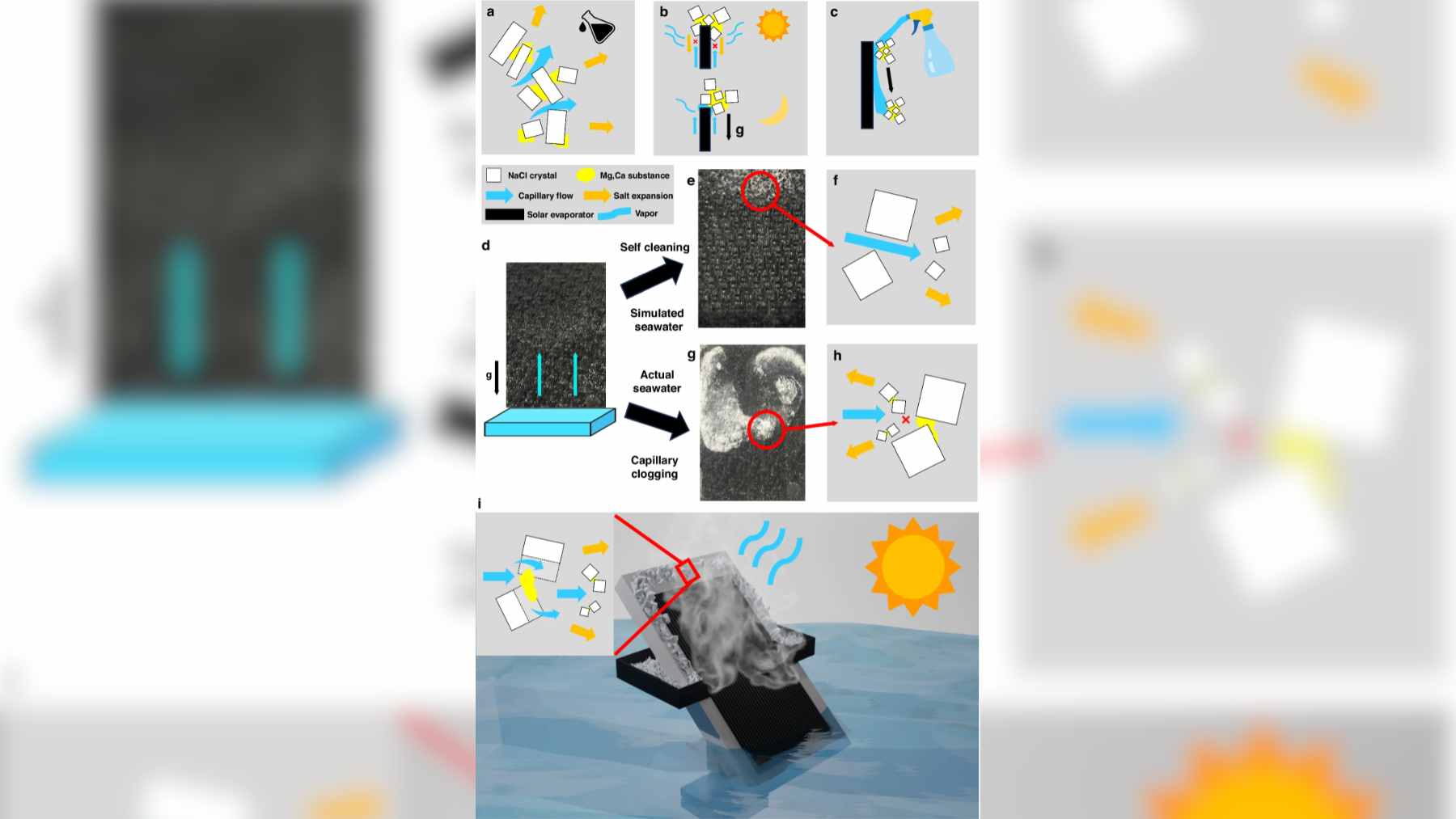
In practical terms, seawater moves as a thin film over an active laser-treated area. Sunlight heats that layer, water evaporates, and the vapor can be distilled into fresh water. The leftover salts do not stay where they can clog the working surface.
Instead, the design guides salts and minerals toward untreated side areas of the panel. Those passive regions act almost like a collection zone, keeping the main evaporation area clear so the process can keep running.
The coffee ring trick
The clever part may sound familiar to anyone who has left a coffee spill on a table. When the water dries, a darker ring forms around the edge because the particles move outward as the liquid evaporates.
Chunlei Guo, professor of optics and physics at the University of Rochester and senior scientist at the school’s Laboratory for Laser Energetics, says the team used that same basic effect to move salts away from the active surface. “We use that same principle to advance the salts to the passive region,” Guo explained.
That detail matters because real seawater is messy. Lab-made seawater with mostly sodium chloride can form loose, porous crystals, but ocean water also contains magnesium and calcium materials that can harden into crusty deposits. Think of a clogged shower head, then imagine a much saltier version of the same problem.
Tested on real ocean water
The researchers tested the system with water samples from the Pacific, Atlantic, and Indian Oceans. According to the University of Rochester, the surface was able to clean itself while fresh water was extracted and salts were pushed into passive collection areas without reducing panel efficiency.
The published study also reported continuous operation for one week under one sun conditions. The device achieved an average evaporation rate of about 0.36 lbs. of water vapor per ft.²/h, a salt harvesting rate of about 0.20 ounces per ft.²/h, roughly 74% solar-to-vapor conversion efficiency, and nearly 100% salt extraction.
That does not mean solar panels like these are ready to replace large desalination plants tomorrow. The work has so far been demonstrated in proof-of-concept devices, and scaling any water technology brings questions about cost, durability, maintenance, and performance in harsh coastal environments.
From waste to supply chain
Still, the environmental angle is only half the story. If the salts can be collected as solids, they may become useful materials rather than a disposal burden.
The most eye-catching example is lithium, a key ingredient in lithium-ion batteries used in electric vehicles, phones, laptops, and grid storage systems.
In a related paper in the Journal of Materials Chemistry A, Guo and colleagues showed that similar superwicking panels could separate lithium from other salts by embedding hydrogen titanate nanoparticles into tiny grooves on the black metal surface.
Using water from Utah’s Great Salt Lake, the team recovered about 50% of the lithium contained in the salts left after desalination. For the most part, that is still an early research result, not an instant mining revolution. However, it points toward a future where water treatment plants could also become mineral recovery sites.
What to watch next
The promise is easy to understand. A solar-powered desalination device that makes fresh water, avoids toxic brine discharge, and captures valuable minerals could be especially attractive for sunny coastal regions, remote communities, and places where the grid is weak or water demand is rising.
The hard questions are just as important, though. Can laser-treated metal panels be produced cheaply at large scale? How long will they last in real saltwater conditions? Can the collected minerals be separated economically enough to matter?
For now, the Rochester research is best seen as a strong signal, not a finished product. It shows that desalination does not always have to be a trade-off between drinking water and salty waste. Sometimes, with the right surface and a little help from sunlight, the leftovers may be part of the value.
The study was published in Light Science & Applications.