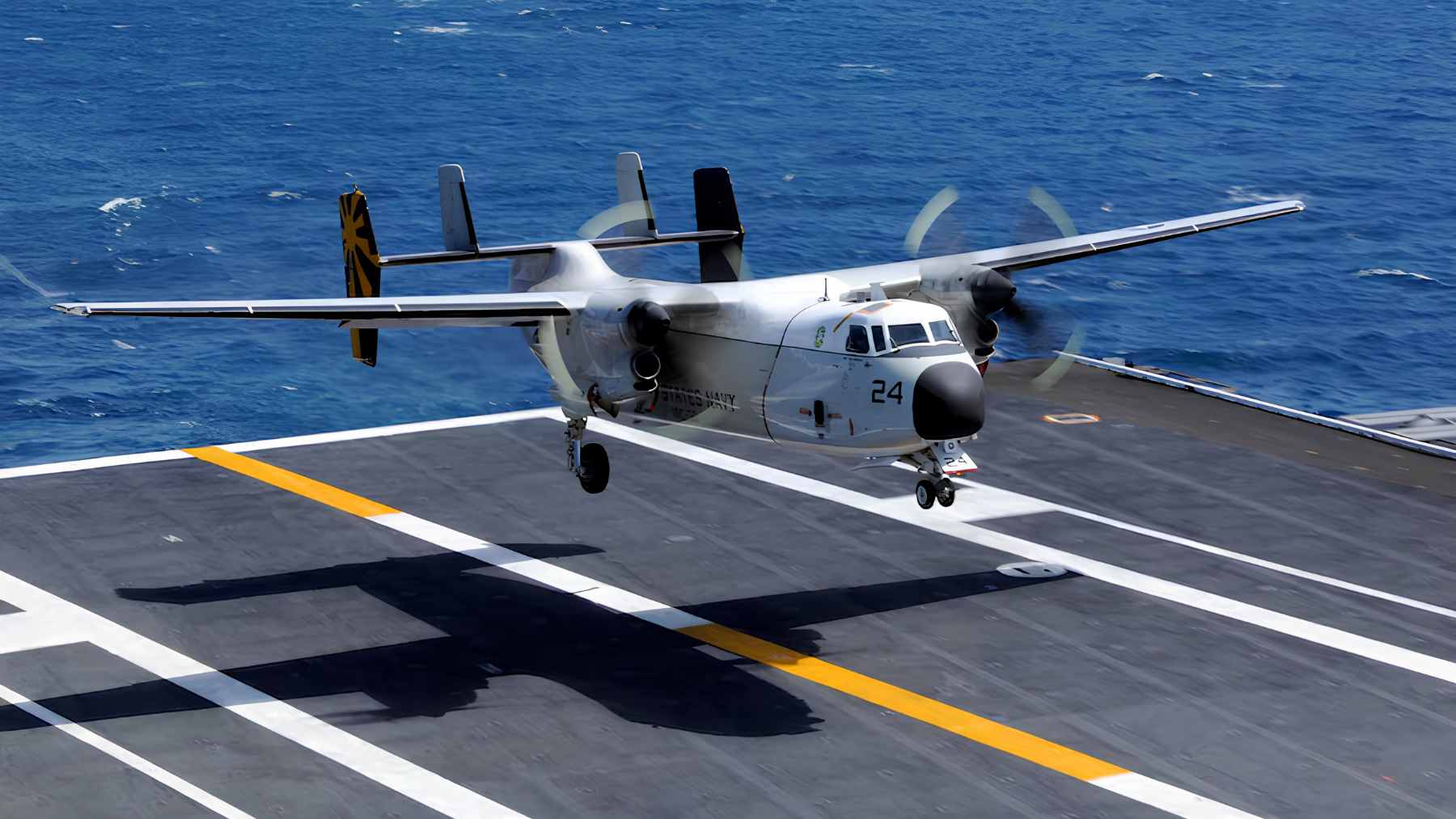
Landing a loaded cargo plane on a moving ship is not normal aviation. It is a controlled stop on a crowded deck, surrounded by salt spray, jet noise, and very little room for error.
That is exactly where the C-2A Greyhound has made its name for more than five decades. Built for the Navy’s Carrier Onboard Delivery mission, this twin-engine aircraft has carried cargo, mail, spare parts, medical supplies, and people between shore bases and aircraft carriers at sea.
Now, as the CMV-22B Osprey takes over the job, the old Greyhound is entering the final stretch of a long and demanding service life.
A flying lifeline at sea
The C-2A Greyhound is not glamorous in the way a fighter jet is. Still, without aircraft like this, a carrier strike group can quickly feel very far from home.
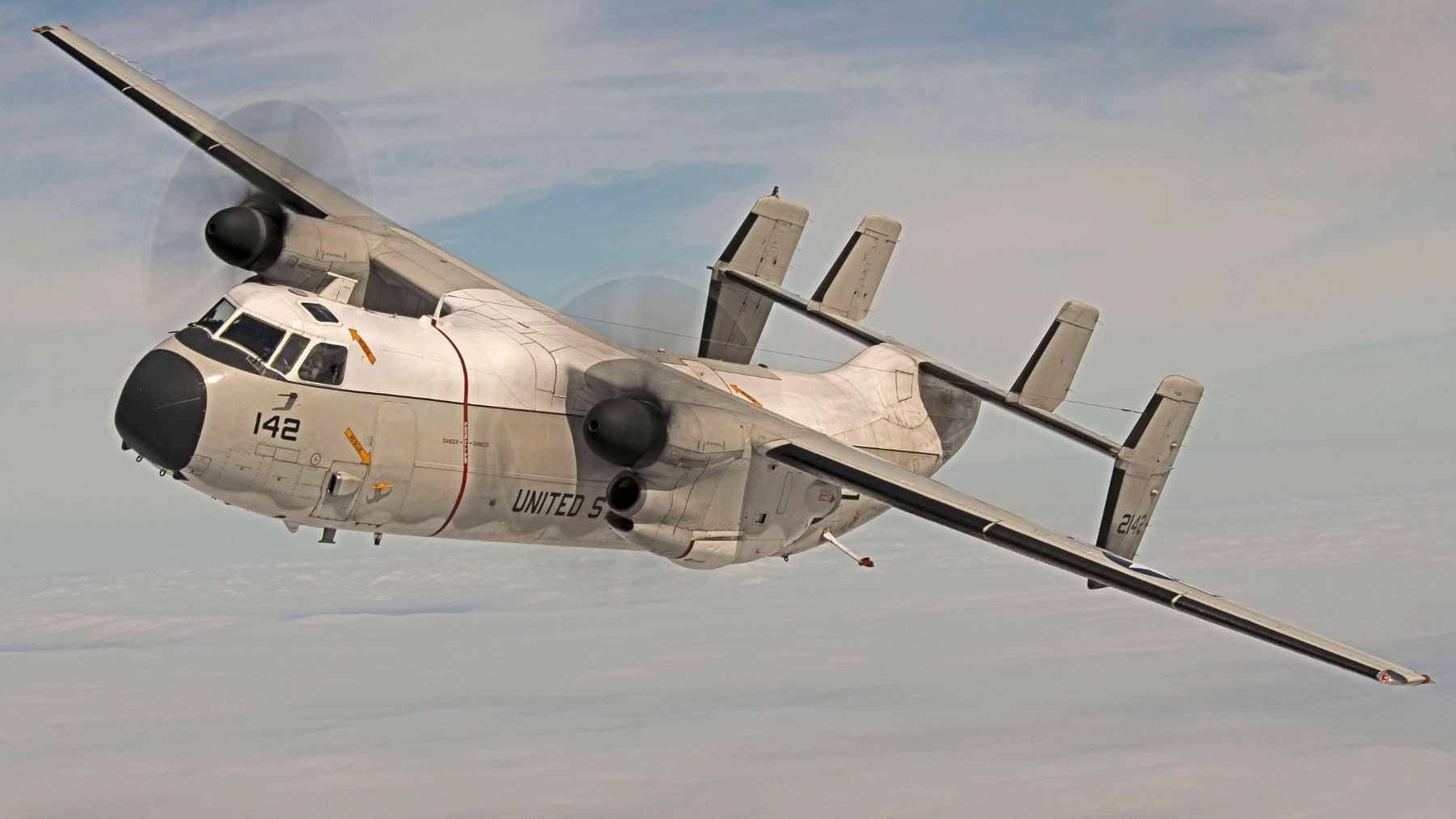
NAVAIR describes the Greyhound as a high-wing, twin-engine Carrier Onboard Delivery aircraft powered by two Allison T56-A-425 turboprop engines. Its job is simple to explain but hard to perform: moving urgent cargo between ship and shore in a matter of hours.
It allows jet engines, critical spare parts, passengers, mail, and litter patients to reach a carrier without forcing the ship to return to port. For sailors at sea, even a mail delivery can matter. Morale is logistics, too.
How it lands on a carrier
The most dramatic part comes at touchdown. The supplied background describes the Greyhound as an aircraft capable of landing on a carrier at about 240 km/h (150 mph) and stopping in only seconds.
That stop depends on the same brutal carrier logic used across naval aviation. Catapults can launch aircraft down the flight deck at 160 mph in less than three seconds, while arresting gear brings landing aircraft to a complete stop in about 340 feet.
For the Greyhound, this means a reinforced landing gear, a tailhook, and a structure built to absorb punishment that would be unthinkable for most civilian aircraft. It is not a gentle landing, it is more like catching a moving truck with a cable.
Built for awkward cargo
The Greyhound’s usefulness comes from its shape as much as its engines. NAVAIR notes that the aircraft was derived from the E-2C Hawkeye, but with a widened fuselage and a rear loading ramp. That makes it far easier to move bulky cargo on and off the aircraft.
Its cabin can handle priority cargo such as jet engines, passengers, litter patients, and critical spare parts. A cargo cage system restrains loads during ship launches and landings, while straight-in rear loading helps crews turn the aircraft around quickly on a carrier deck.
Space is always tight at sea. That is why folding wings matter, not as a flashy feature, but as a practical trick that keeps the flight deck from turning into a traffic jam.
Why the Osprey is taking over
The Navy’s replacement is the CMV-22B Osprey, a tiltrotor aircraft that can take off and land like a helicopter but fly longer distances like a turboprop aircraft. NAVAIR says it is the replacement for the C-2A in the Carrier Onboard Delivery mission.
That shift is about flexibility. The Osprey can operate from shore, expeditionary locations, or sea bases, and it can move personnel, mail, supplies, and high-priority cargo to carriers at sea. It is designed to carry up to 6,000 lbs. of cargo or personnel over a 1,150 nautical mile range.
Does that make the Greyhound obsolete overnight? Not exactly. In military aviation, replacing an aircraft is rarely as clean as swapping out an old phone for a new one.
The transition is messier than it looks
A 2025 NAVAIR update shows why the Greyhound is still important. Fleet needs required an extension of the C-2A’s service life, and that created unexpected supply pressure for a legacy aircraft whose parts are no longer easy to find.
One key issue was the auxiliary power unit, a small engine used to start the aircraft’s main engines and support ground maintenance. NAVAIR reported that the aircraft’s mission was extended through September 2026, forcing maintenance teams to rebuild support capacity for components that were already 30-plus years old.
That detail says a lot. The hardest part of modernization is not always the new machine. Sometimes it is keeping the old one alive long enough for the new one to fully take over.
What the Greyhound leaves behind
The C-2A Greyhound’s story is really a story about the hidden side of military power. Fighters may get the attention, but carriers also run on spare parts, medical supplies, trained crews, and dependable delivery routes.
There is also an environmental angle, though not a simple “green aircraft” one. Official Navy sources frame the transition around mission flexibility and logistics, not emissions claims, and that distinction matters. Better routing, fewer delays, and smarter use of deck space can still shape how much fuel, maintenance, and material a naval force consumes over time.
At the end of the day, the Greyhound was built to do one difficult job again and again. It carried the small things that keep big ships moving. Soon, that job will belong more fully to the Osprey, but the old cargo plane’s legacy is already clear.
The official statement was published on NAVAIR.