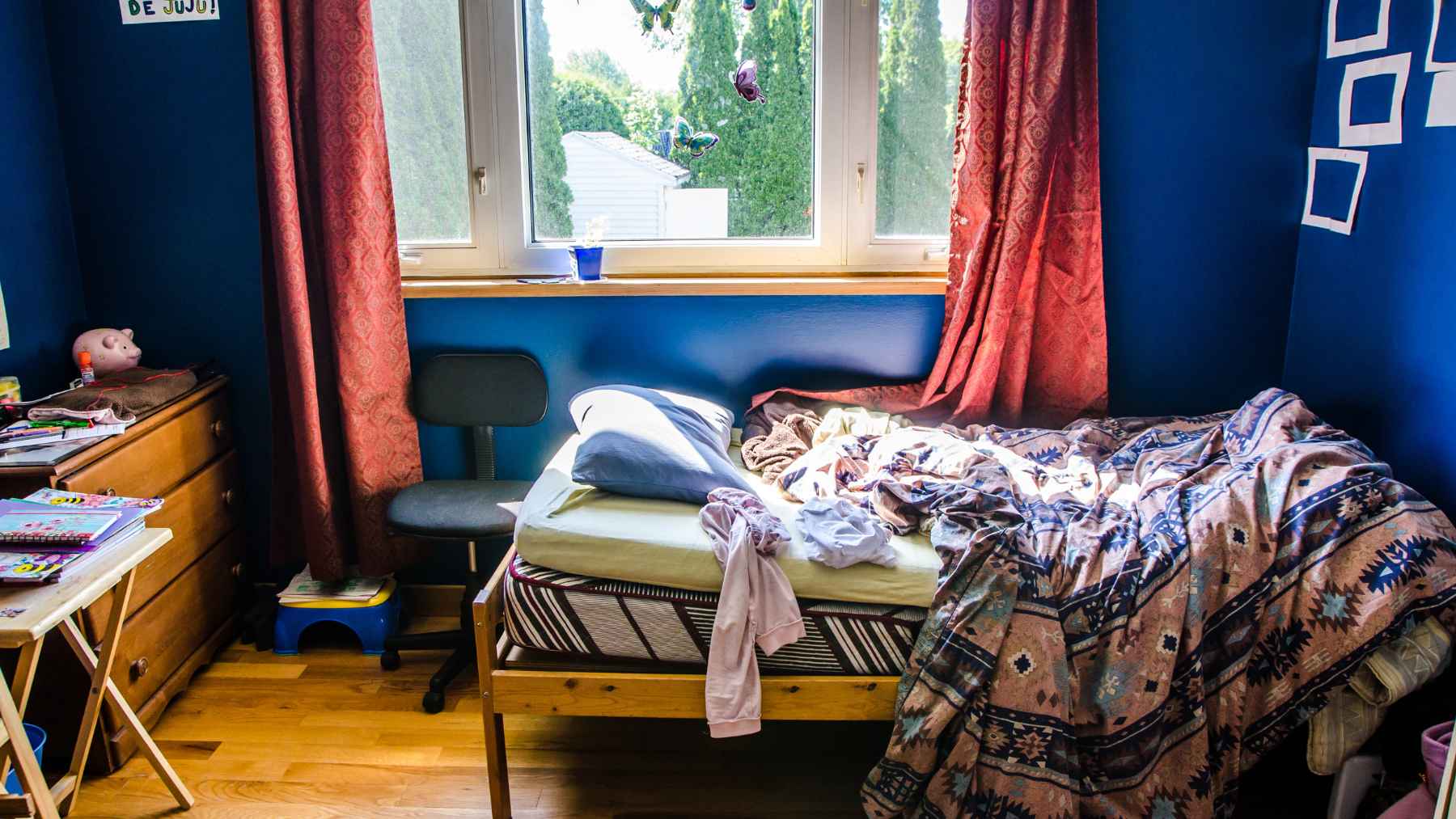
Clothes on the floor, cups on a desk, and a chair that has basically become a second closet can look like simple laziness. That picture has fueled a popular idea that messy bedrooms mean someone lacks routine or avoids responsibility, but the actual science tells a more complicated story.
Research suggests that personal spaces give real clues about who we are, our organization and personality.
Other studies found that a bit of chaos can bring more creative speaking, at least briefly, though later attempts to repeat that finding did not hold up. So the room does tell you something. It just doesn’t tell you everything about your whole story.
A room leaves behavioral clues
Samuel D. Gosling and his colleagues at the University of Texas at Austin wanted to know if total strangers could guess someone’s personality just from looking at their bedroom or office.
In the bedroom study, seven observers walked around the spaces of 83 college students and recent graduates, never meeting any of them, and researchers then compared those first impressions against what the actual occupants and their friends said about them.
Observers were especially consistent and somewhat accurate when judging openness and conscientiousness.
Clean, organized, uncluttered rooms were one of the main things people picked up on when judging conscientiousness, a Big Five personality trait linked with being dependable, persistent, responsible, and organized.
But a clue is not a proof. The same researchers found that stereotypes can color these judgments too, and one messy room on its own can not prove someone has no routine or is avoiding responsibility.
Order may nudge everyday choices
Canadian psychologist Jordan Peterson turned “clean your room” into a phrase almost everyone has heard, the idea being to start with something small you can actually control. That advice may be useful as a practical reset, but it is a self-help principle rather than clinical research on personality.
Kathleen D. Vohs and her University of Minnesota team took it further and actually tested it by changing the room itself. Out of 34 Dutch students, 67 percent of the ones sitting in a tidy room picked an apple over chocolate, compared to just 20 percent in the messy room.
And 82 percent in the neat room ended up donating money, versus 47 percent in the messy room.
What that really shows is that surroundings can nudge a choice in the moment. It doesn’t mean someone who leaves laundry on the floor is irresponsible in general, or that making your bed is going to fix bigger problems in your life.
Messiness and creativity
In a related experiment, 48 American students were split between neat and messy rooms and asked to invent uses for ping-pong balls.
Both groups came up with about the same number of ideas, but independent judges rated the ideas from the messy-room ideas as more creative, and more of them qualified as genuinely original.
The theory here is pretty simple. A little disorder might push people to break away from the usual rules, kind of like how a blank page can lead somewhere different when nothing feels too rigid. Still, that is not a green light to treat every cluttered bedroom as a sign of hidden genius.
Why the caution? A 2019 conceptual replication led by Alberto Manzi at Mercy College tested 100 people using a mix of verbal, visual, and problem-solving tasks.
This time, there was no real advantage found for working in a messy space, and the research concludes that if the effect exists at all, it is probably small and inconsistent.
A sudden change matters more
A messy room becomes more concerning when the mess is new, persistent, and comes together with other changes.
The National Institute of Mental Health lists fatigue, reduced interest, trouble concentrating, and difficulty meeting responsibilities among possible signs of depression, all of which can make laundry, dishes, or basic tidying feel unexpectedly hard.
That does not mean a messy room equals depression. Health professionals look for a pattern of symptoms, usually lasting at least two weeks and interfering with daily life, and not just one unmade bed after a busy weekend.
If someone who is normally organized suddenly stops caring about their space, and it comes with pulling away from people, losing energy, or falling behind on everyday things, that’s worth paying attention to. Symptoms that stick around or start to feel distressing are a good reason to talk to a health care provider.
What your bedroom really says
Think of your bedroom less like a verdict and more like a dashboard. Is the mess just a comfortable system you have had for years, or has it started blocking your floor, messing with your sleep, slowing down your work, or making you feel embarrassed? How it is actually affecting your daily life matters a lot more than whether every book is lined up perfectly.
In practical terms, a small reset can give you a lot of useful information. Make the bed, clear a path to walk through, pick up the laundry, and spend ten minutes putting things back where they belong.
If that feels easy to do, it is probably just habit getting in the way. But if you feel that you can’t bring yourself to start, even after days, that should deserve attention.
In the end, a messy bedroom might just mean someone is less organized, going through a stressful time, really busy right now, or just someone who is uncomfortable with a bit of mess. It cannot, by itself, prove irresponsibility, diagnose depression, or certify creativity.
The main study on physical order and behavior was published in Psychological Science.