
Could a disease known for stealing memory leave its first footprints in the gut? A new study suggests it can, at least in a mouse model of Alzheimer’s.
Researchers found that beta-amyloid, a sticky protein tied to the disease, built up in the digestive nervous system months before the animals began to lose memory, and a natural compound called butyrate helped block that process.
That does not mean a yogurt, a supplement, or a high-fiber breakfast can prevent Alzheimer’s in people. Not quite, but the work gives scientists a new place to look for early warning signs, long before forgetfulness becomes part of daily life.
A gut clue
Alzheimer’s is usually described as a brain disease, and for good reason. Its most visible signs are memory loss, confusion, trouble finding words, and gradual loss of independence.
Beta-amyloid is one of the best-known players in that story. It is a small protein fragment that can collect into harmful deposits and disrupt neurons, the cells that carry messages through the nervous system.
The gut has neurons, too. This network is called the enteric nervous system, and it helps control digestion, movement, and signals traveling between the intestine and the brain. That is why scientists often call it the body’s “second brain.”
What the mice showed
The work was led by Rodrigue Brossaud, Michel Neunlist, and Moustapha Cissé with colleagues at Nantes Université, CHU Nantes, Inserm, and INRAE. The team studied SAMP8 mice, a strain used to model aging and Alzheimer-like changes.
In those animals, excessive beta-amyloid production in the gut appeared by the second month of life. Memory problems did not show up until after six months, leaving a roughly four-month gap. In other words, the intestine was already changing while the brain still looked behaviorally quiet.
The buildup was not just sitting there. It was linked to damaged connections between intestinal neurons, long-lasting inflammation, and digestive trouble, especially constipation.
Anyone who has cared for an older relative knows how easy it is to brush off constipation as minor, but here it may be part of a much larger biological warning system.
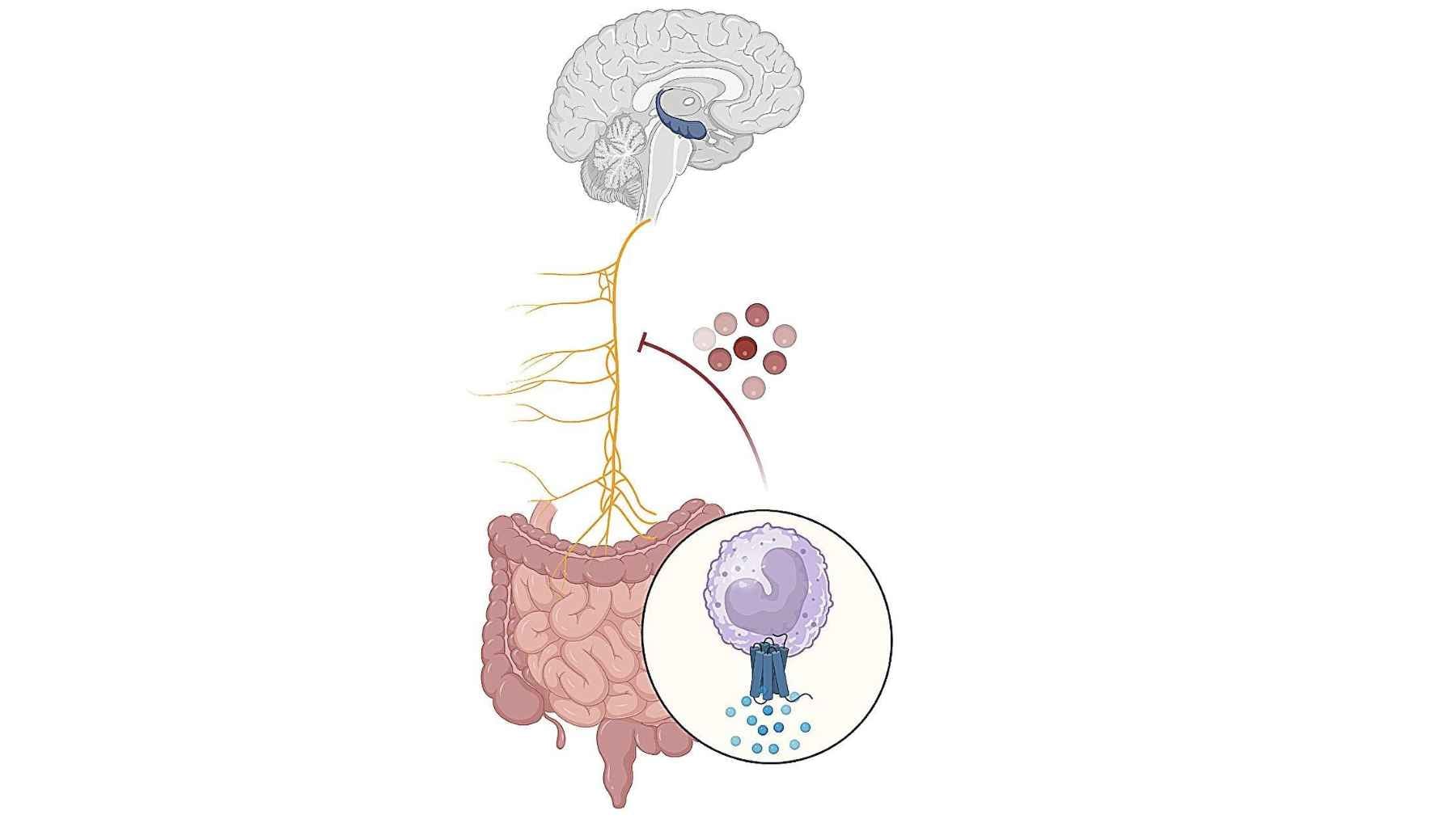
A diagram shows the connection between the gut and the brain, highlighting how beta-amyloid buildup in the digestive nervous system may precede memory loss in Alzheimer’s disease.
Why butyrate matters
The researchers then turned to butyrate, a short-chain fatty acid made naturally when certain gut bacteria break down dietary fiber. In plain English, it is one of the useful substances your microbiome can produce when fiber reaches the colon.
When butyrate was given early to the Alzheimer-prone mice, the results were striking. It reduced beta-amyloid buildup in the gut, protected local nerve connections, lowered inflammation, and helped prevent memory loss in animals that were genetically vulnerable.
“The accumulation of beta-amyloid in the gut is a triggering mechanism of the disease, rather than a simple contributing factor,” Cissé said. It is a cautious but important shift in emphasis. The gut may not be a side story.
Not a diet cure
It is important to note that the study was done in animals and lab models, not in a clinical trial of people with Alzheimer’s. That means no one should treat butyrate, fermented foods, or fiber supplements as proven protection against dementia.
Still, the idea fits with a wider pattern. A 2024 study using large health records from South Korea and Japan found that constipation was associated with higher Alzheimer’s risk, while mouse experiments suggested slow gut transit could worsen brain amyloid and inflammation.
Another 2023 study argued that gut-derived beta-amyloid may help feed the gut-brain axis in Alzheimer’s. Taken together, these studies do not close the case. They do make the digestive system harder to ignore, though.
Earlier detection
The most ambitious possibility is early detection. If Alzheimer’s-related changes appear in the gut before memory symptoms, doctors might someday look for intestinal biomarkers, meaning measurable biological signs of disease, before the brain has suffered major damage.
That could involve a gut biopsy, a microbiome analysis, or another test that has not yet been validated. For now, it remains research, not a medical tool. The trouble is, Alzheimer’s is usually noticed late, and the clock may already be moving.
The next step is to test other bacterial metabolites and see whether they can reverse symptoms once the disease is more advanced. Scientists also need to learn whether blocking intestinal beta-amyloid can truly slow the disease in humans.
A new map of Alzheimer’s
For decades, Alzheimer’s research has focused mainly on the brain. This study does not replace that map. It adds another route, one that runs through digestion, inflammation, gut bacteria, and the nerves embedded in the intestinal wall.
That matters because Alzheimer’s is unlikely to be solved by one switch or one target. It may require finding the disease earlier and interrupting several signals at once. The gut could become one of those signals.
The official study has been published in Molecular Psychiatry.