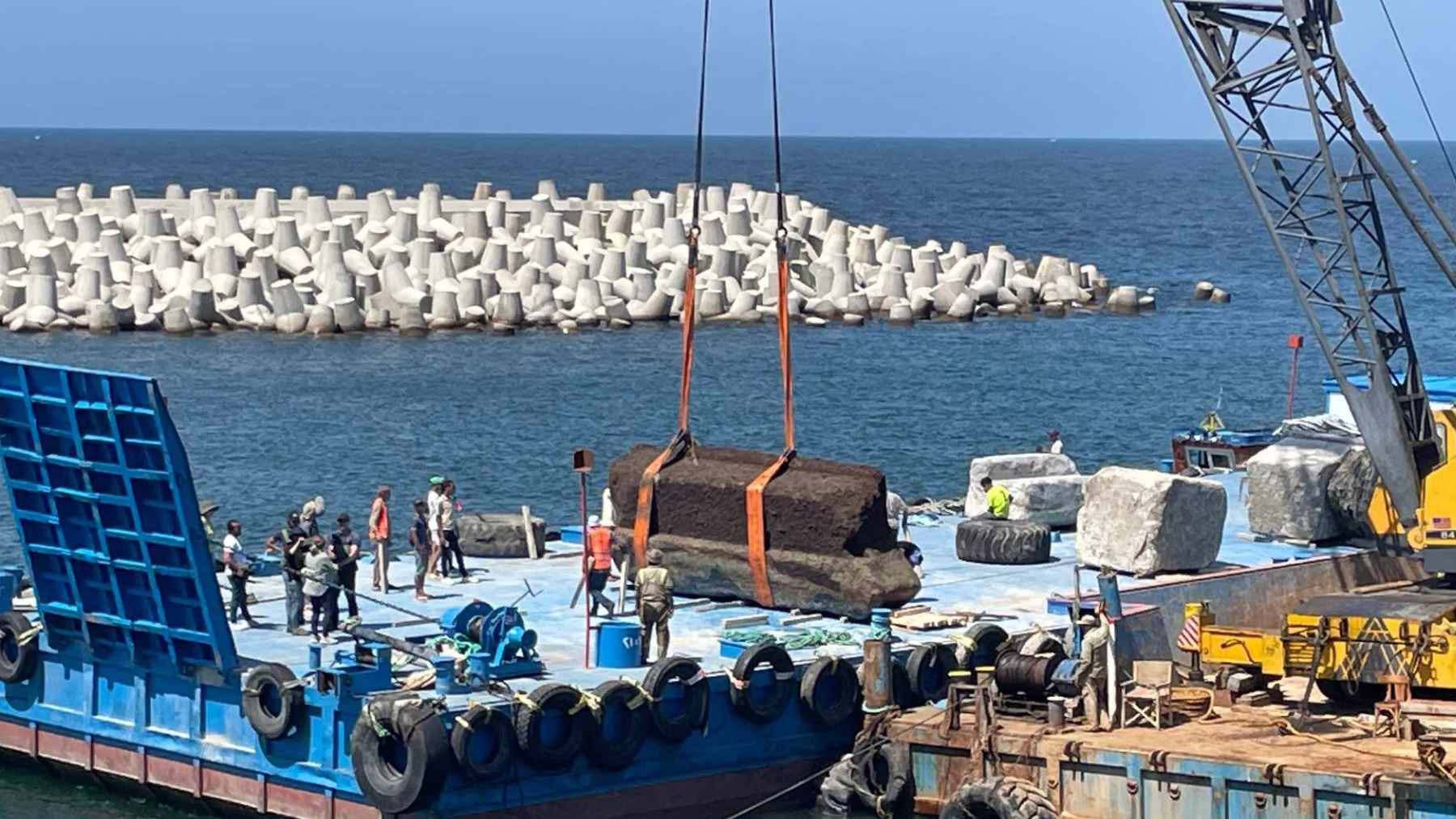
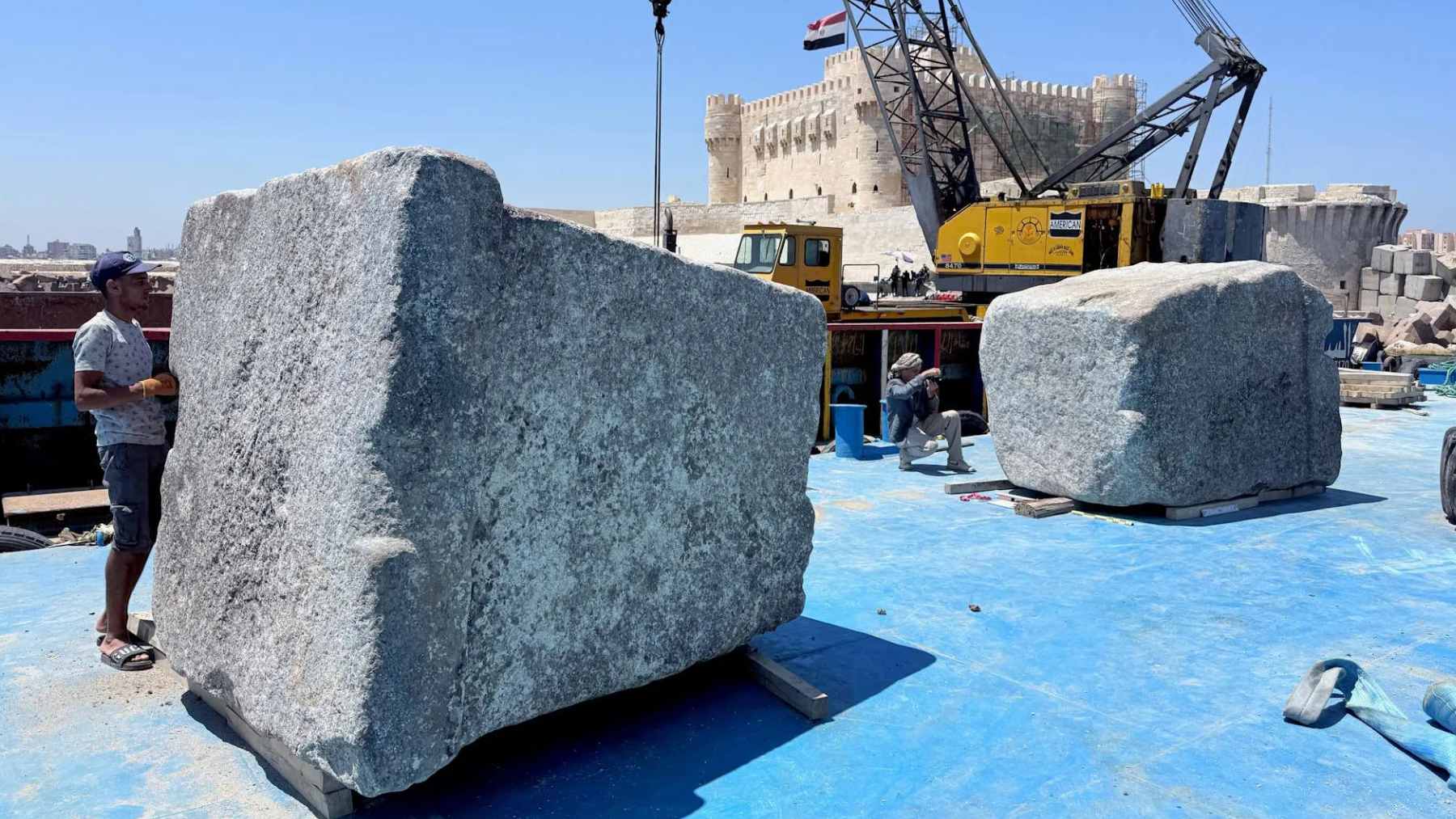
Archaeologists have brought 22 massive stone blocks from the ancient Lighthouse of Alexandria out of the Mediterranean, reopening one of history’s most famous engineering stories from the bottom of the sea.
The blocks are believed to come from the lighthouse’s monumental entrance, including lintels, jambs, a threshold, base slabs, and parts of a previously unknown Egyptian-style pylon from the Hellenistic period.
This is not the kind of “treasure” that fits inside a chest. It is a rescue effort for one of the Seven Wonders of the Ancient World, using cranes, underwater archaeology, photogrammetry, and digital-twin technology to rebuild a lost structure without pretending the sea has given up all its secrets. And that is where the environmental story begins.
A wonder rises again
The operation is part of thePHAROS program, carried out under the scientific supervision of archaeologist and architect Isabelle Hairy of France’s CNRS.
According to La Fondation Dassault Systèmes, the mission successfully lifted 22 of the lighthouse’s largest blocks from the water so they can be studied, scanned, and added to a larger digital reconstruction effort.
Some of these stones weigh roughly 80 to 90 tons. Imagine moving something heavier than a loaded city bus while waves, salt, and fragile archaeology all get a vote. It is slow work for a reason.
The lighthouse once stood at the entrance to Alexandria’s Great Harbor, where the medieval Qaitbay Fort now rises. CEAlex says the underwater site includes architectural blocks, statuary, and hard stone fragments such as granite, quartzite, marble, limestone, and other materials, many of them imported from southern Egypt.
Why the sea matters
The Lighthouse of Alexandria was built at the beginning of the third century BCE and stood about 100 meters tall, according to the foundation’s account of the project. Its beacon helped guide sailors along a dangerous coastline and helped make Alexandria a key hub of Mediterranean trade.
But the same coast that made the city powerful also made it vulnerable. CEAlex notes that the site sank beneath the Mediterranean along with the ruins it carried because of subsidence affecting Alexandria’s coast since antiquity.
That detail feels especially modern. Around the world, coastal heritage sites are under growing pressure from flooding, erosion, and rising seas, and a 2022 study in Nature Climate Change found that African natural and cultural heritage sites face increasing exposure to coastal hazards.
By 2050, the number of exposed sites could more than triple under high-emissions scenarios, according to the researchers.
Digital twin archaeology
What happens after the blocks reach dry land? For the most part, the answer is not guesswork. The team plans to scan the pieces through detailed photogrammetry, then hand the data to volunteer engineers from La Fondation Dassault Systèmes, who will analyze and reposition them virtually like a giant archaeological puzzle.
The goal is to create a digital twin of the lost lighthouse. This way, researchers can test ideas about how the structure was built, how it may have collapsed, and where individual blocks might have belonged before time and the sea scattered them.
More than 100 blocks have already been digitized underwater over the past decade, the foundation said. CEAlex also reports that since 2012 it has used photogrammetry to build a precise 3D model of the underwater site, with thousands of blocks recorded in its database as of 2020.
Not treasure hunting
There is a big difference between recovering heritage and stripping the seabed for display. UNESCO’s 2001 Convention on the Protection of the Underwater Cultural Heritage says underwater heritage should be protected for humanity, and it encourages responsible, non-intrusive access when that does not put sites at risk.
Its rules also favor nondestructive survey methods before recovery, unless excavation is needed for scientific study or protection. That is why projects like PHAROS matter beyond one famous monument. They show how advanced technology can help researchers preserve a site’s story instead of simply removing its most dramatic pieces.
There is also a public side to this. A faithful digital model could let students, museum visitors, and curious readers explore the lighthouse without diving into a protected archaeological zone or disturbing the marine environment around it.
A city built on light
The Lighthouse of Alexandria was more than a beautiful tower. It was infrastructure, a trade tool, a safety system, and a symbol of power in a city where Greek and Egyptian traditions met in stone.
That is what makes the recovered blocks so valuable. A doorway can tell researchers about engineering. A threshold can hint at traffic, ritual, and daily use. Even a damaged slab can become evidence when it is scanned, compared, and placed back into a larger pattern.
At the end of the day, the sea did not return a complete wonder. It returned pieces. But with the right tools, and enough caution, those pieces may finally show us how one of the ancient world’s greatest structures really worked.
The official press release was published on La Fondation Dassault Systèmes.