A new cosmology study suggests the universe may not drift outward forever after all. Using a dark-energy model tested against major sky surveys, researchers estimate that the cosmos could have a total lifespan of about 33.3 billion years, ending in a final collapse known as the “Big Crunch.”
That does not mean the end is coming in 33.3 billion years from today. Since the universe is already about 13.8 billion years old, the model points to roughly 20 billion years left, if its assumptions hold. That little detail matters, because this is not a doomsday warning.
It is a bold scientific forecast built on a question that still keeps physicists awake at night: what is dark energy really doing?
A universe that turns back
For decades, many scientists expected the universe to keep expanding, pushed along by dark energy. In that familiar picture, galaxies would grow farther apart over unimaginable stretches of time, leading to a cold, empty future often called the “Big Freeze.”
The new study offers a very different possibility. In the researchers’ model, the universe would keep expanding for billions of years, reach its largest size, and then begin contracting.
Cornell University physicist S.H. Henry Tye said the new data “seem to indicate that the cosmological constant is negative, and that the universe will end in a big crunch.”
In practical terms, the universe would not fade away like a light left on in an empty room. It would reverse course, pulling matter and space-time toward an extremely dense final state.
Dark energy is the key
The whole story turns on dark energy, the mysterious ingredient believed to drive the universe’s accelerating expansion. We cannot bottle it, touch it, or measure it directly in the everyday sense, but its influence shows up in how galaxies move and how space expands.
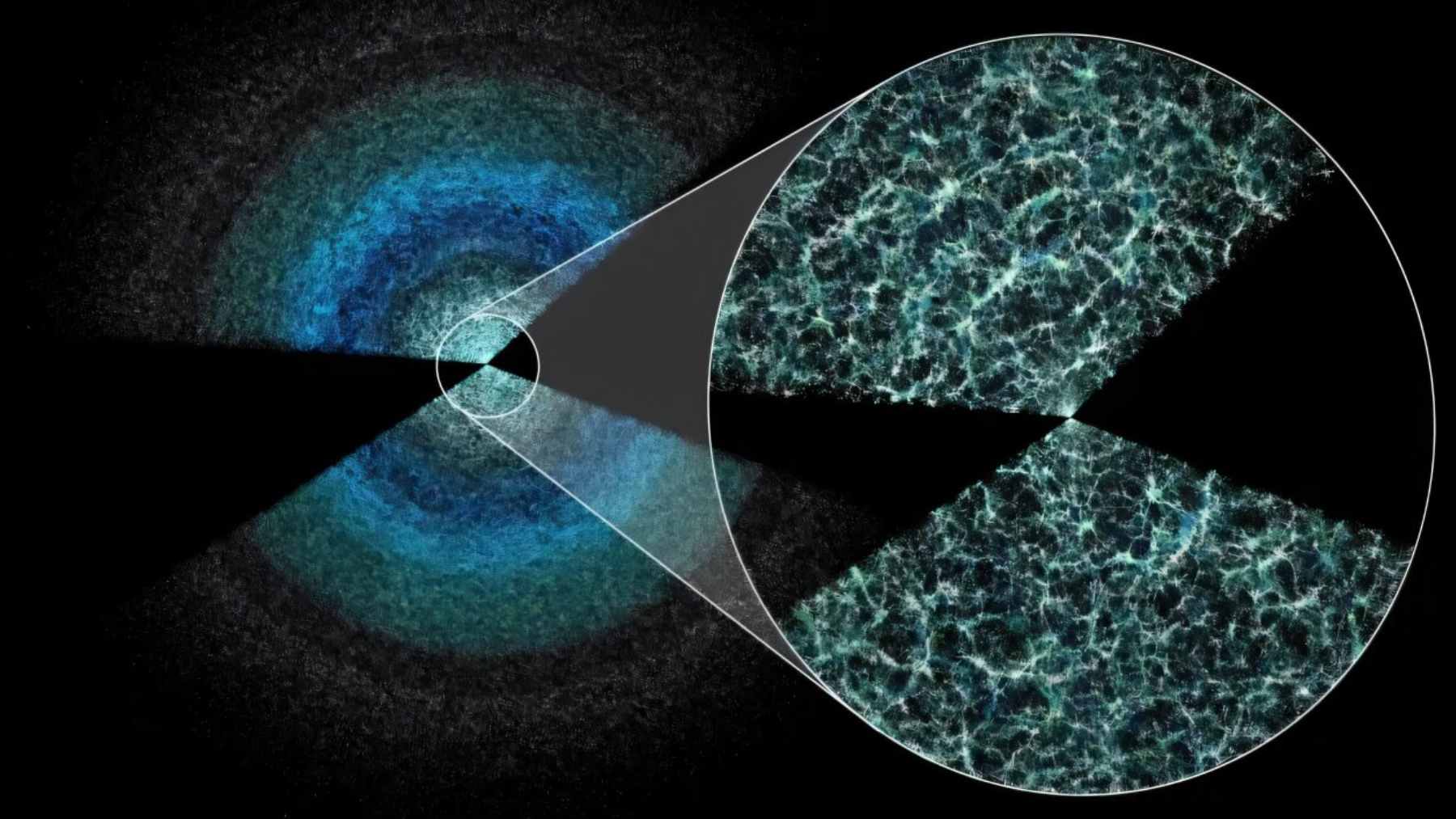
Recent results from the Dark Energy Spectroscopic Instrument, better known as DESI, have made the mystery even sharper. Its first three years of data include nearly 15 million galaxies and quasars, and the findings strengthen hints that dark energy may be changing over time rather than acting as a fixed constant.
That is where things get interesting. If dark energy changes, then the future of the universe becomes less like a train running forever on the same track and more like a road trip where the map suddenly updates halfway through.
The axion idea
The model explored in the paper uses something called axion dark energy. Axions are hypothetical ultralight particles that physicists have discussed for years as possible pieces of the dark matter puzzle.
Here, the researchers combine an ultralight axion field with a cosmological constant. Their calculation suggests that this mix can fit the current DES and DESI observations, while also making the underlying cosmological constant negative.
That negative value is the twist. If it is right, gravity and dark energy would eventually stop playing tug-of-war in the way many scientists expected. The universe would expand for a while longer, then contraction would take over.
Why the date is not final
It sounds precise–almost too precise. A universe with a 33.3-billion-year lifespan has the feel of a cosmic calendar invite.
But scientists are not claiming the case is closed. The authors themselves stress that the estimate depends on recent observations being confirmed and on the axion dark-energy model being the correct way to interpret them. More data will be needed before anyone can say the Big Crunch has moved from possibility to likely fate.
DESI’s own team has also been careful. Its results have not yet reached the 5-sigma standard normally used in physics for a discovery, even though several combinations of data point in the same direction. That is how science often works–first comes the strange signal, then the hard checking.
Telescopes are changing the story
What makes this research feel so modern is the technology behind it. DESI can capture light from 5,000 galaxies at once, and it is mounted on the Nicholas U. Mayall Telescope in Arizona. By the end of its survey, the project aims to measure roughly 50 million galaxies and quasars.
Those numbers are not just impressive trivia. They show how astronomy has become a data-heavy field, closer in some ways to climate modeling or high-end computing than to the old image of one person staring through a telescope.
Also, the stakes are not just philosophical. Understanding dark energy shapes how scientists think about the structure, history, and future environment of everything we know.
The night sky may look quiet from a backyard, but under the hood, the universe is still giving researchers a lot to argue about.
What to keep in mind
So, should anyone panic? Absolutely not. Even in this more dramatic model, the timeline is so vast that it sits far beyond human history, civilization, and even the future of Earth as we know it. The real takeaway is not fear, but humility.
The universe may still have a final chapter, and our best instruments are only now beginning to read the first lines of it.
The study was published in the Journal of Cosmology and Astroparticle Physics.