Can a train station help build a city before the city itself is fully grown? In northern China, Xiong’an Railway Station was designed with that exact idea in mind, giving a new urban area near Beijing a high-speed gateway before daily life there has fully caught up.
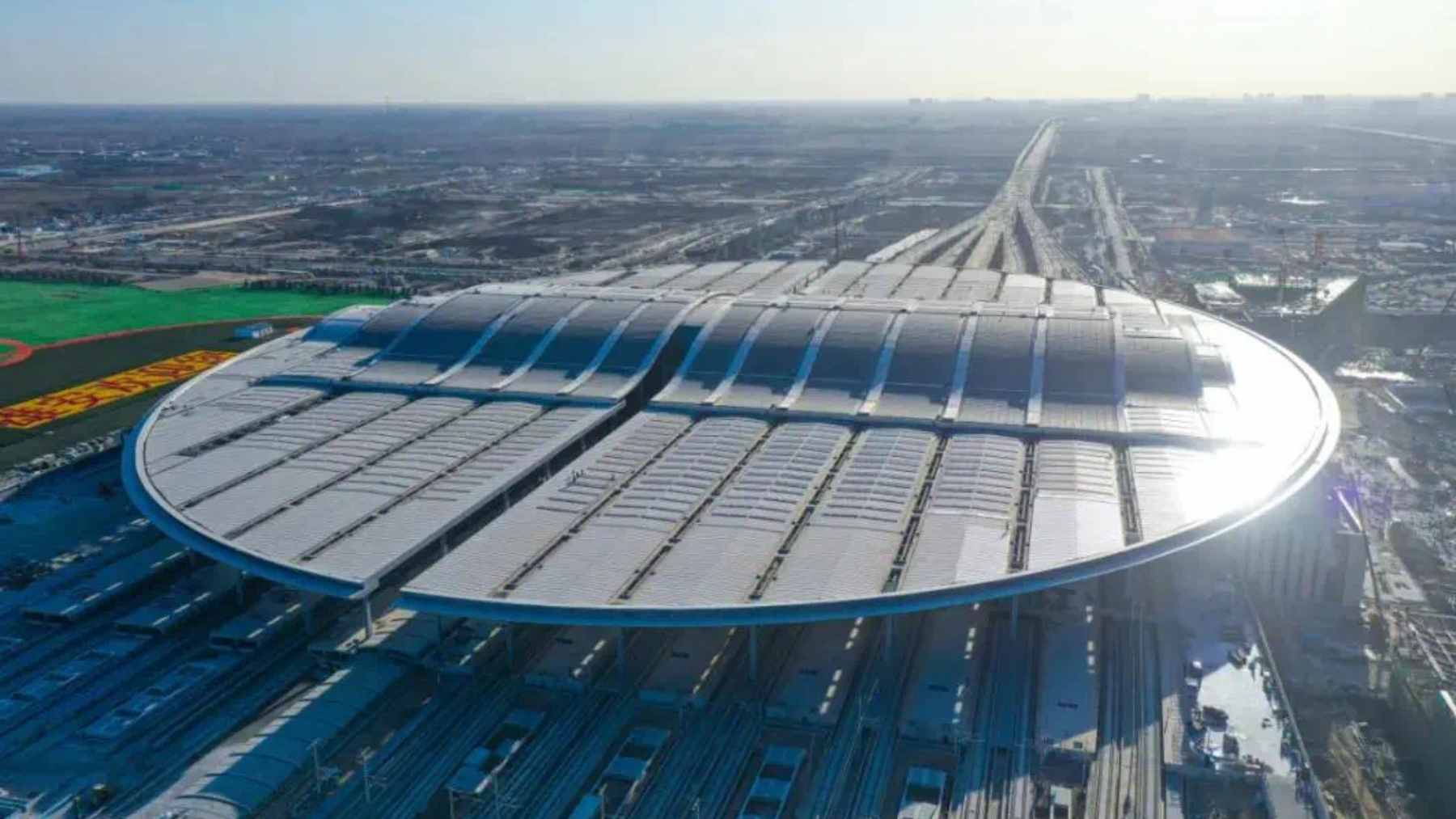
The station opened on December 27, 2020, with the departure of the C2702 Fuxing bullet train, and its scale still feels almost unreal. It covers about 5.1 million ft.², or roughly 117 acres, but the bigger story is what sits inside and on top of it: solar panels, digital construction tools, welding robots, and building systems designed to respond in real time.
A gateway for a planned city
Xiong’an Railway Station is not just a bigger terminal with more platforms. China State Construction Engineering Corporation described it as the first major infrastructure project completed in Xiong’an New Area, a government-backed city project in Hebei province.
That detail matters because Xiong’an was created to take on functions that are not essential to Beijing’s role as China’s capital, while also strengthening the Beijing, Tianjin, and Hebei region. In everyday terms, the station is the front door to a city that is still being assembled around it.
How big is it? Infrastructure Global says the transportation hub is comparable in total construction area to three Berlin Central Railway Stations. That is not a station so much as a transport district under one roof.
Built fast, but not simply
The station took about two years to build, a pace that would be eye-catching for almost any major infrastructure project, but the challenge was not only speed. Crews also had to bring together a huge roof, steel structures, passenger halls, tracks, energy systems, and a working high-speed rail connection.
A major tool behind that push was building information modeling, often known as BIM. Think of it as a shared digital version of the project, allowing engineers and builders to spot problems before they become expensive mistakes on site.
Liu Weiqun, president of China Railway Design Corporation, said the company used BIM for intelligent three-dimensional management through design, construction, and operation. That is a dry phrase, but in practice it means fewer surprises when thousands of parts have to fit together.
Robots helped shape the frame
CSCEC said automatic robots were used in the station’s steel structure work to standardize the welding process. That may sound like a small detail, but in a project with repeated steel connections, consistency can be the difference between fast construction and costly rework.
The building also used fair-faced concrete on a large scale. This is concrete left visible instead of covered later, so mistakes cannot be hidden behind another layer of finish.
That is the lesson tucked into the engineering. Big infrastructure is not only about pouring more concrete more quickly, it is also about keeping quality steady when the clock is moving.
Faster trips, less waiting
The Beijing-Xiong’an intercity high-speed railway is about 58 miles long, based on the official line length, and Xiong’an is the largest of its five stations. The line links the new area to Beijing West Railway Station and Beijing Daxing International Airport.
For passengers, the numbers are easy to understand. The trip from Beijing West Railway Station to Xiong’an takes about 50 minutes, while the ride from Daxing airport to Xiong’an can take about 19 minutes.
That is where the technology becomes personal. Less time on the road can mean less traffic, fewer emissions, and fewer long waits between a flight, a train, and the rest of the day.
A solar roof with a real job
The station’s oval roof is not just there to look impressive from above. Xinhua reported that about 452,000 ft.² of photovoltaic panels were installed on the roof, turning it into a power station in its own right.
State Grid Xiong’an Integrated Energy Services said the system can generate an average of 5.8 million kilowatt-hours of electricity each year. Luo Xiaodong, a project manager with the company, said the solar project was expected to cut carbon dioxide emissions by about 4,960 U.S. tons per year and save around 1,984 tons of standard coal.
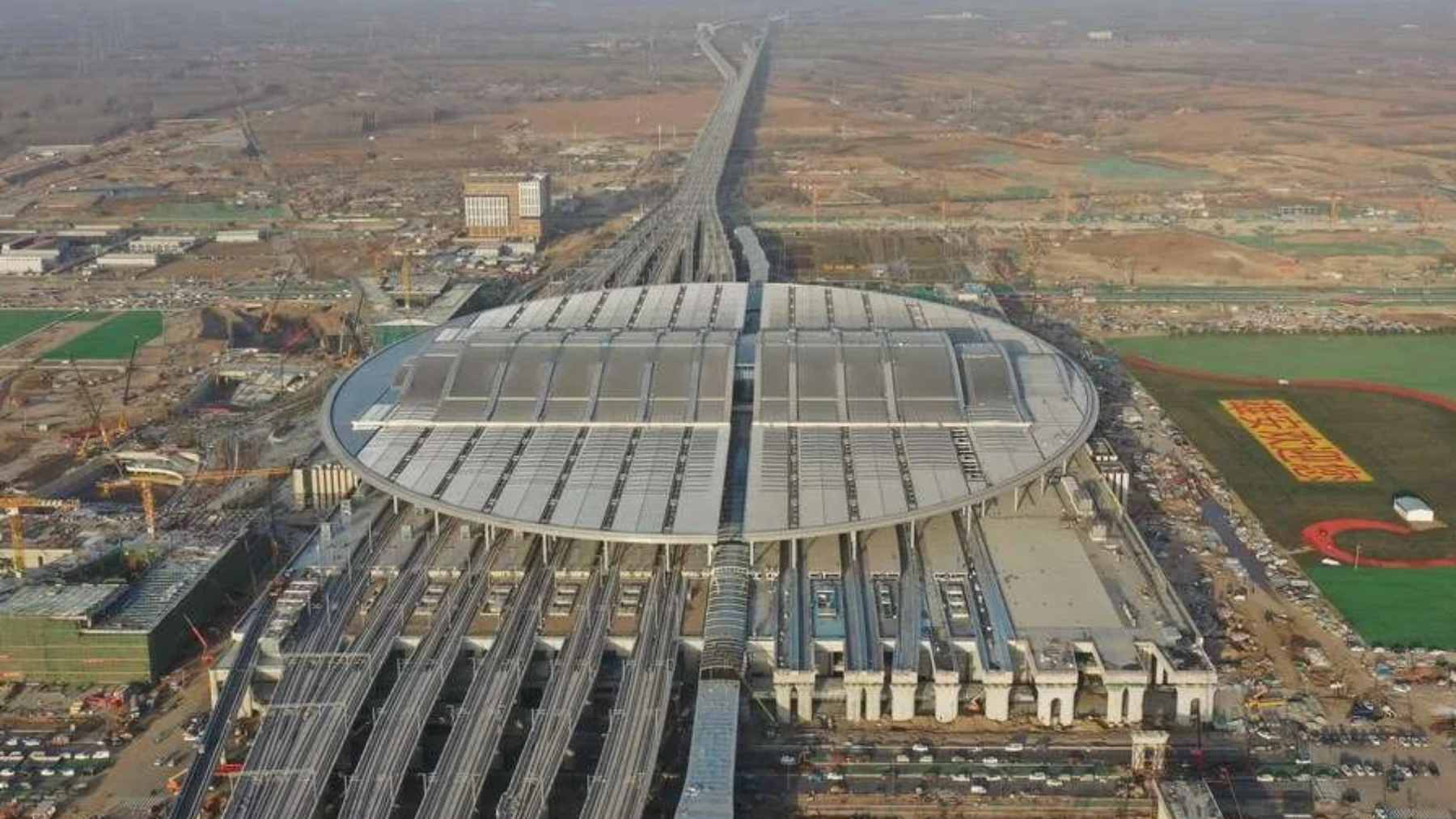
The system was connected to the grid on December 25, 2020, just two days before the station officially started operations. In practical terms, the clean-energy feature was not added later for publicity; it was part of the building’s start-up.
Light, noise, and smart control
Passenger comfort also appears in the design. The station includes long natural-light strips about 49 ft. wide, helping sunlight reach the waiting hall and reducing the need for artificial lighting during the day.
Sound-absorbing platform walls were also included. Anyone who has stood beside a busy rail line knows why that matters. Noise can turn a quick commute into a tiring one before the train even arrives.
Researchers writing in the Proceedings of the Institution of Civil Engineers also noted the use of artificial intelligence for real-time building management, along with cloud computing, the Internet of Things, big data, mobile internet, and BIM.
In other words, the station is meant to be monitored and adjusted as people, trains, lighting, and energy demand change through the day.
Why this station still matters
Xiong’an Railway Station is one of the clearest signs of how China wants to build new urban infrastructure. In March 2026, China’s State Council said the new area should keep receiving nonessential functions from Beijing and explore future-oriented smart city management models.
There is still an important caveat. New cities do not become real just because the station opens. They need jobs, schools, shops, neighborhoods, routines, and the slow daily habits that make a place feel lived in.
Even so, the station shows the first piece of the puzzle already working. At the end of the day, it is trying to prove that future infrastructure can move people, save energy, and help a new city take shape all at once.
The official statement on the project was published on China State Construction Engineering Corporation.