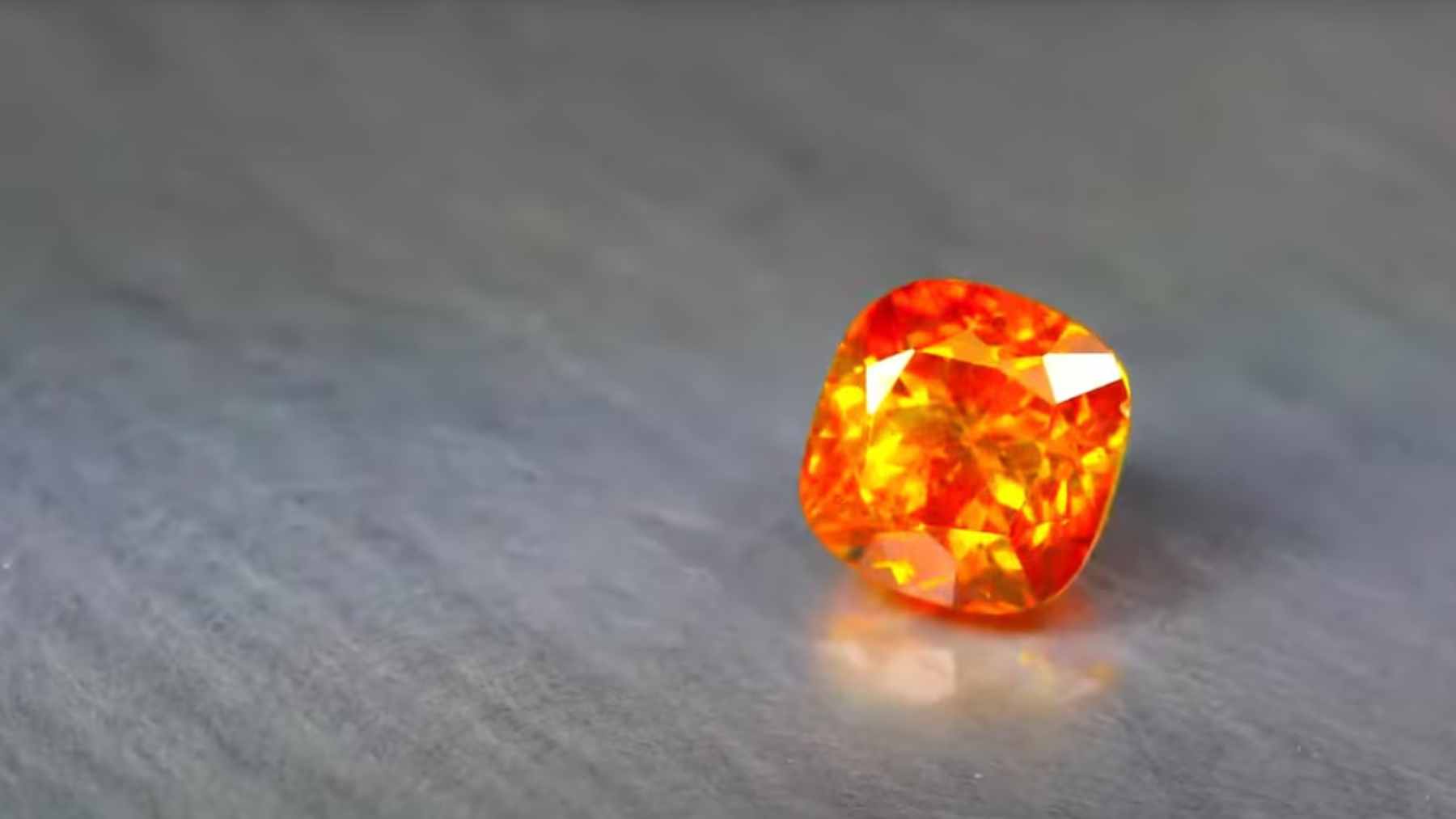
A tiny reddish-orange crystal from Myanmar is small enough to vanish next to a kitchen crumb, yet it has become one of the strangest reminders that Earth’s catalog is still unfinished. The mineral is called kyawthuite, and its scientific description rests on a single 1.61-carat sample, which weighs about 0.011 oz.
That is the headline, but the bigger story is not about jewelry sparkle. At a time when businesses, governments, and clean-tech industries are searching the ground for valuable materials, this one tiny stone shows how much depends on patient fieldwork, museum collections, and laboratory tools.
A mineral of one
Kyawthuite was approved as a valid mineral species in 2015 and first published in 2017, according to Mindat’s mineral record. The peer-reviewed study was written by Anthony R. Kampf, George R. Rossman, Chi Ma, and Peter A. Williams.
The crystal was found as a waterworn specimen in alluvium near Chaung-gyi-ah-le-ywa, close to Mogok in Myanmar. In plain English, it came from loose gravel or sediment moved by water, not from a neat rock face with a label on it.
That matters because a gem’s resting place is not always its birthplace. Researchers say the composition suggests kyawthuite likely formed in a pegmatite, a coarse-grained rock that can concentrate unusual elements during the final stages of magma cooling.
Why scientists care
A mineral is not defined only by how it looks. Scientists also check its chemistry and its atomic structure, almost like checking both the ingredients and the recipe.
Kyawthuite’s ideal formula is Bi3+Sb5+O4, meaning it contains bismuth, antimony, and oxygen. Mindat lists it as an approved mineral in the oxide class, with a monoclinic crystal system and a structure special enough to separate it from minerals that may look similar at first glance.
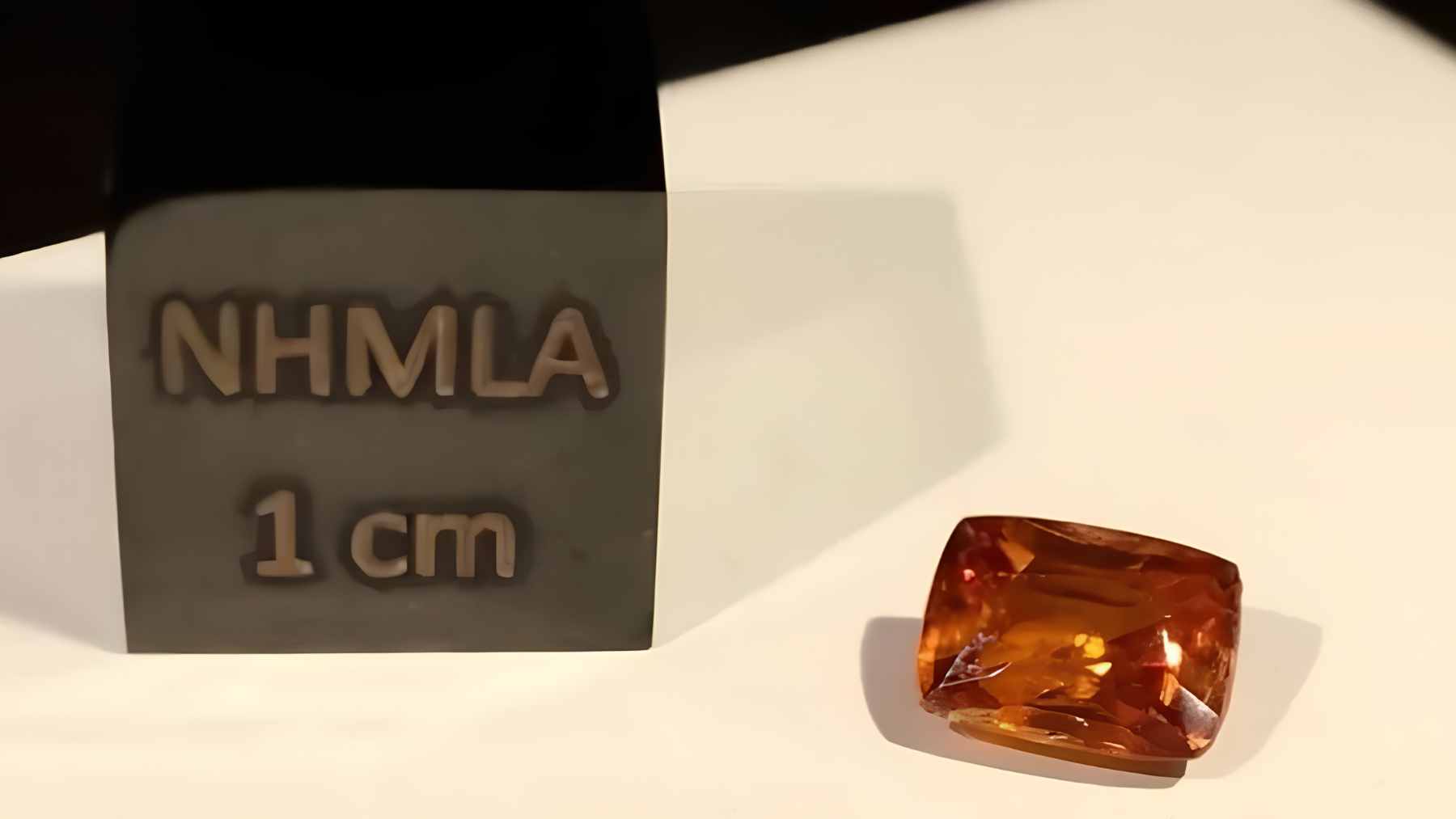
How can something this small carry so much weight in science? Because in mineralogy, the type specimen becomes the reference point. For kyawthuite, that reference is one faceted gem kept in the Mineral Sciences Department at the Natural History Museum of Los Angeles County, under catalog number 65602.
Tiny but heavy
The known kyawthuite crystal is reddish orange, transparent, and has an adamantine luster, a bright shine often compared with diamond-like brilliance. Its Mohs hardness is 5.5, which makes it harder than a copper coin but softer than quartz.
It is also surprisingly dense. The measured density converts to about 0.3 lbs./inch³, so a larger piece would feel heavy in the hand. Of course, no larger natural piece has been confirmed.
That is part of what makes kyawthuite so unusual. Many famous gemstones are rare in the marketplace, but they are known from multiple deposits. Kyawthuite sits in a different category because the scientific record still points to one natural crystal.
Mogok’s natural laboratory
Mogok is already legendary in the gem world. The American Museum of Natural History notes that the region is known for ruby, sapphire, spinel, peridot, and moonstone, and describes it as an unusually diverse mineral area.
Still, kyawthuite is not just another pretty stone from a famous mining district. It is a scientific outlier, the kind of mineral that appears once, makes researchers update the catalog, and then leaves everyone asking where the next one might be hiding.
The region’s geology helps explain the mystery, at least to a large extent. Mogok includes different gem-forming environments, including pegmatites and rocks changed by heat, pressure, and fluids. Those conditions can create pockets of rare minerals, but nature does not always repeat the trick.
Rare does not mean priceless
Here is the catch: being one of a kind does not automatically make kyawthuite the most expensive stone on Earth.
A gem’s market value depends on demand, beauty, size, cut, provenance, and whether buyers are actually willing to pay. Kyawthuite’s importance is different. Its value is scientific, because there is almost no natural material available for testing, comparison, or future study.
That distinction is important for readers following mining, business, and technology news. Not every rare mineral becomes a supply-chain prize. Sometimes, rarity is a warning label that says the planet’s chemistry can be more selective, fragile, and unpredictable than any market forecast.
A lesson for the mineral age
Kyawthuite arrives at a moment when the world is paying closer attention to what lies underground. Batteries, electronics, energy systems, and advanced manufacturing all depend on mineral knowledge, and that knowledge starts with correctly identifying what Earth has actually made.
This tiny crystal also points to a quieter truth, though. Museums are not just places where old objects sit behind glass. In cases like this, they serve as long-term scientific memory, keeping the type material available for future researchers with better tools and new questions.
At the end of the day, kyawthuite is a small stone with a big message: Earth still has surprises left, and some of them are so small they could be missed in a handful of gravel.
The study was published on Cambridge Core in Mineralogical Magazine.