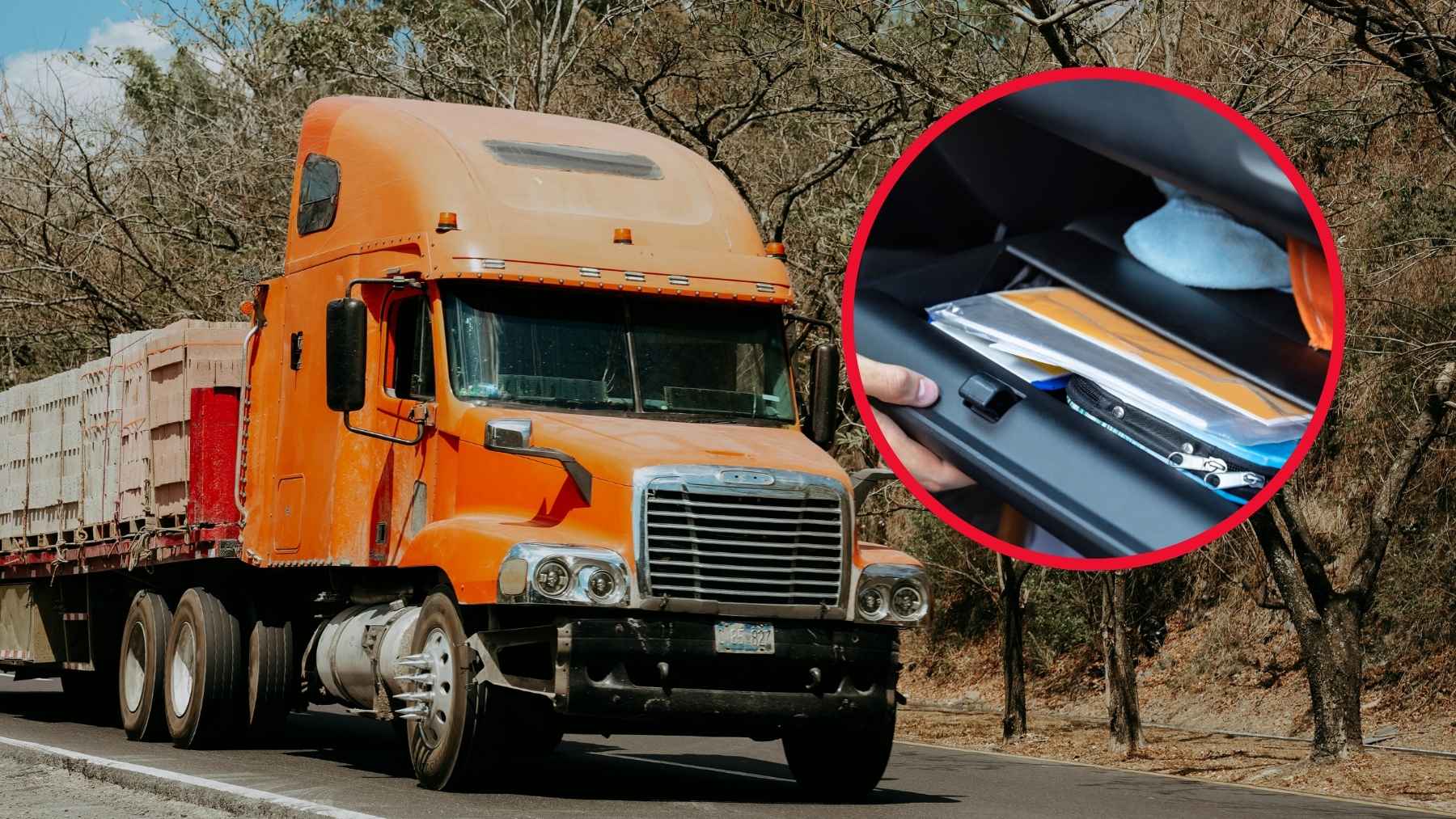
At 22, Andrea García Cano spends her workday moving refrigerated trailers between logistics terminals in Catalonia and a central hub in Zaragoza. “In my truck’s glove compartment I carry hand sanitizer, diesel receipts, and the phone charger cable,” the Barcelona-area driver says.
It is a tiny inventory for someone responsible for a heavy articulated vehicle on busy Spanish roads.
Why does an almost empty glove box matter? Because it opens a window onto a much bigger change in a road freight industry that needs younger workers, more women, and new skills as it prepares for tougher emissions rules.
A Spanish Transport Ministry report says women account for only about 2% of professional truck drivers, while the sector needs roughly 15,000 additional workers.
Three ordinary items behind a high-stakes job
The minimalist glove box fits the way García approaches her cab. Hand sanitizer covers a practical need, the diesel receipts document daily expenses, and the charger cable keeps her phone ready. Nothing flashy.
Before leaving, she walks around the truck to check its lights and confirm that the refrigerated trailer is correctly coupled. That visual inspection may take only a few minutes, but it is one of the quiet routines that separates a safe departure from a dangerous one. In trucking, even sophisticated machinery still depends on a person noticing when something does not look right.
García prefers daytime work and uses electronic music as a steady background that helps her maintain attention. The open road can feel peaceful, but urban traffic is a different story when a large truck has little room to maneuver.
A career chosen rather than inherited
García did not grow up in a family of truck drivers. Her interest in cars, motorcycles, trucks, and roads developed on its own, and she began asking about heavy-vehicle licenses soon after earning her car license at 18. Her partner, who is also a truck driver, later helped her understand the profession’s daily reality.
At 21, she qualified to drive rigid and articulated trucks, reaching the required age at a point when few people are ready to take responsibility for a vehicle of that size. Before moving into the cab full time, she worked as a forklift operator at a distribution center.
That gave her a view of the supply chain from the warehouse floor before she began carrying freight between terminals.
Her first routes were not a gentle introduction, since she had to drive a large rigid truck through central Barcelona amid congestion, tight streets, and unpredictable motorists. The stress was real, but it did not push her away. After working for three companies, she settled into her current daytime role exchanging refrigerated trailers.
The industry still has an old gender problem
A 22-year-old woman at the wheel of a heavy truck still attracts attention at loading docks and service areas. García says some veteran workers have questioned whether she knows how to drive simply because she is young and female. She tries not to let those comments define the job.
There is support too. Other drivers and logistics workers congratulate her, ask about her experience, and welcome the sight of more women entering the profession.
A Transport Ministry report citing industry data estimated that only around 5,000 of Spain’s approximately 250,000 truck drivers are women, while just 11% of truck licenses issued in 2022 went to women.
Age makes García’s position even more unusual. An EU transport review reported that people under 25 accounted for only about 6 to 7% of Europe’s truck drivers, while the average age across the broader driver workforce was 51.5 in 2019. Her story is therefore about more than breaking a gender barrier, since it also raises the question of whether trucking can attract a new generation.
Diesel receipts meet a lower-emission future
One item in García’s glove box tells the story of freight as it exists today. The diesel receipts are a paper trail from a sector that still depends heavily on fossil fuels, even as Europe pushes manufacturers toward cleaner heavy trucks. Heavy-duty vehicles produce roughly 27% of the EU’s road transport emissions.
The rules are getting tighter. The EU’s standards still set manufacturer fleet targets that require emissions from covered new heavy-duty vehicles to fall by 45% from 2030, 65% from 2035, and 90% from 2040 against the relevant baseline.
These targets apply to vehicle makers rather than individual drivers, but people like García will be the ones adapting to new powertrains, charging routines, software, and operating procedures.
That is where her age becomes a business story, not just a social media curiosity. Spanish-registered vehicles performed 14.2% of EU road freight transport in 2023, the third-largest national share behind Poland and Germany. A country moving that much freight cannot modernize its fleets without also improving recruitment, training, and working conditions.

Her next move may be into the traffic office
García does not expect to remain behind the wheel forever. She plans to complete a higher vocational qualification in transport and logistics before pursuing traffic-management and supervisory roles in the sector. The aim is greater schedule stability and a career that fits more easily around her personal plans.
That ambition is practical rather than a rejection of trucking. Time spent coupling trailers, navigating city streets, waiting at terminals, and inspecting a vehicle before departure gives a future dispatcher or traffic manager knowledge that cannot be learned from a spreadsheet alone. It could help her make better decisions about routes, workloads, and the realities drivers face.
For now, she remains in the cab, with electronic music playing and three ordinary items in the glove box. The list is simple. The industry she is entering is anything but.
The original report was published on Auto Bild España.