A German renewable energy developer has moved a 99.2 MWp agrivoltaic project in western Romania to the ready-to-build stage. PNE Romania says the Hotar development in Bihor County is designed to combine solar generation, continued agricultural use, and a 57 MWh battery system on the same site.
The headline number is large, but the land-use idea may matter even more. Hotar is meant to show that utility-scale solar does not always have to replace farming, while storage could make part of its daytime electricity available when clouds arrive or evening demand begins to rise.
Ready to build
Ready-to-build sounds like construction is already underway. It is not. At Hotar, PNE is using the milestone after securing approvals, permits, and grid connection documentation, but its announcement does not say crews have started work.
PNE says its team secured 64 approvals and studies, obtained building permits for the full project ecosystem, and worked through the connection process for a 110 kV substation. In the announcement, the company did not provide a construction start, equipment supplier, completion date, or final investment cost.
Farming between the panels
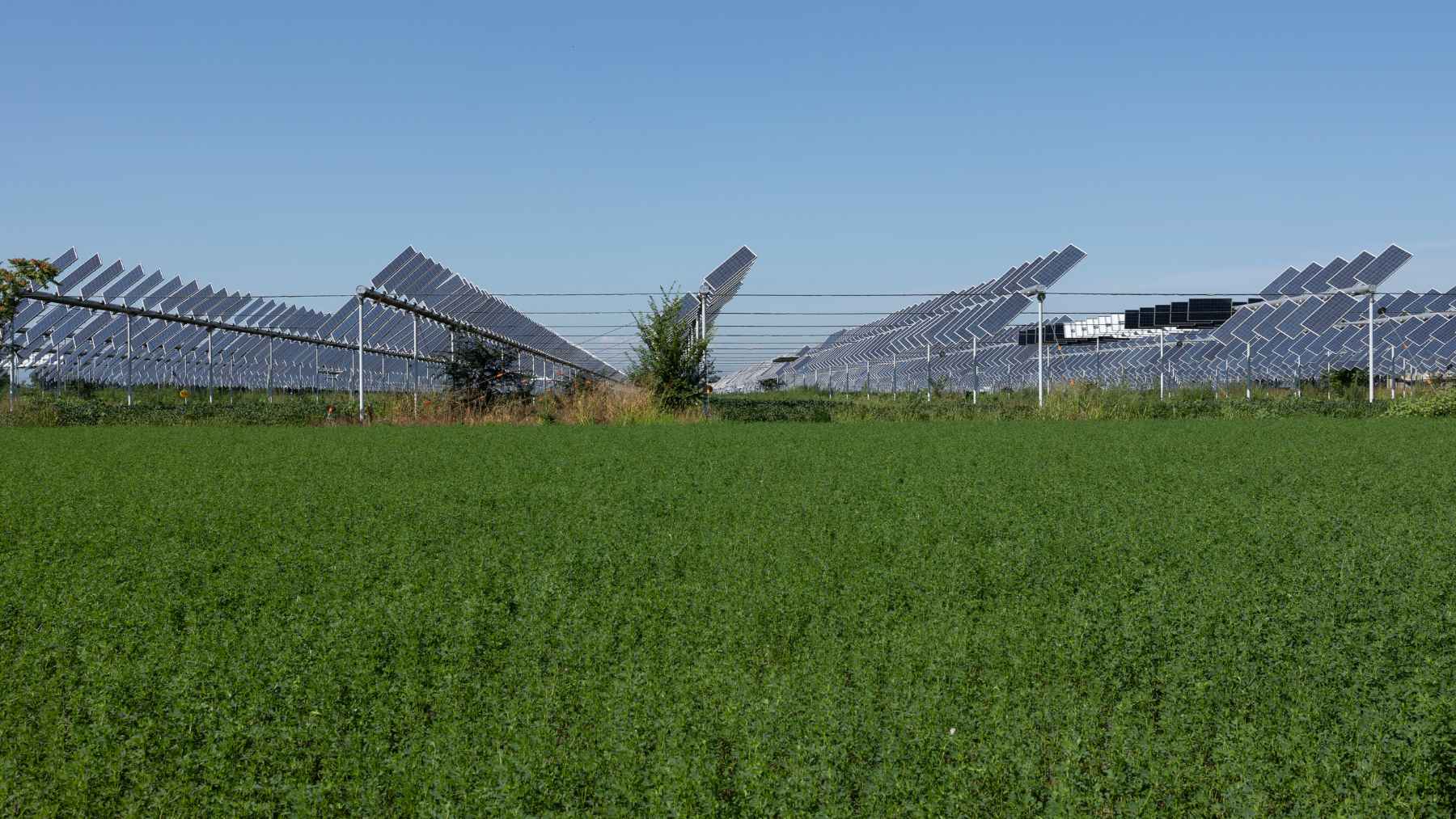
So, what will the site actually look like? Agrivoltaic systems usually raise solar modules above the crop zone or place them in wider rows, leaving space for plants, farm machinery, irrigation, or grazing animals underneath and between the structures.
A tractor still needs room to turn. Crops also need the right balance of sunlight and shade, which means panel height, spacing, tilt, and orientation must be designed around the agricultural activity rather than added as an afterthought.
PNE has not yet disclosed Hotar’s exact mounting height, row spacing, crop selection, or livestock plan. That missing information matters because the project will only prove its dual-use claim if farming remains practical and measurable after the solar equipment is installed.
Shade can help, but not always
Solar panels can create a cooler microclimate, reduce heat stress for some crops, and lower water needs in certain conditions. They may also offer some protection from harsh sun and severe weather, which can be useful as farmers face hotter and less predictable growing seasons.
But agrivoltaics is not a one-size-fits-all recipe. Research reviewed by the U.S. Department of Energy and the International Energy Agency’s photovoltaic program shows that results depend heavily on the crop, local climate, shading pattern, and system design.
Too little spacing can make field work awkward, while poorly matched shade may reduce the performance of plants that need strong sunlight. In practical terms, that means Hotar’s environmental value will depend on real agricultural output, not simply on calling the project agrivoltaic.
What 99.2 MWp means
The small “p” in 99.2 MWp is important. It refers to the solar modules’ peak rated capacity under standard test conditions, not a promise that the facility will deliver 99.2 MW every hour of the day.
Actual production will rise and fall with sunlight, temperature, season, equipment performance, and grid availability. PNE has not published an annual generation forecast for Hotar, so estimates about how many homes it could supply would be speculative at this stage.
The project is also part of a wider Romanian portfolio. PNE says its 106 MWp Maxineni agrivoltaic project in Brăila County reached ready-to-build status earlier, while the operational 87 MW Oradea solar project developed by its Romanian team sits about 25 miles from Hotar.
Why the battery matters
Hotar’s planned 57 MWh battery is meant to make the solar plant more flexible. Storage can absorb electricity when solar output is high, release it later, and smooth some of the short-term swings caused by passing clouds or changing demand.
Still, 57 MWh does not tell readers how powerful the battery will be. Megawatt-hours measure stored energy, while megawatts measure how quickly that energy can be delivered, and PNE has not disclosed the battery’s MW rating or expected discharge duration.
That distinction is easy to miss. Without the power rating, it is not possible to say whether the system is designed mainly for brief grid support, several hours of energy shifting, or a mixture of services.
A business and grid milestone
The long permitting list reveals another side of the story. Large renewable projects are not built by panels and batteries alone, because grid access, environmental reviews, construction rights, and commercial agreements can decide whether a project ever leaves the spreadsheet.
“Success in the renewable energy sector isn’t just about the megawatts,” PNE said. Daniela Dinescu, managing director of PNE Romania, added that the milestone “proves that with the right expertise, we can deliver complex, premium, large-scale hybrid projects that provide stability to the national grid.”
For investors, ready-to-build status can reduce development uncertainty and make a project easier to finance, sell, or take into construction. For Romania, the bigger question is whether approved developments can connect on schedule and deliver electricity when the grid needs it.
Europe is watching agrivoltaics
The European Commission’s Joint Research Centre has estimated that using just 1 percent of the European Union’s agricultural land for agrivoltaics could support about 944 GW of solar capacity. That is a technical potential, not a construction forecast, but it shows why developers and policymakers are paying close attention.
The same research stresses that farming must remain the primary land use and that machinery or livestock must still have access. At the end of the day, agrivoltaics works only when the field produces two useful outputs instead of letting one quietly displace the other.
Hotar has now crossed a difficult administrative threshold, but the most important evidence will come later. Construction details, the agricultural plan, battery specifications, and measured farm performance will show whether this nearly 100 MW project becomes a genuine dual-use model or simply a promising concept on paper.
The official statement was published on PNE Romania’s LinkedIn page.