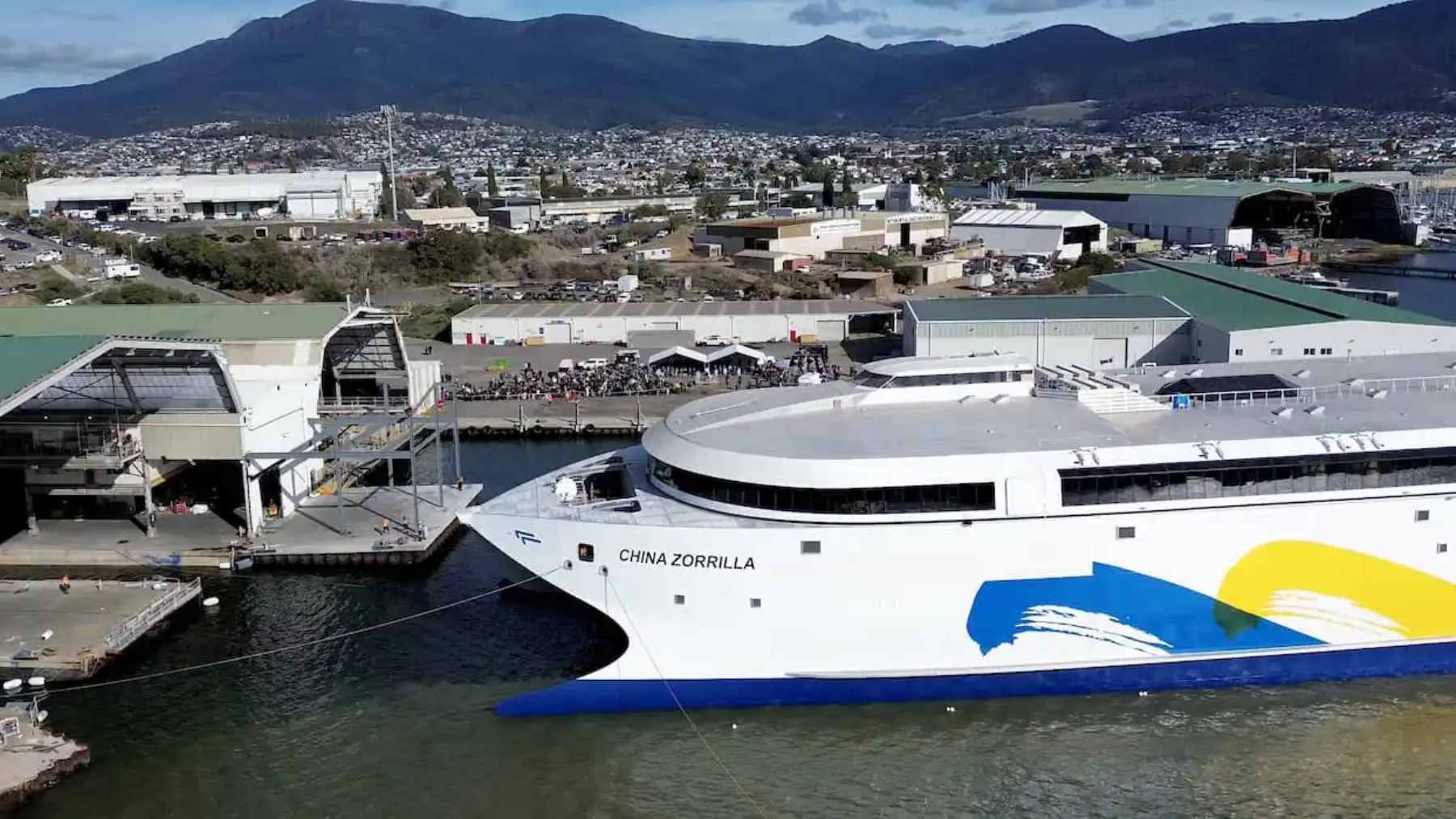
A massive heavy-lift ship is now on its way to Hobart, Tasmania, to collect the China Zorrilla, the world’s largest battery-electric ferry, before carrying it to South America. The twist? One of the cleanest ferries ever built still needs a 712-ft. transport vessel to reach the route where it can finally prove what electric shipping can do.
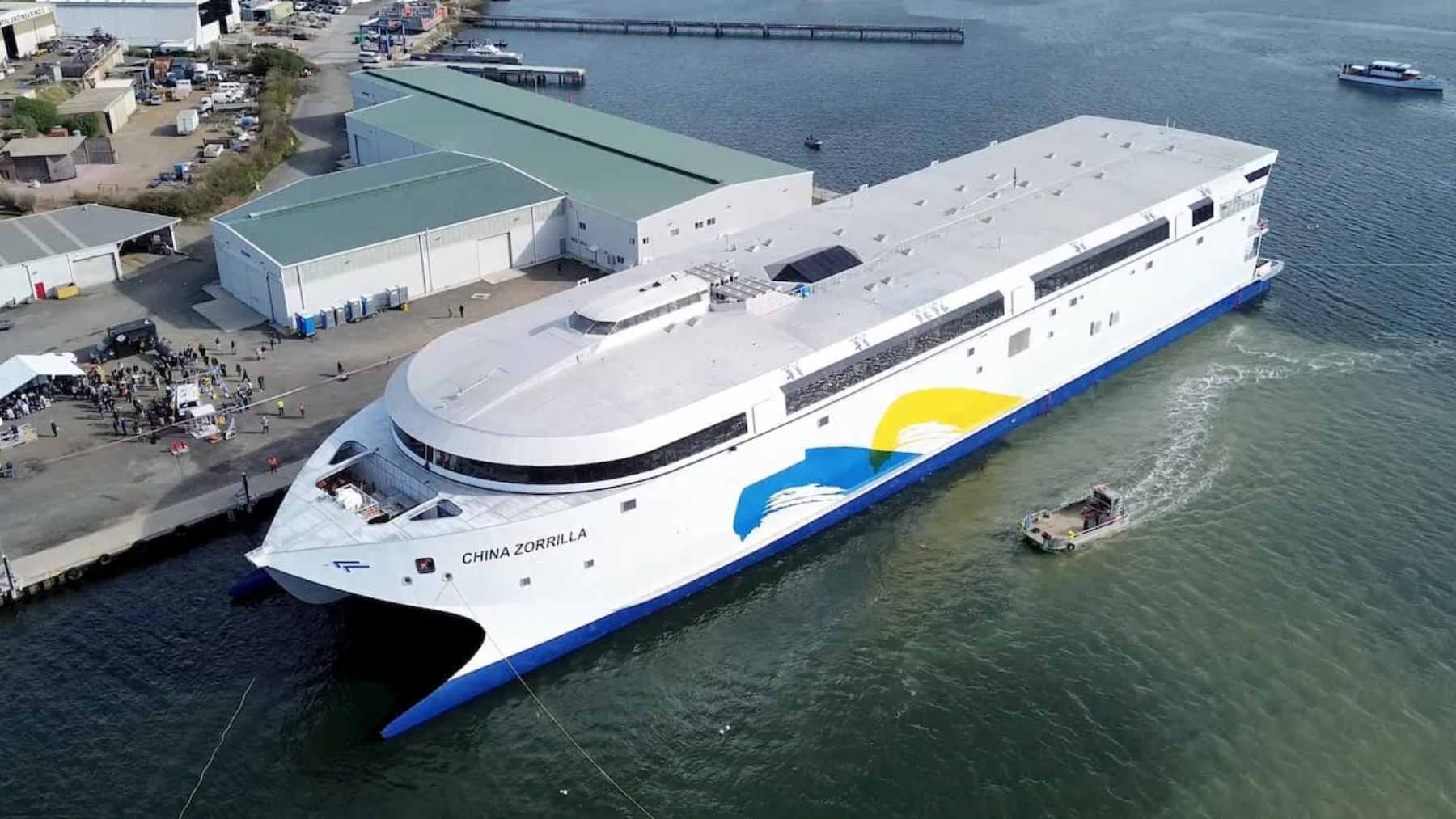
The 427-ft. catamaran was built by Incat for Buquebus and is designed to carry 2,100 passengers and 225 cars between Buenos Aires, Argentina, and Colonia, Uruguay. In practical terms, a busy river crossing could soon be served by a ship powered by batteries instead of diesel fuel.
A giant ship for a giant ferry
The MV Black Marlin is no ordinary delivery truck of the sea. At about 712 ft. long and 138 ft. wide, the semi-submersible heavy-lift vessel is built to carry huge marine structures, including ships, cargo, cranes, oil platforms, and drilling equipment.
Incat says the Black Marlin will travel to Tasmania via South Africa and Melbourne before loading Hull 096, the construction name for the China Zorrilla. If the schedule holds, the ship could arrive in Hobart around mid-July, with the voyage to Buenos Aires expected to take about 30 to 40 days.
It sounds almost theatrical, and in a way, it is. A vessel that Incat describes as the largest battery-electric ship ever constructed will be floated onto another ship, locked down, and carried across oceans like a carefully packed piece of high-tech cargo.
The loading puzzle
Getting the China Zorrilla onto the Black Marlin will not be as simple as tying up at a dock. The heavy-lift vessel must partly sink its cargo deck below the waterline, allowing tugboats to help position the ferry above a specially prepared cradle.
Then comes the delicate part. Water is pumped back out of the Black Marlin, lifting its deck and the ferry out of the river before crews secure the China Zorrilla with chains and lashings.
The depth matters, too. According to Incat officials cited by ABC News, the partly submerged Black Marlin could draw about 75 ft. of water, meaning TasPorts will need to determine the safest deep-water location in the River Derwent.
Why not sail it there?
Here is the question many people will ask: if this is such an advanced electric ship, why can’t it just sail itself to South America?
The answer says a lot about where clean maritime technology stands right now. The China Zorrilla was designed for the relatively calm Río de la Plata route, not for a long open-ocean crossing from Australia to Argentina.
Incat’s head of projects, David Riseley, said the decision to wait for a suitable heavy-lift ship was partly about protecting the ferry’s structure. The company had considered other options, including adding diesel generators to power the electric motors, but chose the slower and safer route instead.
Batteries at ferry scale
The China Zorrilla is not just a ferry with a plug. Its energy storage system is listed by Incat at 41.2 megawatt-hours, with charging capacity from two 8-megawatt DC chargers and eight 2,400-kilowatt electric motors driving eight Wärtsilä waterjets.
Corvus Energy, which supplied the battery systems, says the vessel has more than 40 megawatt-hours of storage, making it the largest battery system installed onboard a ship. Incat has also said the vessel is powered by more than 275 tons of batteries, a reminder that clean propulsion still requires serious engineering muscle.
For passengers, the result should feel familiar. You board, park the car, buy something at the duty-free shop, and cross the river. Behind the walls, though, the machinery is very different.
A test for the industry
The delivery delay also shows how global shipping remains vulnerable to geopolitics and logistics. ABC reported that the originally booked heavy-lift ship became stuck in the Persian Gulf amid the U.S.-Iran conflict, forcing Incat to find another vessel.
That matters because the electric ferry business is no longer a small experiment tucked away in a shipyard. Operators are watching closely, and Incat’s battery-electric designs have already drawn more interest, including from Denmark’s Molslinjen for one of Europe’s busiest ferry corridors.
At the end of the day, this is a test of more than one ship. It is a test of whether ports, shipbuilders, battery suppliers, ferry operators, and cargo specialists can work together fast enough to make electric maritime transport normal.
Cleaner shipping still has a long road
The China Zorrilla arrives at a moment when shipping is under growing pressure to cut emissions. The International Maritime Organization’s 2023 strategy calls for international shipping to cut carbon intensity by at least 40% by 2030, push zero or near-zero greenhouse gas technologies to at least 5% of energy use by 2030, and reach net-zero greenhouse gas emissions by around 2050.
Battery-electric ferries will not solve every shipping problem. A short, repeatable river crossing is a much better match for batteries than a container ship crossing the Pacific, at least for now.
But that is exactly why this project matters. It focuses electrification where it can work first, then lets the industry learn from the real-world pressure of schedules, charging systems, passenger service, maintenance, and safety.
What happens next
Once the Black Marlin reaches Hobart, the loading operation could take several days. For people watching from shore, it may look like a slow-motion engineering performance, but for Incat and Buquebus, it is the final major step before the ferry begins its new working life.
There is a nice bit of symbolism here. A huge fossil-era logistics machine is helping deliver a battery-powered ferry that points toward a cleaner future.
That future is not perfectly neat, it rarely is. But if the China Zorrilla performs as planned between Uruguay and Argentina, the humble ferry may become one of the clearest examples yet that electric ships can move from headlines to daily life.
The official statement was published on Incat.