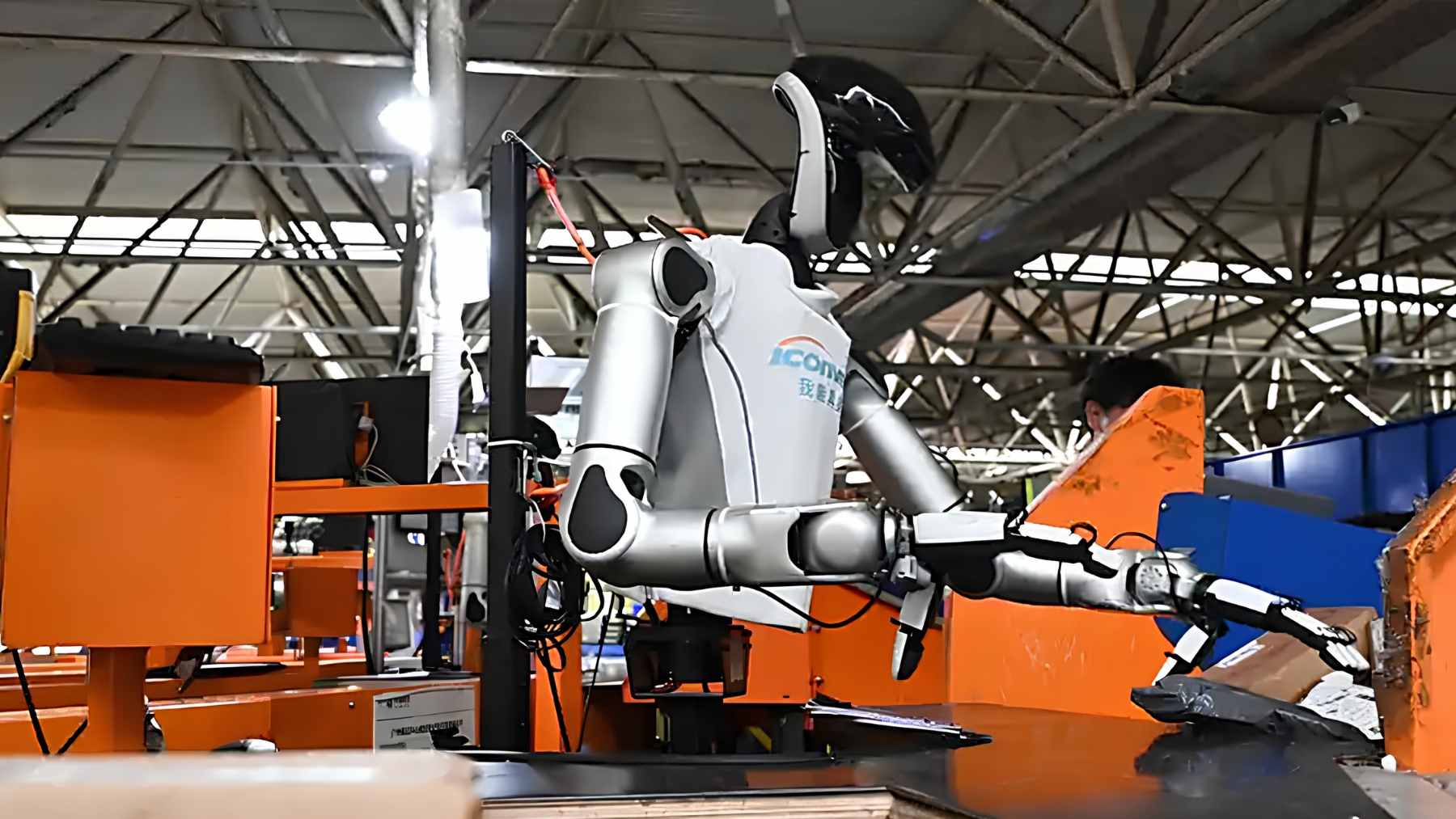
China has put humanoid robots to work inside a major postal hub in Guangzhou, where the machines are being used to sort and identify parcels at speeds of up to 1,200 items per hour.
The deployment, reported by China Post Group and Xinhua, is taking place at the Jianggao mail processing center under the Guangzhou postal center, a facility that handles an average of 6.5 million mail items a day and can exceed 10 million during peak periods.
That number is hard to picture until you think about everyday life. A phone case ordered at lunch, a replacement charger bought at night, a birthday gift shipped across the country. Behind each small package is a system of warehouses, belts, trucks, labels, boxes, and now increasingly, robots.
Robots enter the parcel rush
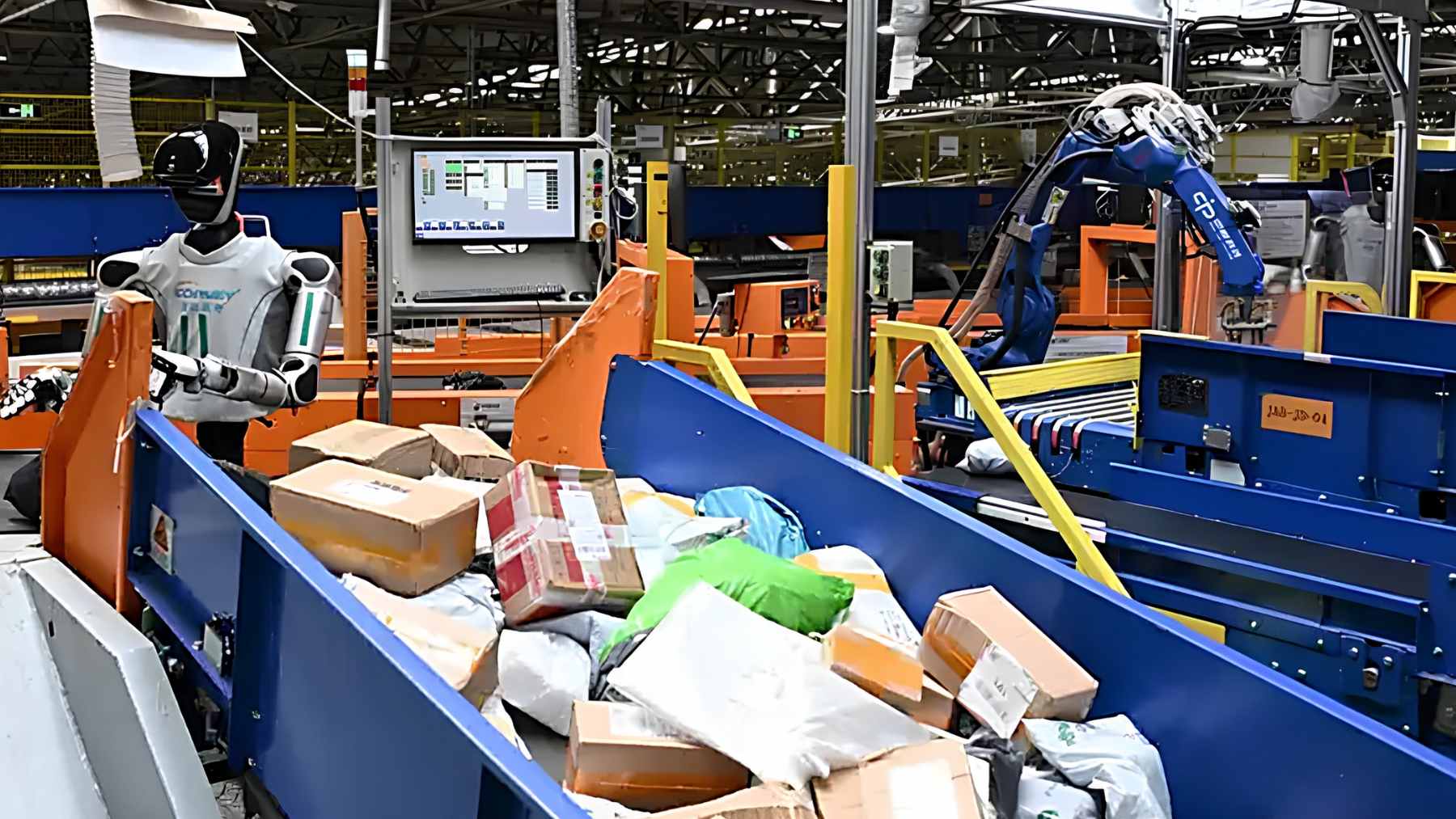
The new robotic sorters are not working alone. According to China Post’s official posting, the Guangzhou center has been upgrading its sorting equipment with robots, robotic arms, unmanned forklifts, and intelligent operation systems as part of a broader shift from manual sorting toward more automated processing.
In practical terms, the warehouse is starting to look less like a traditional mailroom and more like a connected machine. Humanoid robots handle parcels, robotic arms help move items through the line, and unmanned forklifts carry loads across the floor.
Why use humanoid robots at all? The main idea is flexibility. Unlike fixed industrial machines, humanoid systems are built to work in spaces designed around people, which could make them easier to add to existing sites without rebuilding the entire warehouse.
Why Guangzhou matters
Guangzhou is not just another logistics location. It sits inside one of China’s most active commercial regions, where e-commerce demand and export flows put constant pressure on parcel networks.
China’s postal industry processed 216.5 billion delivery items in 2025, up 11.5% from the year before, according to data released at the 2026 national postal work conference. The courier sector alone handled 199 billion parcels, while postal industry revenue reached about $256.5 billion.
So, a robot that can sort 1,200 parcels per hour is not just a flashy demo. At this scale, even small gains in speed, accuracy, and uptime can ripple through a huge delivery system.
The green question
At first glance, parcel-sorting robots might sound like a straightforward efficiency story. Faster sorting could reduce bottlenecks, help trucks leave on time, and cut some wasted handling. That matters when logistics networks are under pressure every hour of the day.
But the environmental picture is more complicated. Road transport emitted just over 6.6 billion tons of CO2 in 2024, and trucks accounted for about one-third of road-sector emissions, according to the International Energy Agency.
That’s why warehouse automation cannot be judged only by speed. The bigger question is whether it helps the whole logistics chain become cleaner, from packaging and routing to vehicle use and energy demand.
Online shopping has a footprint
E-commerce looks clean when all you see is a package at the door. The mess is usually somewhere else.
UNCTAD’s Digital Economy Report 2024 notes that e-commerce’s environmental footprint is shaped by warehousing, transportation, packaging, and consumer behavior.
The report also cites research finding that e-commerce generated 4.8 times more packaging waste than brick-and-mortar retail in the Republic of Korea, with added implications for greenhouse gas emissions.
That is where robots could help, but only to a point. Better identification of parcels may reduce errors and damaged goods, while smarter sorting could keep packages moving through fewer unnecessary steps. Still, robots do not automatically make a cardboard box reusable or a delivery van electric.
China’s robot race gets real
This Guangzhou deployment fits into a much larger national robotics push. The International Federation of Robotics reported that China was the world’s largest industrial robot market in 2024, accounting for 54% of global deployments and more than 2 million operational industrial robots.
That industrial base gives China a major advantage. It can test robots in demanding real-world places, gather data, improve the systems, and then try again at larger scale.
For humanoid robotics, logistics may be one of the first serious proving grounds. Warehouses are repetitive, structured, and full of tasks that are difficult for people to do all day but still tricky for machines to handle reliably.
Not a simple win
There is a reason many warehouse operators still rely on simpler machines. Humanoid robots are mechanically complex. They may be more expensive to buy, maintain, and repair than fixed conveyor systems or standard robotic arms.
They also consume electricity and require components, sensors, batteries, software, and spare parts. If the power behind them comes from high-emission sources, or if they are replaced too quickly, some of the environmental benefits can shrink.
The best case is more practical than futuristic. Robots help reduce errors, smooth peaks in demand, prevent unnecessary rehandling, and give operators better data about package flows. That is useful, but it is not magic.
What workers should watch
China Post’s report describes a shift from traditional manual sorting toward unmanned and intelligent processing. That wording matters because postal centers are not just technical systems, they are workplaces.
For workers, the most immediate change may be fewer repetitive lifting and sorting tasks, especially during peak seasons when parcel volumes can become exhausting. On the other hand, automation usually creates a need for new skills in maintenance, monitoring, software support, and safety management.
The trouble is, those transitions are rarely automatic. If robots become common in logistics, companies and governments will need to think carefully about training, job quality, and how people work alongside machines.
What happens next
The key test will be reliability. Can humanoid robots keep sorting parcels hour after hour in a messy warehouse where packages come in different sizes, weights, shapes, and conditions?
Another test will be environmental honesty. If logistics companies claim these systems are greener, they will need to show more than sorting speed. They will need data on energy use, packaging waste, route efficiency, damaged parcels, and emissions across the whole delivery chain.
For now, the Guangzhou deployment shows that humanoid robots are moving from stage performances into everyday infrastructure. Not every package will be touched by a robot tomorrow, but the direction is clear.
The official statement was published on China Post Group’s website.