A strange little robot from Duke University may offer a fresh answer to a big question in robotics. What should a machine look like if it has to move through forests, sand, wet ground, bark, clutter, and rough terrain without getting stuck every few feet?
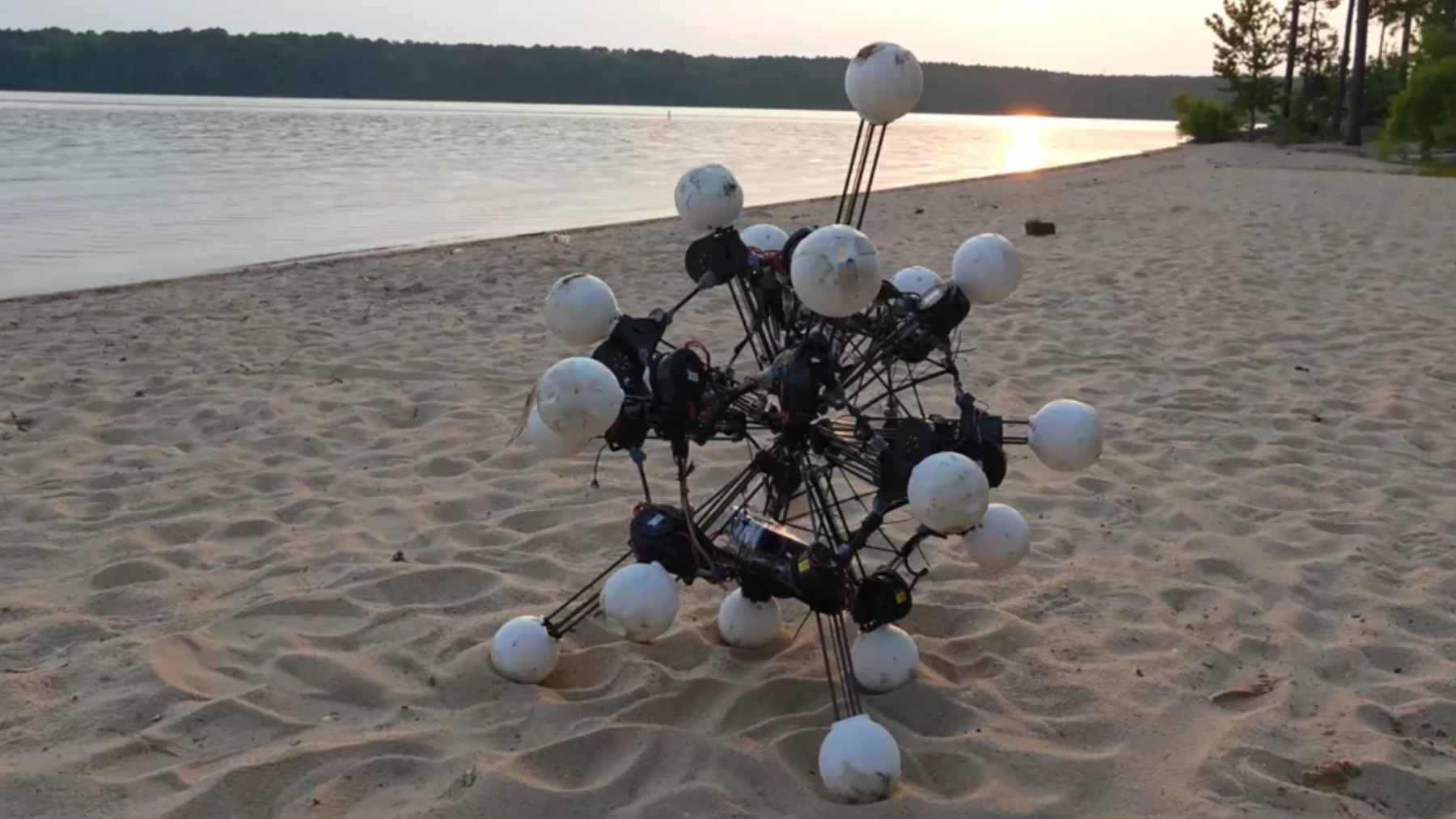
The answer, at least in this new study, is not a humanoid, a robot dog, or a drone. It is Argus, a sea-urchin-like robot with 20 telescoping legs, 20 depth cameras, and no obvious front or back.
That odd shape could matter for future environmental tech, search and rescue, military robotics, and any industry that needs machines to work where roads, floors, and flat surfaces are nowhere to be found.
Argus has no front
For decades, engineers have borrowed ideas from nature. They have built robots that walk like dogs, balance like humans, crawl like insects, and fly like birds.
Duke’s Argus takes a different path. Its legs radiate from a central body, each one tipped with a depth camera, which gives the robot a nearly all-around view of its surroundings.
That is why the team named it after Argus, the all-seeing figure from Greek mythology. Fitting name, right?
Why symmetry matters
The Duke team did not begin by asking which animal the robot should copy. Instead, the researchers used a mathematical idea called dynamic isotropy, which measures how evenly a robot can accelerate its center of mass in every direction.
The score runs from 0 to 1. Most robots in use today, including advanced quadrupeds, humanoids, and conventional drones, score below 0.6, according to Duke. Argus scored 0.91, close to the theoretical maximum.
In practical terms, the robot does not have to turn around before reacting. “Forward and backward become the same,” said Boyuan Chen, director of Duke’s General Robotics Lab. The whole way engineers think about control begins to shift.
Built from simulations
Before building Argus, the researchers ran more than 1,500 robot-shape simulations. They were looking for a body that could act with the same strength and agility in almost any direction, instead of being better at moving one way than another.
The winning arrangement was based around a regular dodecahedron, a three-dimensional shape with 12 pentagonal faces. That geometry allowed the team to spread the robot’s legs and cameras in a way that gave it unusual balance, vision, and movement.
It sounds like classroom geometry turned into hardware. But here, the math is the machine.
Tested in the wild
To see whether the design worked outside a lab, the team took Argus onto Duke’s campus and into rougher spaces. It moved across concrete, grass, dense foliage, soft sand, wet surfaces, and bark, while handling obstacles up to 5 inches tall.
The robot also self-stabilized after being pushed, kept moving after three of its legs were broken, carried a 10-lb. payload at nearly full speed, and pushed a 3-ft. cube while rolling. It could even climb between close vertical walls by bracing and thrusting with different legs.
“Watching Argus move is unlike watching any other robot we’ve worked with,” said Jiaxun Liu, a Ph.D. student in Duke’s General Robotics Lab and co-first author of the study.
Why this matters for the environment
The study does not claim Argus is ready to patrol national parks or monitor fragile habitats tomorrow. Still, its tests point toward something important for ecology and environmental work.
Forests, wetlands, beaches, and disaster zones are messy places. A machine that can move through cluttered terrain without needing a clear front, a smooth trail, or perfect balance could eventually help researchers design robots for places where wheels and tracks struggle.
That could matter for environmental monitoring, post-storm assessments, hazardous-site inspection, or field research in areas that are hard or risky for people to enter. The key word is “could,” because Argus is still a proof of concept, not a finished commercial product.
The defense connection
There is also a clear military and defense angle. Duke says the work was supported by DARPA programs, the U.S. Army Research Office, and the U.S. Army Research Laboratory STRONG program.
That does not mean Argus is a battlefield robot. But rugged mobility is a major concern for defense researchers, especially in collapsed buildings, rough outdoor terrain, underwater environments, and places where a normal machine may fail quickly.
Search and rescue is another obvious possibility. Chen told The Associated Press that the same principle could help guide future search-and-rescue robots, underwater or aerial vehicles, and machines that can grip objects in unusual ways.
Business is already watching
Whenever a new robot body works this differently, the next question is simple: can it become useful outside the university?
Duke says it has filed patent rights for technology associated with the manuscript. The school also directed commercial licensing inquiries to its Office for Translation and Commercialization, which suggests the design may have a business path if future versions prove practical.
There is a cost question, too. Each of Argus’s telescoping legs costs about $300, according to the information shared about the project. With 20 legs and 20 cameras, this is not exactly a garage gadget yet.
Not the final answer
Argus is not being presented as the one perfect robot body for every job. The researchers describe it more as proof that dynamic symmetry can be used to compare robot designs and create new ones from scratch.
That distinction matters. The big idea may not be this exact 20-legged machine, but the design principle behind it.
“It changes what’s possible,” said Boxi Xia, a postdoctoral researcher at Duke’s General Robotics Lab. For the most part, that possibility begins with a simple lesson: robots do not have to look like us to be useful to us.
A new kind of robot blueprint
At the end of the day, Argus is a reminder that nature does not offer just one blueprint for movement. Dogs, insects, starfish, sea urchins, and humans all solve different problems in different ways.
Robotics may be entering a similar phase. Instead of copying one familiar body shape, engineers can start with the environment, the task, and the math, then let the right form emerge from there.
For environmental technology, that could be a big shift. The trouble is, the real world is not flat, clean, or predictable. Argus was built for exactly that kind of mess.
The study was published on Science Robotics.