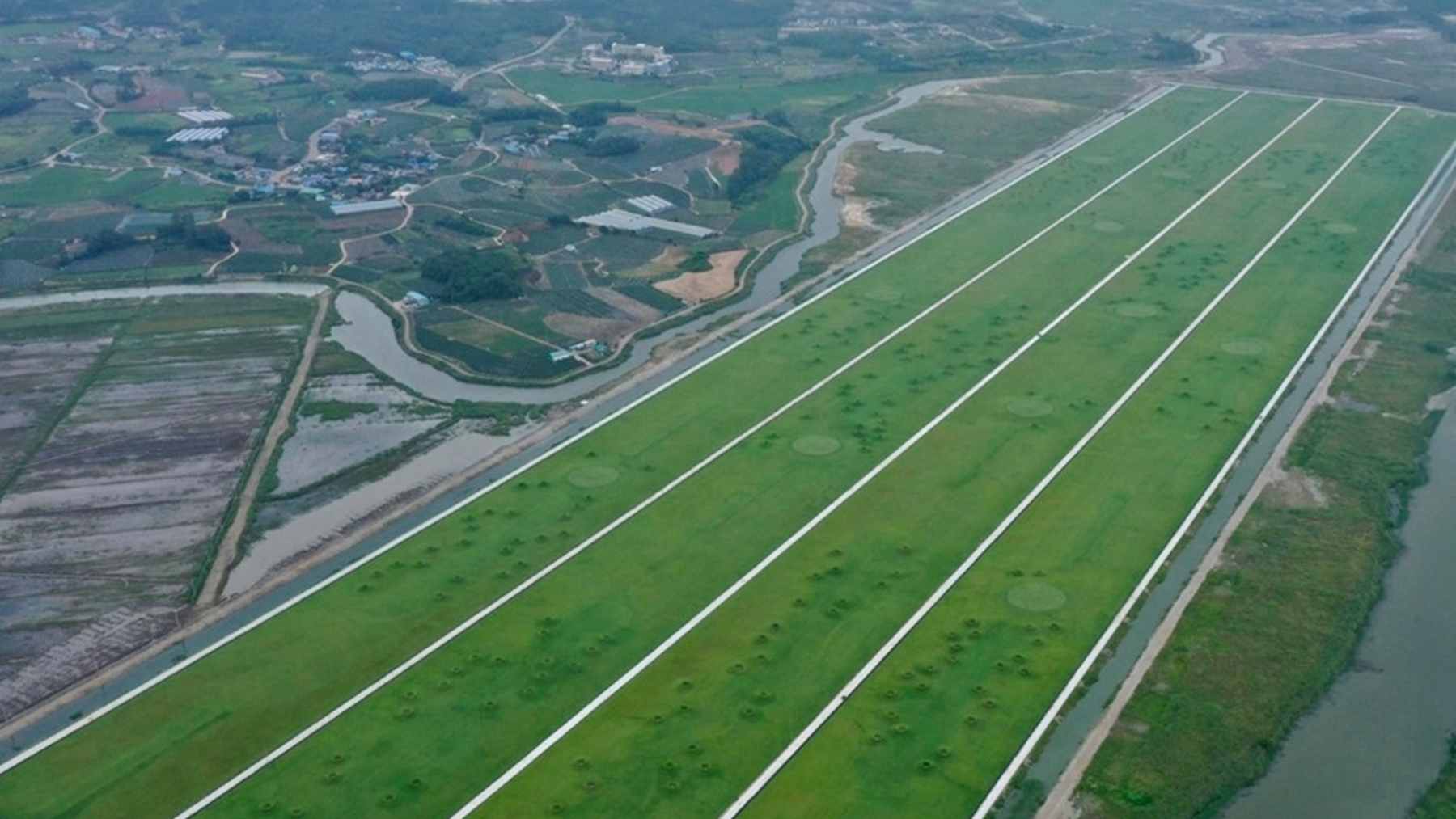
A golf course built to help anchor South Korea’s giant Solaseado tourism city may be heading toward a very different second life. Cosmos Links CC, an 18-hole public golf course in South Jeolla Province, opened in March 2024 with a striking runway-style layout, but financial trouble pushed it into public auction after only months of operation.
The site was once valued at about 206 billion won, roughly $137 million, but it was later acquired for 65 billion won, or about $43 million. BS Group has not confirmed a final plan, yet reports say renewable energy, including solar power, is being reviewed for the land.
That turns one failed leisure project into a bigger question for South Korea. What should happen when expensive, open land no longer works as a golf business?
A golf dream fell fast
Solaseado was designed as a huge tourism and leisure corporate city across Yeongam and Haenam in South Jeolla Province. Jeonnam’s official investment page lists the project area at about 13 square miles, with planned facilities including an F1 racing venue, hotels, resorts, a theme park, a marina, and golf courses.
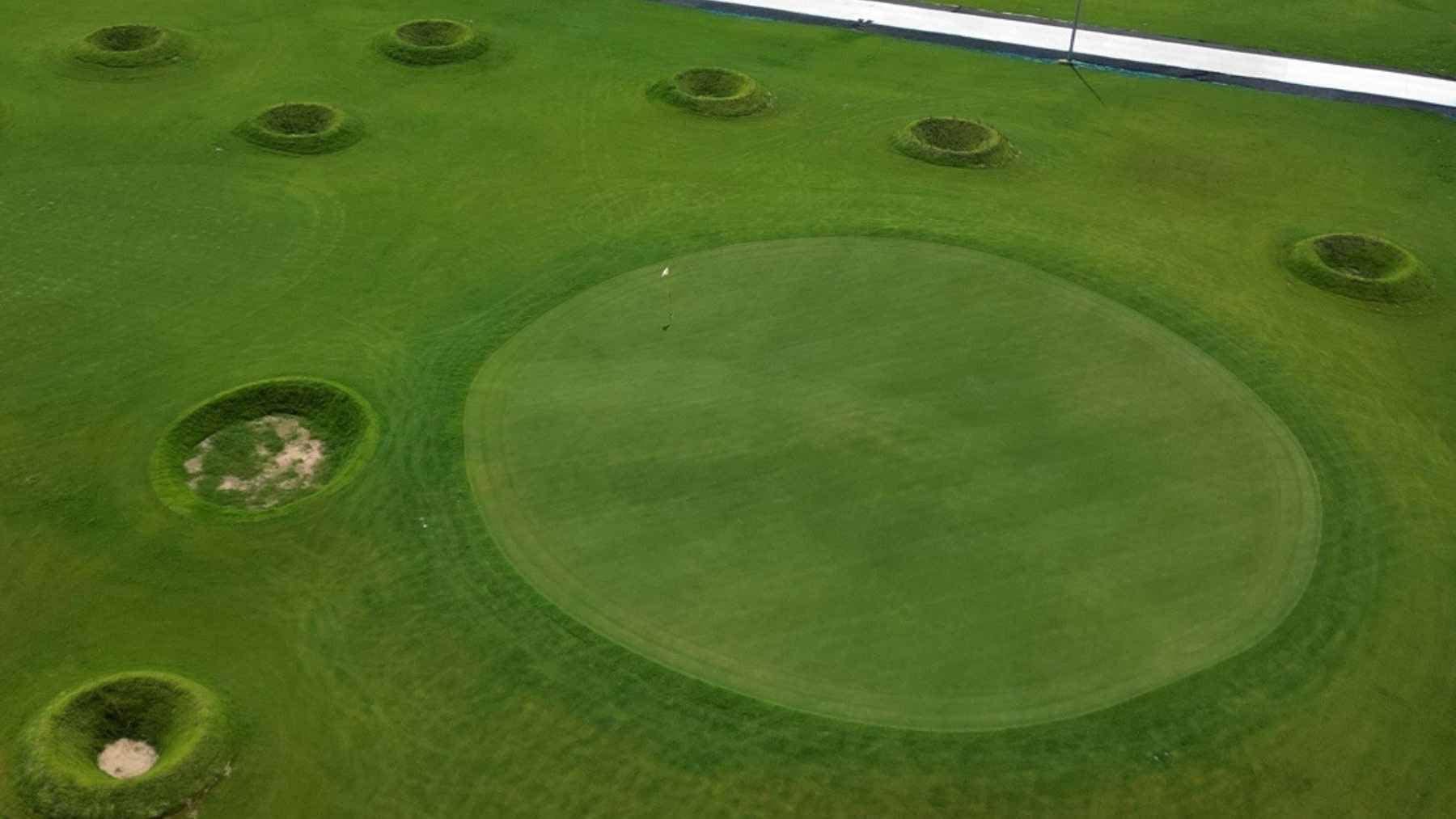
Cosmos Links CC was meant to fit that vision. Its unusual straight-line course used four connected fairway strips, each about 6,070 feet long and 328 feet wide, with a combined course distance of 4.2 miles. From above, it looked less like a traditional golf escape and more like a piece of infrastructure.
But the numbers told a harder story. The course opened in March 2024, closed operations on August 31 of the same year, and went through repeated auction attempts before BS Group’s affiliate moved to buy the land and buildings.
TheBell reported that the site covers about 841 acres, a size that makes it valuable even if the golf business itself failed.
Why solar wants fairways
Solar developers tend to like the same things golf courses already have. They need broad, open land, limited shade, road access, and terrain that has already been shaped and maintained. In practical terms, fairways can look a lot like ready-made platforms for panels.
That does not mean every closed golf course should become a solar farm. Local residents may worry about views, land values, wildlife, and whether a green landscape is being replaced by a more industrial one. Still, leaving hundreds of acres idle is not exactly beautiful, either.
This is where the economics start to bite. Golf can be expensive for younger players, from clubs and clothes to green fees and travel. If business golf also fades, courses lose one of their most reliable customer bases, and the land beneath them suddenly becomes the real asset.
Japan already tried it
South Korea does not have to imagine what this might look like. Japan has been turning underused or abandoned golf-course land into solar facilities for years, offering a preview of what could happen at sites like Cosmos Links.
Kyocera announced in 2015 that its joint venture would build a 23-megawatt solar plant on an abandoned golf course in Kyoto Prefecture. The company estimated the plant would generate 26,312 megawatt-hours a year, enough electricity for about 8,100 typical local households.
A later Kyocera project went even bigger. In 2018, the company completed a 29.2-megawatt solar plant in Yonago City on about 296 acres of land originally planned for a golf course and other uses. With 108,504 solar modules, Kyocera estimated annual output at 36,080 megawatt-hours, enough for around 12,000 households.
ORIX also moved into this space. In 2014, the company announced a 51-megawatt solar project on the former TOSHIN Lake Wood Golf Club site in Mie Prefecture, using about 204,120 panels across roughly 295 acres.
The projected output was about 59.8 million kilowatt-hours a year, equivalent to the annual electricity use of around 16,620 households.
Solar is not a magic fix
It is tempting to see solar panels as a clean rescue plan for failed golf properties. The reality is more complicated. A solar project still needs permits, financing, grid connections, engineering work, and sometimes storage systems to manage power when the sun is not shining.
There are also unresolved business questions. TheBell reported that BS Group’s internal direction for the Cosmos Links site had not been finalized, and that renewable-energy development was still under review. In other words, this is not yet a confirmed solar farm.
That nuance matters. A golf course can fail quickly, but a solar complex cannot simply appear overnight. Developers have to prove that the numbers work, that local opposition can be managed, and that the grid can actually use the power being generated.
A bigger energy signal
Solaseado itself is no longer just a leisure story. Jeonnam’s official project page lists a power-generation district and an RE100-focused industrial zone among the plans for the wider development area. That puts energy, technology, and business infrastructure closer to the center of the project than a simple resort-city label would suggest.
TheBell also reported that BS Group is looking at Solaseado as part of a broader clean-energy and advanced-industry strategy, with solar, wind, and data-center development all part of the larger conversation. That makes the Cosmos Links site more than a stranded golf asset. It could become a test case for how South Korea reuses leisure land in an era of energy transition.
For the most part, the shift is easy to understand. A golf course needs paying players. A solar plant needs sunlight, panels, and a buyer for the electricity. When one model stops working, the other can start to look very practical.
A fairway with a different future
Cosmos Links CC was designed to draw golfers, tourists, and attention to a mega-development. Instead, it may end up drawing energy planners, solar investors, and local officials trying to avoid another white elephant.
That may sound like a comedown, but it also reflects a broader change. Around the world, land once set aside for recreation, retail, or real estate speculation is being reconsidered through the lens of climate, electricity demand, and long-term maintenance costs.
For now, the safest reading is simple. Cosmos Links is not yet a confirmed solar farm, but the economics are pulling the conversation in that direction. If the project moves ahead, a golf course that struggled to find players could end up producing power instead.
The official press release was published on Kyocera.