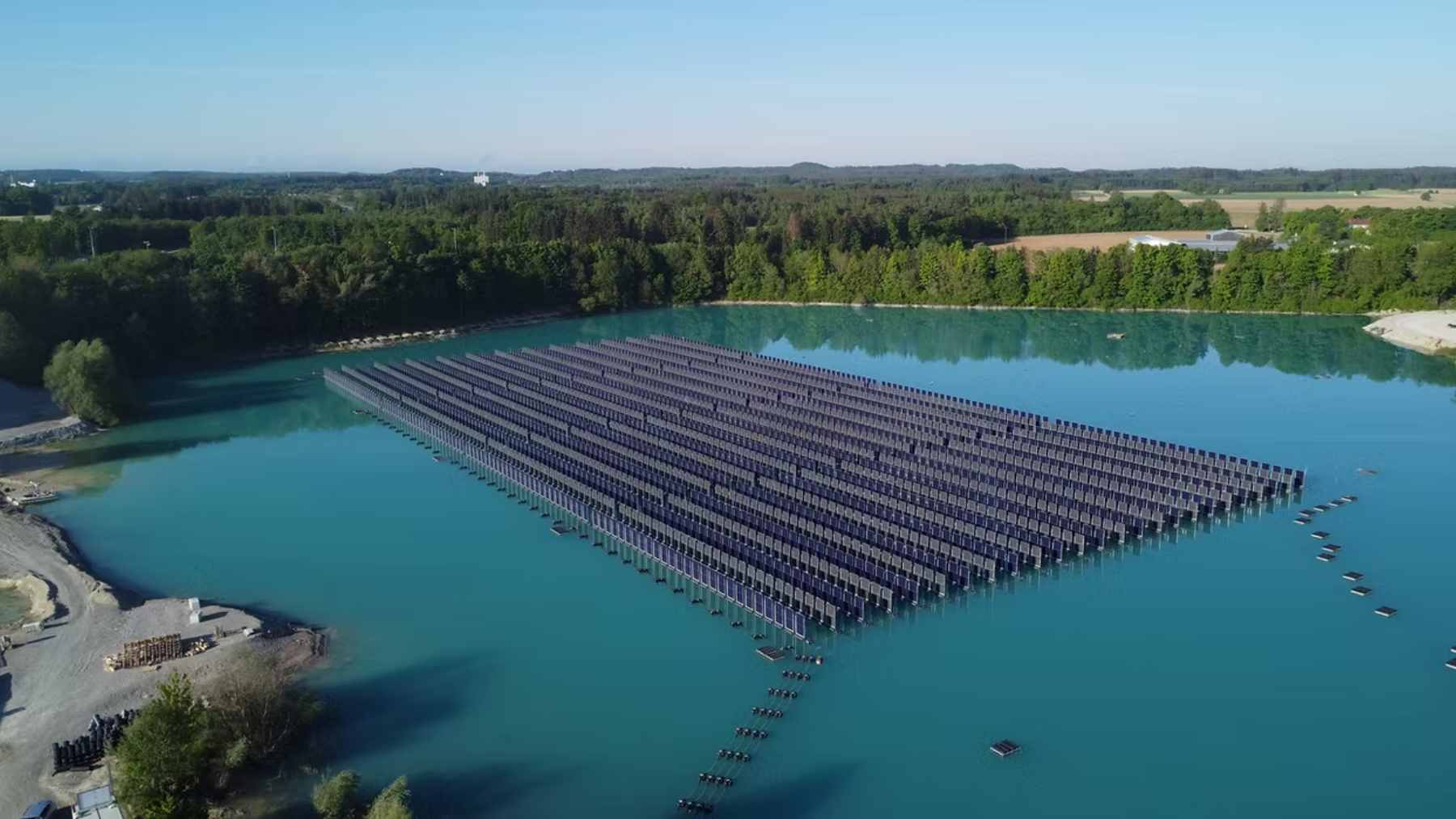
Germany has switched on what SINN Power calls the world’s first utility-scale floating solar plant with panels mounted vertically, not tilted toward the sky.
Built on the Jais gravel pit lake in Bavaria’s Starnberg district, the 1.87 MW project uses around 2,500 bifacial modules in an east to west layout that aims to generate more electricity at sunrise and sunset, when households and industry are actually pulling power.
That timing matters more than it used to. Across Europe, solar’s rapid growth is pushing wholesale prices down around midday and sometimes into negative territory, which hurts the economics of “more noon” power and raises the value of generation that shows up earlier and later in the day.
In the U.S., federal energy analysts have described the same basic problem through the “duck curve,” where solar floods the grid at lunch and then demand ramps up fast as the sun goes down.
How vertical panels change the solar curve
Traditional solar farms are usually designed to maximize output around solar noon, because that’s when the sun is strongest.
Vertical east-to-west systems flip the goal by chasing two daily peaks, catching morning light on one side and afternoon light on the other, which research suggests can better match real-world load patterns in many settings. Why fight for a bigger lunchtime spike if the grid is already saturated at lunch in some regions?
On the Jais lake, SINN Power says the design is paired with wide open corridors of water, with rows separated by at least four meters to keep light and oxygen moving across the surface.
The company also points to the legal constraint in Germany that caps floating solar coverage at 15% of a waterbody under the Water Resources Act, saying this site uses about 4.65% of the lake surface while staying under that threshold.
Early performance claims are part of the story, too. SINN Power says the plant was on the grid by late summer 2025 and produced over 100 MWh in its first three weeks even with autumn weather, while the gravel operation’s grid electricity purchases fell sharply in the same period.
Yield forecasts shared in industry reporting also point to a reduction of grid purchases “up to 70%,” with surplus electricity exported when available.
The business case is about value, not just volume
For years, solar’s headline advantage was simple: cheaper panels for more megawatts, more megawatt hours, and lower emissions. But in markets with lots of midday solar, the conversation is shifting toward “capture price,” meaning what producers actually earn for the power they generate, which has been squeezed by oversupply in the middle of the day.
That squeeze is not theoretical. Spain’s solar industry warned in 2025 that hundreds of hours of zero or negative prices were piling up, putting pressure on project revenues and the pace of buildout, and Germany has weighed reforms aimed at better integrating renewables as midday surpluses contribute to negative pricing.
If morning and evening electricity holds more value, designs that tilt production toward those hours may start to look less like a niche engineering trick and more like a business strategy.
On-site economics can be even more direct. A gravel plant does not buy electricity in a smooth line all day, and neither do most businesses that run equipment, pumps, crushers, lighting, and charging at predictable times. If a solar system can cover a large share of those peaks, it can cut the power bill without needing as much storage to move noon electricity into the evening.
Ecology on the waterline
Floating solar is often pitched as a land-saving tool, because it uses reservoirs, quarry lakes, and other man-made water bodies instead of converting open land. That is one reason environmental groups and planners pay attention, especially in regions where permitting and land access are now the biggest bottlenecks for clean energy deployment.
Water is not an empty platform, however. Environmental research and impact assessments note that floating PV can change light penetration, water temperature, oxygen exchange, and biological productivity, with outcomes that can be positive or negative depending on local conditions and how much surface area is covered.
That’s why many experts treat early ecological claims as hypotheses that need multi-year monitoring, not a victory lap.
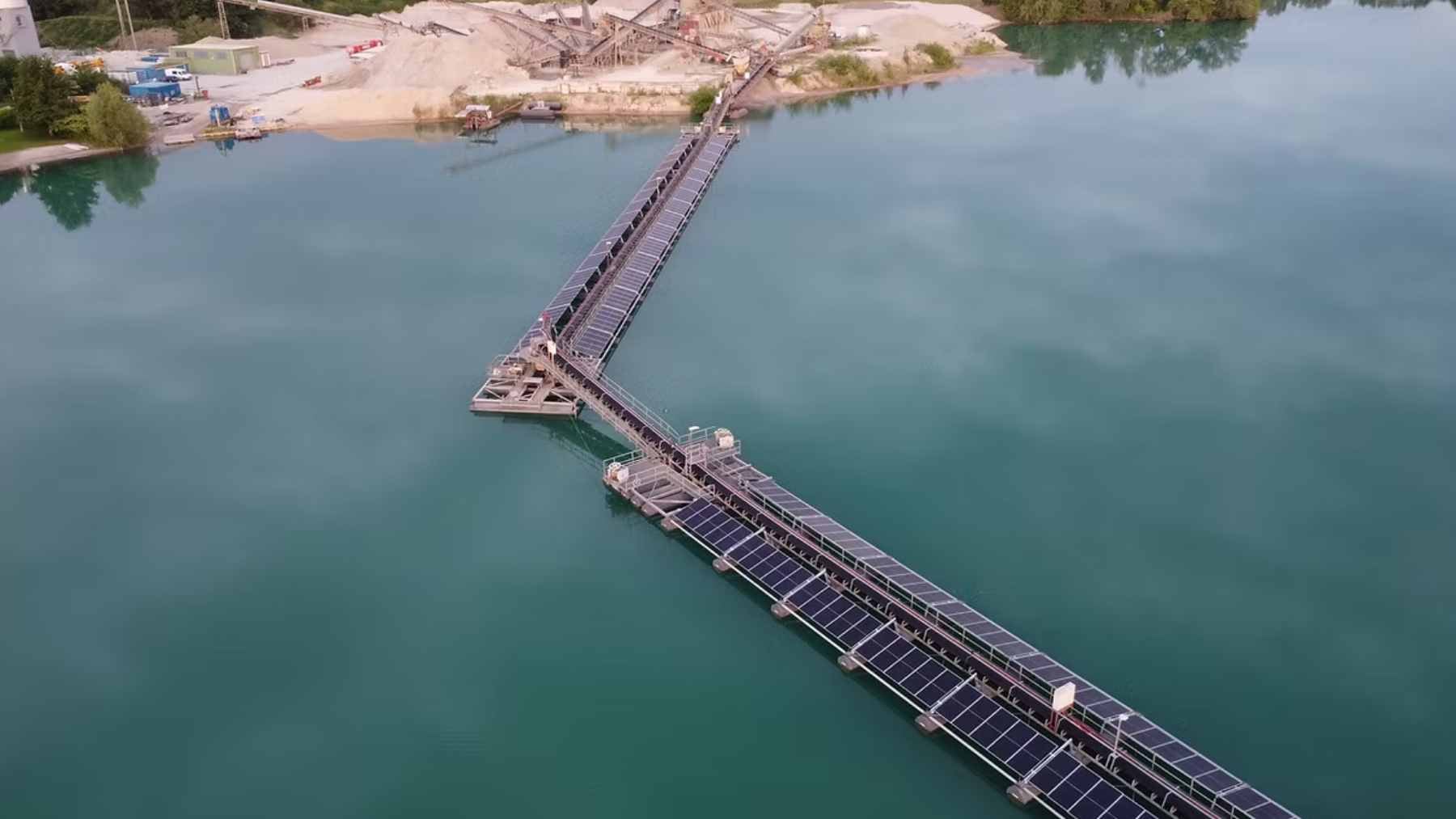
SINN Power’s own observations are intriguing but still early stage. The company and trade outlets say monitoring buoys suggested water quality “tended to improve,” and that birds and fish were seen using parts of the structure as habitat.
Even if those patterns hold at this lake, the bigger question is whether similar projects stay ecologically neutral or beneficial across many sites and seasons.
Why defense planners pay attention
Energy is not just an environmental issue anymore, it is a readiness issue. NATO has repeatedly warned that disruptions to energy supply can affect military operations, and U.S. law explicitly pushes the Department of Defense to incorporate energy resilience features such as microgrids so bases can keep power even when disconnected from off base sources.
There is also a practical reason floating solar shows up in defense conversations. One example discussed by clean energy analysts is a floating solar installation planned for a U.S. military training site associated with Fort Bragg, designed to produce power without competing for training land.
If floating solar can be deployed on constrained sites, a vertical design that favors morning and late-day output could be attractive for facilities that need dependable power at the edges of the day, not just at noon.
None of this replaces batteries, backup generation, or hardening critical infrastructure. Still, the quote from SINN Power’s launch captures the mindset shift, describing the system as one that produces electricity when conventional power plants are not running, which is a resilience argument as much as a climate one.
In a crisis, the calendar matters less than the hour you need the power.
What to watch next
The engineering bet will be tested in the boring places where projects succeed or fail. SINN Power and industry reports emphasize storm and wave resistance through a design that allows controlled movement under wind load and uses a keel-like underwater structure around 1.6 meters deep for stability, but long term reliability data will matter more than launch day speeches.
The market bet is just as important. As more grids deal with midday oversupply and price cannibalization, projects that reshape production profiles could become a tool alongside storage, demand response, and transmission upgrades.
The official statement was published on SINN Power.