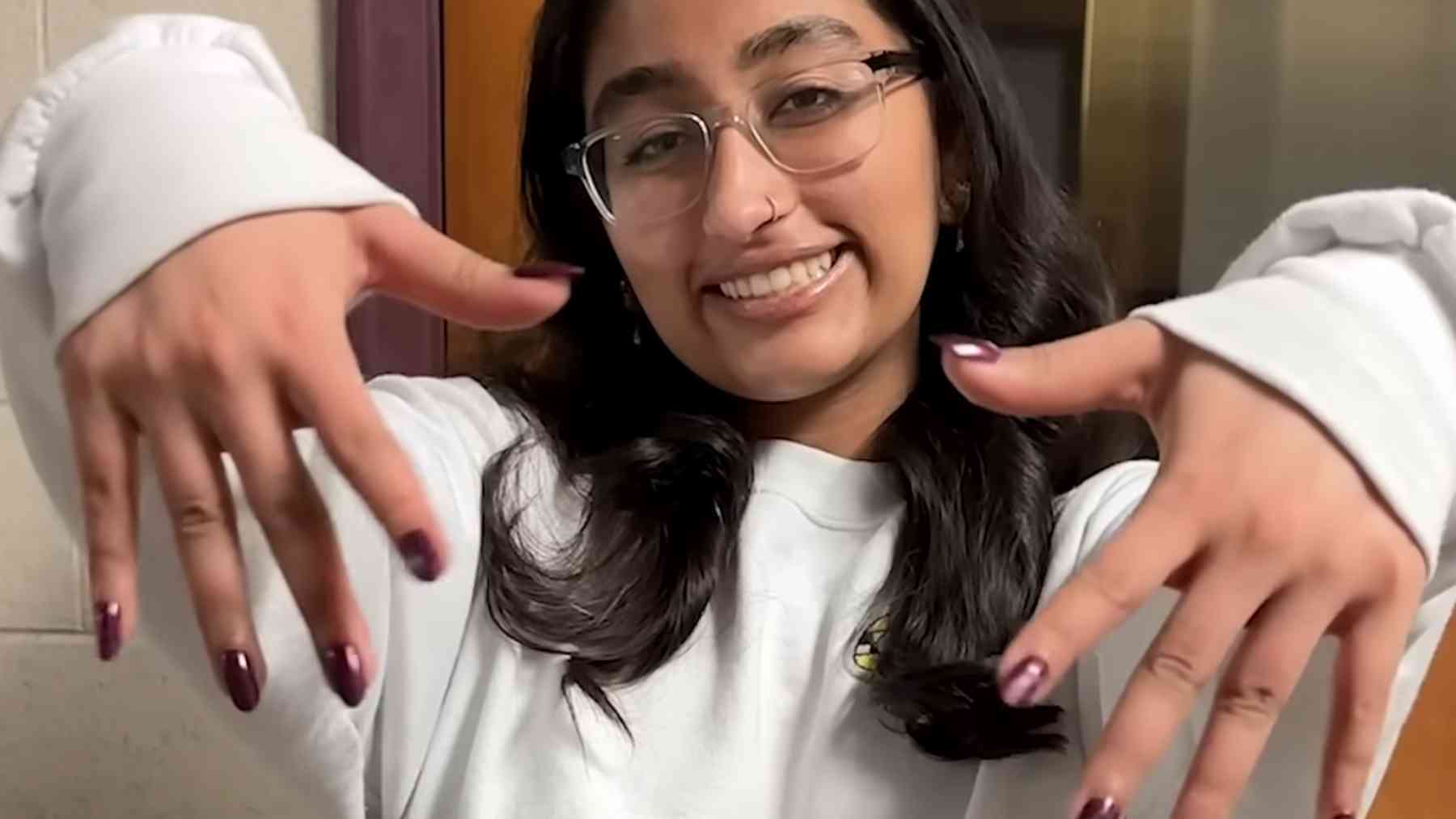
Using a phone with long nails can feel oddly complicated. A simple tap becomes a tiny balancing act, with the finger angled sideways and the nail hovering uselessly over the screen.
Now, a chemistry student has developed a prototype clear nail polish that could help solve that everyday problem. The formula is designed to make a fingernail act more like a fingertip on a capacitive touchscreen, giving people with long manicures, dry skin, or calloused fingertips a new way to use their devices.
A beauty problem with a tech twist
The prototype was created by Manasi Desai, an undergraduate at Centenary College of Louisiana, with research supervisor Joshua Lawrence. Their work was presented at ACS Spring 2026, the spring meeting of the American Chemical Society, held from March 22 to March 26 in Atlanta.
The idea started with a simple observation. Many people with long nails cannot tap phones or tablets as easily as others, and the same can happen to people whose fingertips are dry, gloved, or covered in thick calluses.
That may sound like a small inconvenience. But in daily life, from answering a message to checking in at a kiosk, those missed taps can become frustrating fast.
Why nails do not work like fingertips
Most modern phones and tablets use capacitive touchscreens. These screens create a small electric field, then detect a touch when a conductive material, such as human skin, changes that field.
A fingernail does not do that well. It is not conductive enough, so the screen often ignores it, much like it may ignore a pencil eraser or a gloved hand.
That is why people with long nails often have to press with the pad of the finger instead. It works, for the most part, but it can feel awkward and slow.
How the polish is different
Earlier attempts to make conductive nail polish often relied on carbon nanotubes or metallic particles. Those additives can create safety concerns for people manufacturing the product, especially if particles are inhaled, and they may also limit polish colors by adding a dark or metallic finish.
Desai’s goal was more practical. She wanted a clear topcoat that could go over a manicure or bare nails without changing the look too much.
That matters in beauty. A product may be clever in the lab, but if it ruins the manicure, many people simply will not use it.
The chemistry behind the tap
Desai tested 13 commercial clear-coat polishes and more than 50 additives. After working through many combinations, the best results came from formulas involving taurine and ethanolamine, two organic molecules that helped the coating register as a touch on a smartphone.
The researchers believe the polish works through acid-base chemistry rather than metal-based conductivity. In practical terms, that means protons may be moving between molecules in the polish, creating just enough change for the screen to notice.
It is a tiny chemical trick. Still, it could make the difference between a phone ignoring your nail and recognizing it as a stylus.
Who could benefit
Long nails are the obvious audience, especially for people who wear gel, acrylic, or carefully shaped manicures. Instead of flattening the finger against the screen, they could use the nail more naturally.
But the researchers also see a wider use. Desai said the final clear polish could help people with calluses on their fingertips too, adding that it has “both a cosmetic and lifestyle benefit.”
That includes musicians, carpenters, mechanics, and anyone whose fingertips do not always interact cleanly with a touchscreen. What looks like a beauty product may also become a small accessibility tool.
Not ready for the salon yet
For now, the polish is still a prototype. The best-performing ethanolamine-taurine formula does not work consistently once painted on a nail, and the touchscreen effect may fade after only a few hours because ethanolamine evaporates quickly.
There is also the matter of safety and appearance. ACS noted that the researchers still want a truly nontoxic compound, while some of the safer versions are not yet as clear or polished-looking as a consumer product would need to be.
So, no, this is not something you can pick up at the drugstore this week. It is a promising first step, not a finished bottle for your bathroom cabinet.
What comes next
The team has submitted a provisional patent and continues to test new formulas. Lawrence described the current version as “a good proof of concept,” which is a careful way of saying the science works, but the product still needs refinement.
That is often how beauty innovation happens. Sunscreens, hair dyes, skin-care actives, and nail products all move through rounds of testing before they are safe, stable, and pleasant enough for everyday use.
For people who love long nails but hate fighting with their phone, this research offers a glimpse of a more convenient future. A clear swipe of polish could one day make the nail itself part of the touchscreen experience.
The press release was published on American Chemical Society.