Pain from knee osteoarthritis can make a short walk to the mailbox feel like a serious workout. Yet avoiding movement altogether may deepen stiffness and weaken the muscles that support the joint.
So how can walking help when the joint already hurts? Research and clinical guidance suggest that gradual walking can improve strength, walking ability, and everyday function for some people. It does not rebuild cartilage or cure osteoarthritis, and the useful amount is what a person can tolerate without a lasting flare.
Why too much rest can backfire
Knee osteoarthritis is a degenerative condition in which tissues throughout the joint change over time. It involves more than cartilage and can also affect bone, the joint lining, and nearby muscles, while stiffness often follows rest or inactivity.
Pain understandably makes many people move less because they fear further damage. But long periods of inactivity can reduce leg strength and mobility, making ordinary tasks such as standing from a chair, shopping, or climbing stairs feel harder.
Gentle movement keeps the knee practicing the motion required for daily life. The aim is not to push through severe pain, but to find an activity level the joint can handle consistently.
What the walking study found
In 2003, Laura A. Talbot and colleagues at Johns Hopkins University studied 34 adults aged 60 or older with symptomatic knee osteoarthritis. Everyone received arthritis self-management education, while half also followed a 12-week home program using a pedometer to count steps and set a personalized goal.
The walking group aimed to raise its baseline step count by 30%. By the end, daily steps had risen by 23% in that group and fallen by 15% among those receiving education alone. Leg strength increased by 21% in the walking group, compared with a 3.5% decline in the other group.
Participants in the walking program also became faster on a normal-pace 100-foot test. Still, the small preliminary trial focused on activity, strength, and walking performance, not a guaranteed reduction in pain or a perfect step count. It does show why gradual progression deserves attention.
How walking may reduce symptoms
Each step activates the quadriceps at the front of the thigh, along with the calves, gluteal muscles, and muscles around the hips. When these areas are stronger and coordinated, they can help stabilize the leg and share the forces passing through the knee.
Regular walking can also build endurance and help preserve joint movement. That may mean walking through a grocery store, taking the dog outside, or moving around the house with less difficulty. Progress is rarely a straight line.
The American Academy of Orthopaedic Surgeons strongly recommends supervised, unsupervised, or aquatic exercise over no exercise for improving pain and function in knee osteoarthritis. Walking is one low-impact option, but it may need to be combined with targeted strengthening.
How to begin without overloading the knee
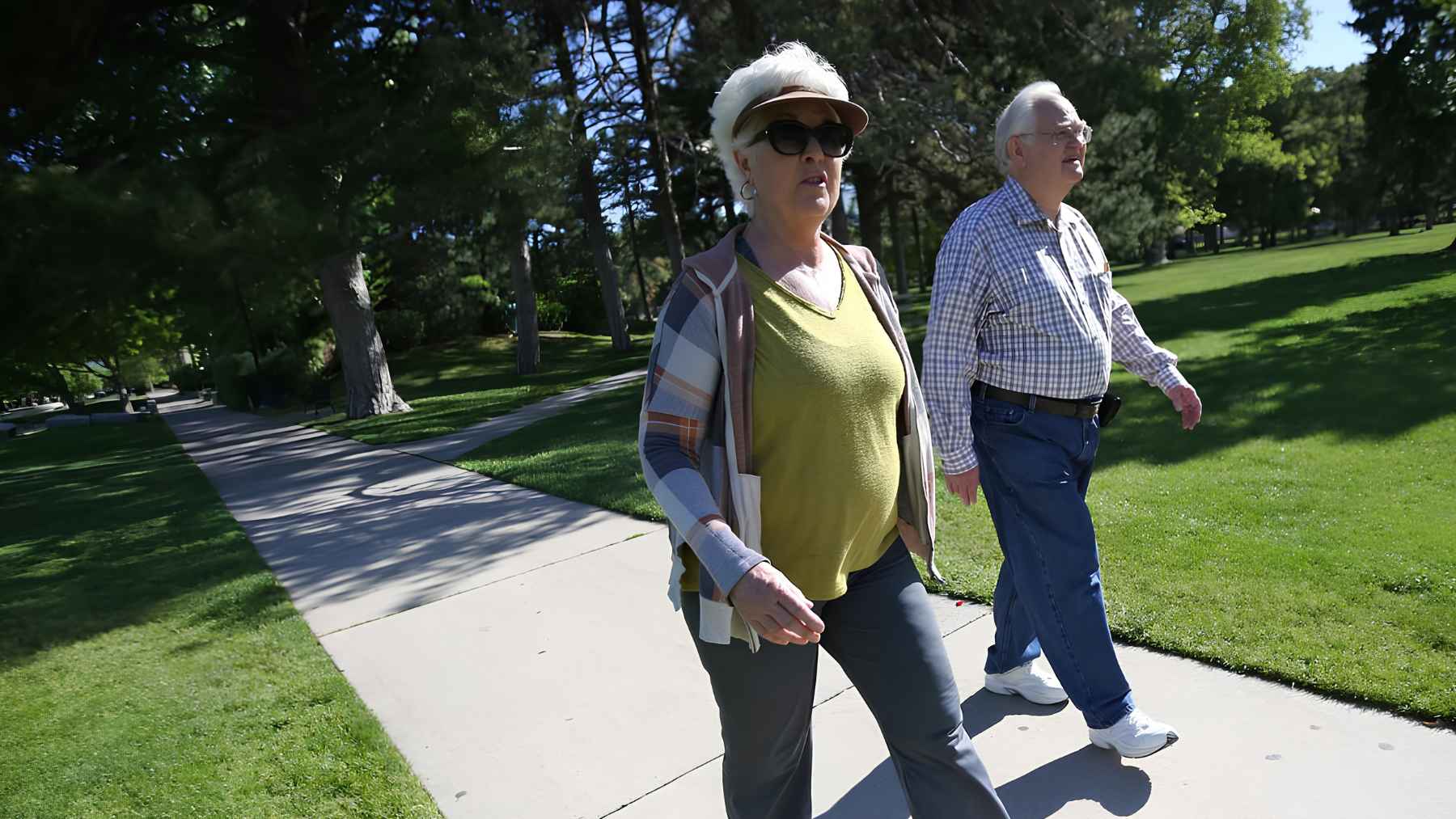
Start with a duration and distance that do not cause a pronounced limp. A flat route near home is easier to control, and several short walks may be more manageable than one long outing. Keep the pace comfortable enough to speak without struggling for breath.
Stable, flexible shoes with room for the toes can make walking more comfortable. Increase frequency before adding much more time or speed, and change only one part of the routine at once. That makes it easier to see what the knee tolerates.
Walking does not challenge every muscle equally. Exercises for the thighs, hips, and gluteal muscles may fill those gaps, ideally with a physical therapist when pain, weakness, or balance problems complicate the plan. During painful periods, water exercise or a stationary bike may be a lower-impact alternative.
Know when to reduce the effort
Mild discomfort at the beginning of a walk may settle as the joint warms up. Pain that grows with every step, changes the way someone walks, or remains clearly worse for hours afterward suggests that the dose was too high. More pain is not proof of a better workout.
Stop and seek medical advice for severe swelling, warmth, redness, a new inability to bear weight, repeated locking or buckling, or pain after a fall or sudden twist. Fever with a hot, swollen knee needs prompt assessment because those symptoms can point to a problem beyond a routine osteoarthritis flare.
A doctor or physical therapist can assess strength, balance, footwear, and walking pattern. They can also determine whether a cane, brace, pool program, or another exercise would be safer for a time.
Let the knee set the pace
The practical goal is not to chase a step number. It is to reduce stiffness, preserve strength, and make daily activities easier while avoiding repeated flares. A simple log of walking time, pain, and later symptoms can reveal the right pace of progression.
Walking can be useful, but it remains one part of a broader treatment plan and should be tailored to the individual. This article is informational and does not replace medical evaluation for intense pain, sudden swelling, locking, or difficulty bearing weight.
The main study was published in the Journal of the American Geriatrics Society.